


Hepatic steatosis and cardiovascular disease outcomes: An analysis of the Framingham Heart Study
- PMID: 25776891
- PMCID: PMC5282653
- DOI: 10.1016/j.jhep.2015.02.045
Hepatic steatosis and cardiovascular disease outcomes: An analysis of the Framingham Heart Study
Abstract
Background & aims: Non-alcoholic fatty liver disease (NAFLD) is highly prevalent and is associated with development of metabolic disease including atherosclerotic cardiovascular disease (CVD). Our aim is to examine the association of hepatic steatosis with prevalent clinical and subclinical CVD outcomes in a large community-based sample, the Framingham Heart Study.
Methods: Hepatic steatosis was measured in 3529 participants using multidetector computed tomography scanning. Multivariable logistic regression was used to determine whether hepatic steatosis is associated with prevalent CVD adjusted for covariates. We also tested whether associations were independent of other metabolic diseases/traits. The primary clinical outcome was composite prevalent clinical CVD defined by prior non-fatal myocardial infarction, stroke, transient ischemic attack, heart failure, or peripheral arterial disease. Subclinical cardiovascular outcomes were coronary artery calcium (CAC) and abdominal artery calcium (AAC).
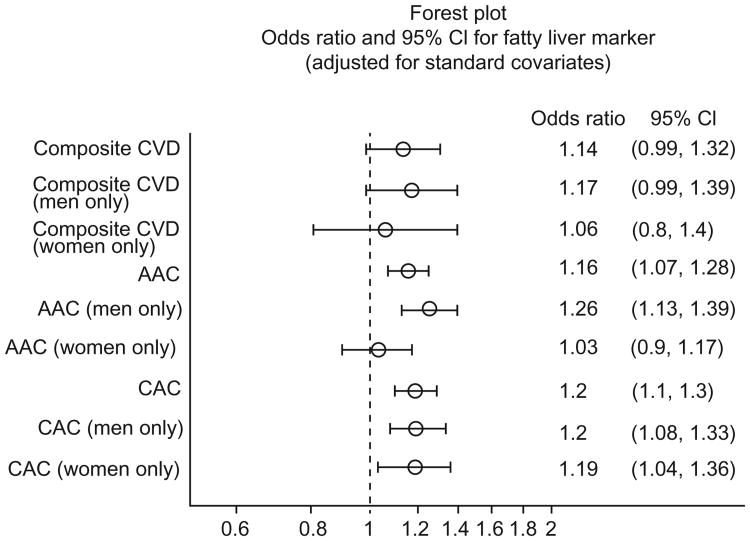
Results: 3014 participants were included (50.5% women). There was a non-significant association of hepatic steatosis with clinical CVD (OR 1.14 [p=0.07]). Hepatic steatosis was associated with both CAC and AAC (OR 1.20 [p<0.001] and OR 1.16 [p<0.001], respectively). Associations persisted for CAC even when controlling for other risk factors/metabolic diseases, but for AAC, the associations became non-significant after adjustment for visceral adipose tissue. The association between hepatic steatosis and AAC was stronger in men than in women (p sex interaction=0.022).
Conclusion: There was a significant association of hepatic steatosis with subclinical CVD outcomes independent of many metabolic diseases/traits with a trend towards association between hepatic steatosis and clinical CVD outcomes. The association with AAC was stronger in men than in women.
Keywords: Abdominal aortic calcium; Cardiovascular disease; Coronary artery calcium; Fatty liver.
Copyright © 2015. Published by Elsevier B.V.
Conflict of interest statement
The authors who have taken part in this study declared that they do not have anything to disclose regarding funding or conflict of interest with respect to this manuscript.
Figures
References
-
- Browning JD, Szczepaniak LS, Dobbins R, Nuremberg P, Horton JD, Cohen JC, et al. Prevalence of hepatic steatosis in an urban population in the United States: impact of ethnicity. Hepatology. 2004;40:1387–1395. - PubMed
-
- Vernon G, Baranova A, Younossi ZM. Systematic review: the epidemiology and natural history of non-alcoholic fatty liver disease and non-alcoholic steatohepatitis in adults. Aliment Pharmacol Ther. 2011;34:274–285. - PubMed
-
- National Cholesterol Education Program (NCEP) Expert Panel on Detection, Evaluation, and Treatment of High Blood Cholesterol in Adults (Adult Treatment Panel III) Third Report of the National Cholesterol Education Program (NCEP) Expert Panel on Detection, Evaluation, and Treatment of High Blood Cholesterol in Adults (Adult Treatment Panel III) final report. Circulation. 2002;106:3143–3421. - PubMed
-
- Targher G, Bertolini L, Rodella S, Tessari R, Zenari L, Lippi G, et al. Nonalcoholic fatty liver disease is independently associated with an increased incidence of cardiovascular events in type 2 diabetic patients. Diabetes Care. 2007;30:2119–2121. - PubMed
Publication types
MeSH terms
Grants and funding
LinkOut - more resources
Full Text Sources
Other Literature Sources
Medical
