Review
. 2015 May 21;44(10):3036-55.
doi: 10.1039/c5cs00020c. Epub 2015 Mar 17.

Rationally designed molecular beacons for bioanalytical and biomedical applications

Affiliations
Review

Rationally designed molecular beacons for bioanalytical and biomedical applications

Jing Zheng et al. Chem Soc Rev. .

Abstract

Nucleic acids hold promise as biomolecules for future applications in biomedicine and biotechnology. Their well-defined structures and compositions afford unique chemical properties and biological functions. Moreover, the specificity of hydrogen-bonded Watson-Crick interactions allows the construction of nucleic acid sequences with multiple functions. In particular, the development of nucleic acid probes as essential molecular engineering tools will make a significant contribution to advancements in biosensing, bioimaging and therapy. The molecular beacon (MB), first conceptualized by Tyagi and Kramer in 1996, is an excellent example of a double-stranded nucleic acid (dsDNA) probe. Although inactive in the absence of a target, dsDNA probes can report the presence of a specific target through hybridization or a specific recognition-triggered change in conformation. MB probes are typically fluorescently labeled oligonucleotides that range from 25 to 35 nucleotides (nt) in length, and their structure can be divided into three components: stem, loop and reporter. The intrinsic merit of MBs depends on predictable design, reproducibility of synthesis, simplicity of modification, and built-in signal transduction. Using resonance energy transfer (RET) for signal transduction, MBs are further endowed with increased sensitivity, rapid response and universality, making them ideal for chemical sensing, environmental monitoring and biological imaging, in contrast to other nucleic acid probes. Furthermore, integrating MBs with targeting ligands or molecular drugs can substantially support their in vivo applications in theranositics. In this review, we survey advances in bioanalytical and biomedical applications of rationally designed MBs, as they have evolved through the collaborative efforts of many researchers. We first discuss improvements to the three components of MBs: stem, loop and reporter. The current applications of MBs in biosensing, bioimaging and therapy will then be described. In particular, we emphasize recent progress in constructing MB-based biosensors in homogeneous solution or on solid surfaces. We expect that such rationally designed and functionalized MBs will open up new and exciting avenues for biological and medical research and applications.


Figures
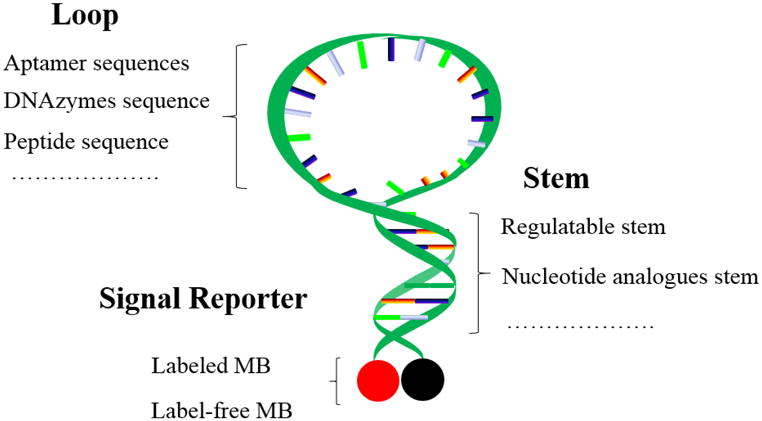
Figure 1
Figure 1
Molecular beacon structure and rationally designed strategies for different parts.
Figure 2
Figure 2
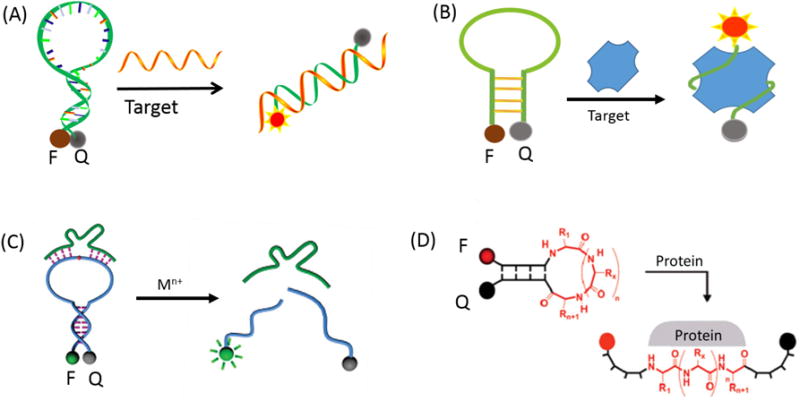
Loop region engineering: (A) Schematic representation of the recognition mechanism for the random DNA; (B) Representation of molecular aptamer beacon; (C) Representation of DNAzyme-based molecular beacon. Reprinted with permission from ref. 36. Copyright (2010) American Chemical Society. (D) Representation of hairpin peptide molecular beacon. Reprinted with permission from ref. 38. Copyright (2007) American Chemical Society.
Figure 3
Figure 3
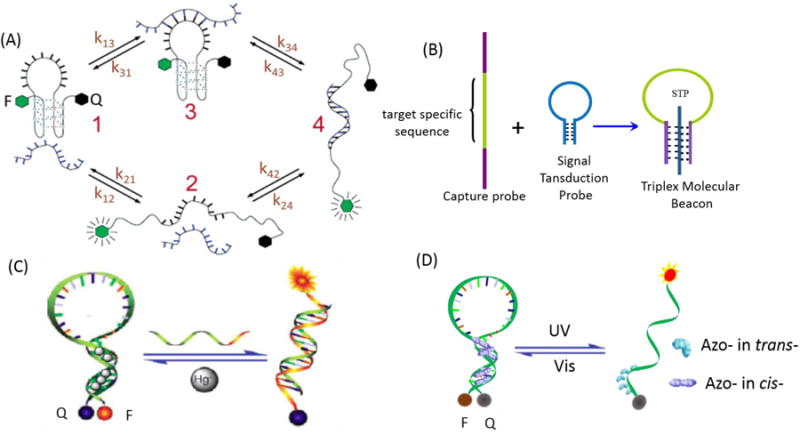
Stem region engineering: (A) G-quadruplex motif-based molecular beacon. Reprinted with permission from ref. 39. Copyright (2006) American Chemical Society. (B) DNA triple helix-based molecular beacon; (C) Metal ion-modulated molecular beacon. Reprinted with permission from ref. 52. Copyright (2009) Royal Society of Chemistry. (D) Photo-regulated molecular beacon.
Figure 4
Figure 4
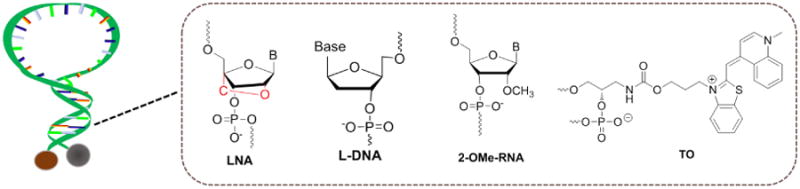
Stem region engineering combined with nucleotide analogues: structures of LNA, L-DNA, 2-OMe-RNA and TO.
Figure 5
Figure 5
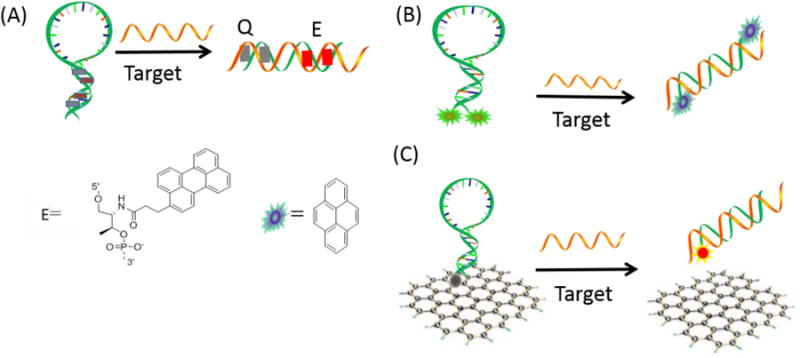
Reporting region engineering of fluorescent molecular beacon. (A) ISMB design and structures of candidate perylene quenchers; (B) EMB; Schematic representation of dual-pyrene-labeled EMB. (C) Schematic representation of target-induced fluorescence change of GO-quenched molecular beacon.
Figure 6
Figure 6
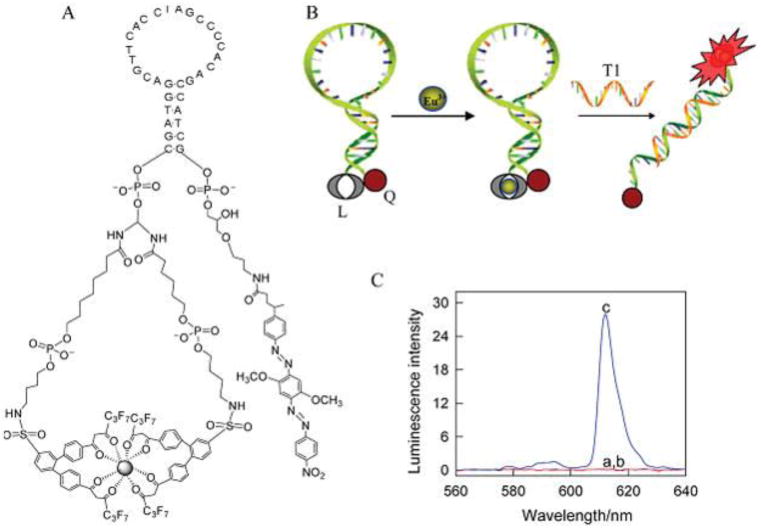
Reporting region engineering of phosphorescent molecular beacon. (A) Structure of the designed molecular beacon. (B) Signaling scheme of molecular beacon hybridization with complementary target DNA. (C) RTP emission spectra of molecular beacon before and after target DNA addition. Reprinted with permission from ref. 81. Copyright (2011) American Chemical Society.
Figure 7
Figure 7
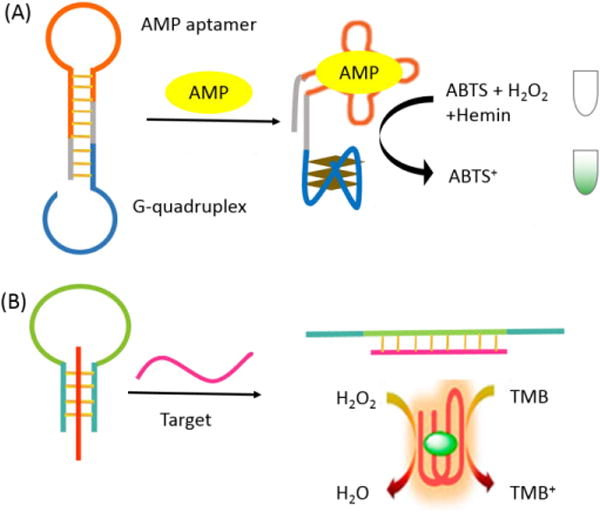
Reporting region engineering of label-free molecular beacon. (A) Analysis of adenosine monophosphate (AMP) by the aptamer-DNAzyme hairpin structure. (B) Construction and operation of the triplex molecular beacon using G-quadruplex sequence as the signal transduction element. The signals are generated from the released G-quadruplex upon target binding.
Figure 8
Figure 8
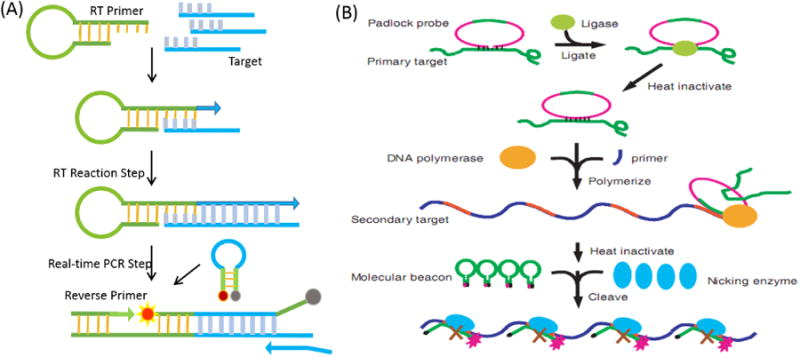
Molecular beacons serving as signal reporter for real-time PCR (A) and RCA-based (B) amplification gene assays. Reprinted with permission from ref. 97. With an increasing number of PCR or RCA cycles, a growing number of amplified target DNA molecules is produced and hybridize with the molecular beacon during the process. Copyright (2002) Oxford University Press.
Figure 9
Figure 9
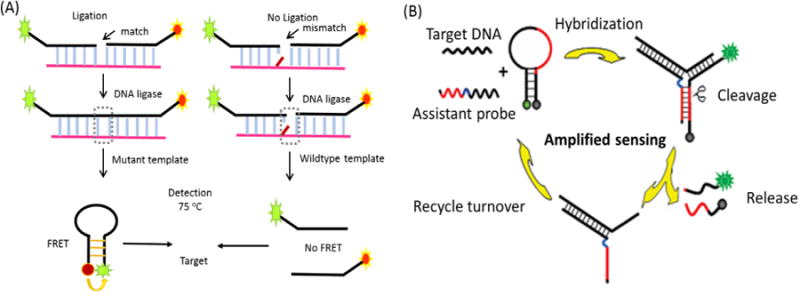
Molecular beacons serving as signal reporter for single nucleotide polymorphism detection. (A) A reverse MB (rMB) is formed by the complementary arm sequences of the ligated primers. Real-time single-pair fluorescence resonance energy transfer (spFRET) measurements were performed in a poly (methyl methacrylate) (PMMA) microfluidic device to detect rMBs formed in a ligation detection reaction (LDR) assay where point mutations in K-ras codon 12 were detected. (B) Design of a molecular beacon-based junction probe system for amplified single nucleotide polymorphism detection. Reprinted with permission from ref. 107. Copyright (2010) American Chemical Society.
Figure 10
Figure 10
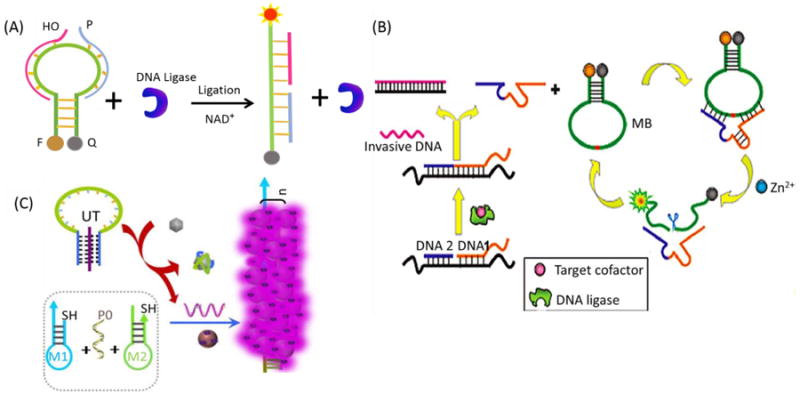
Molecular beacons used for detection of biomolecules in solution. (A) Analysis of NAD+ using molecular beacon and E. coli DNA ligase. (B) Strategy of the catalytic DNAzyme molecular beacon cascade for amplified fluorescence detection of small biological molecules. Reprinted with permission from ref. 116. Copyright (2011) American Chemical Society. (C) Schematic illustration of the structure and working principle of a triplex molecular beacon-based universal SERS detector with amplified signal for the detection of multiple target analytes. Reprinted with permission from ref. 117. Copyright (2014) American Chemical Society.
Figure 11
Figure 11
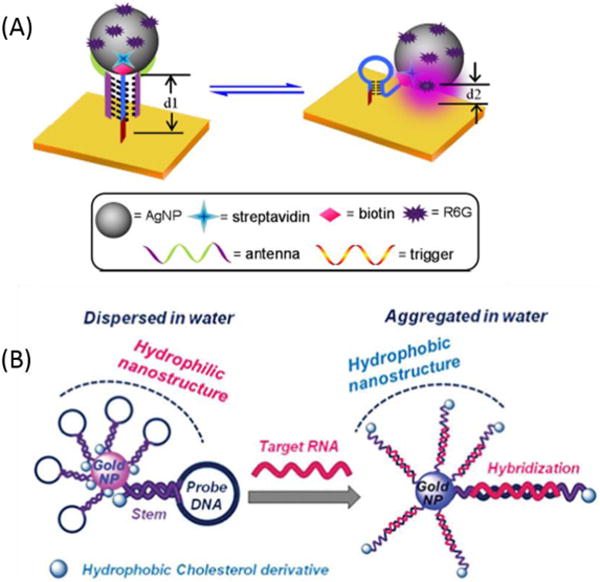
Molecular beacons used for detection of biomolecules on a solid surface. (A) Working principle of the triplex molecular beacon-based DNA nanomachine-directed reversible SERS-active substrate and corresponding reversible SERS “hot-spot” generation through assembly and disassembly of AgNPs on a gold film surface. Reprinted with permission from ref. 123. Copyright (2012) American Chemical Society. (B) Schematic representation of the AuNP sensor with hydrophobic molecular beacons. Reprinted with permission from ref. 125. Copyright (2014) Royal Society of Chemistry.
Figure 12
Figure 12
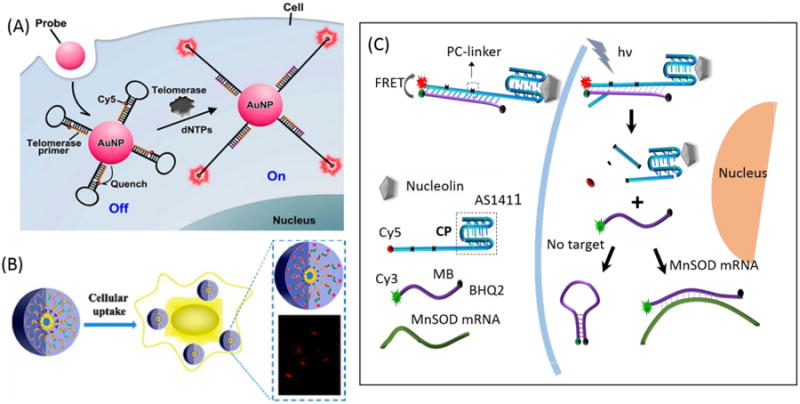
Molecular beacons used for intracellular imaging. (A) Illustration of the nicked molecular beacon-functionalized AuNPs for in situ imaging of intracellular telomerase. Reprinted with permission from ref. 136. Copyright (2014) American Chemical Society. (B) Working principle of switchable molecular aptamer beacon micelle flares for molecular imaging in living cells. Reprinted with permission from ref. 140. Copyright (2013) American Chemical Society. (C) Analysis of the molecular beacon probe for spatiotemporal MnSOD mRNA detection in living cells.
Figure 13
Figure 13
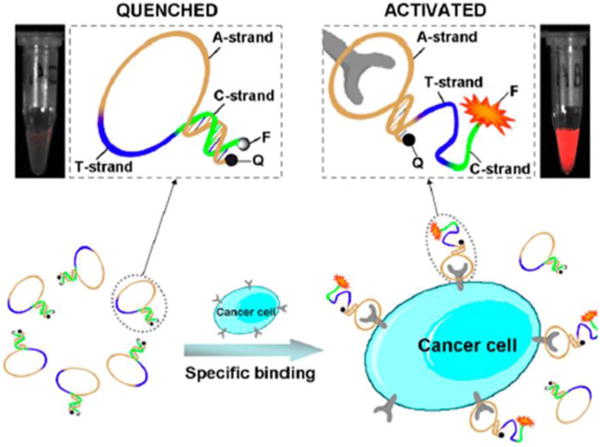
Molecular beacons used for in vivo imaging. Schematic representation of the novel strategy for in vivo cancer imaging using activatable molecular aptamer beacon based on cell membrane protein-triggered conformation alteration. Reprinted with permission from ref. 144. Copyright (2011) National Academy of Sciences, USA.
Figure 14
Figure 14
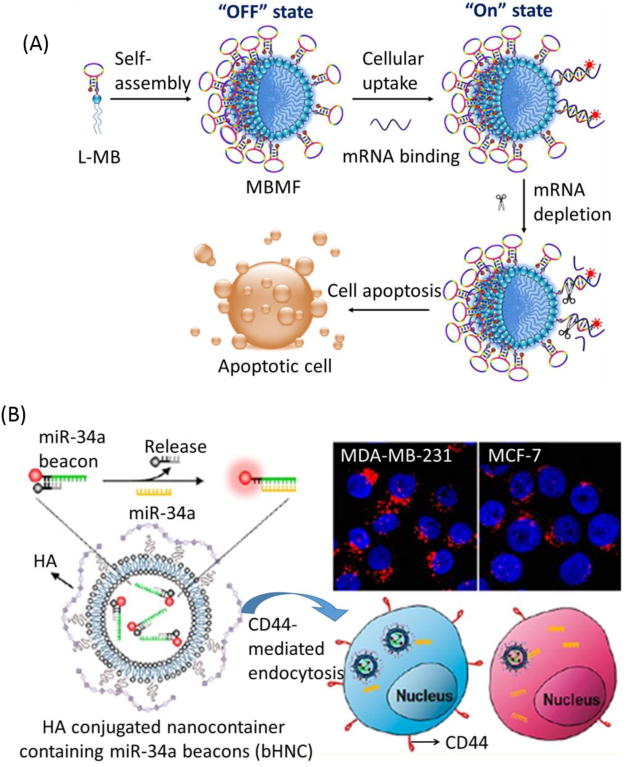
Molecular beacons used for gene therapy. (A) Analysis of molecular beacon micelle flares for intracellular mRNA gene therapy. Diacyllipid-molecular beacon conjugates (L-MBs) self-assemble into MBMFs and enter living cells. (B) Illustration of miR-34a beacon delivery system for targeted intracellular recognition of miR-34a based on HA-coated nanocontainers that encapsulate the miR-34a beacons (bHNCs). Reprinted with permission from ref. 154. Copyright (2012) American Chemical Society.
Figure 15
Figure 15
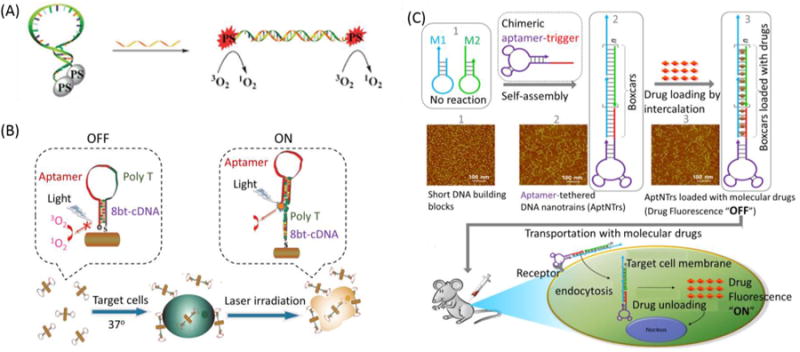
Molecular beacons used for drug delivery. (A) Concept of mRNA-triggered bi-PS molecular beacon for therapy. Reprinted with permission from ref. 155. Copyright (2011) Royal Society of Chemistry. (B) Investigation of MAB-conjugated photosensitizer and AuNRs for photothermal therapy (PTT) and photodynamic therapy (PDT). Reprinted with permission from ref. 157. Copyright (2012) American Chemical Society. (C) Design of the self-assembly of aptamer-tethered DNA nanotrains (aptNTrs) for transport of molecular drugs in theranostic applications. Reprinted with permission from ref. 161. Copyright (2013) National Academy of Sciences, USA

References

    1. Hall BD, Spiegelman S. Proc Natl Acad Sci USA. 1961;47:137–163. - PMC - PubMed
    1. Bolton ET, McCarthy BJ. Proc Natl Acad Sci USA. 1962;48:1390–1397. - PMC - PubMed
    1. Nygaard AP, Hall BD. Biochem Biophys Res Commun. 1963;12:98–104. - PubMed
    1. Wang KM, Tang ZW, Yang CY, Kim YM, Fang XH, Li W, Wu YR, Medley CD, Cao ZH, Li J, Colon P, Tan WH. Angew Chem Int Ed. 2009;48:856–870. - PMC - PubMed
    1. Tyagi S, Kramer FR. Nat Biotechnol. 1996;14:303–308. - PubMed

Publication types

MeSH terms

Substances