


Sociodemographic attributes and spina bifida outcomes
- PMID: 25780069
- PMCID: PMC4536568
- DOI: 10.1542/peds.2014-2576
Sociodemographic attributes and spina bifida outcomes
Abstract
Background: A National Spina Bifida Patient Registry (NSBPR) was begun in 2009 to help understand the natural history of spina bifida (SB) and the effects of treatments provided by SB clinics. We used the NSBPR to explore the relationship of sociodemographic characteristics with SB outcomes.
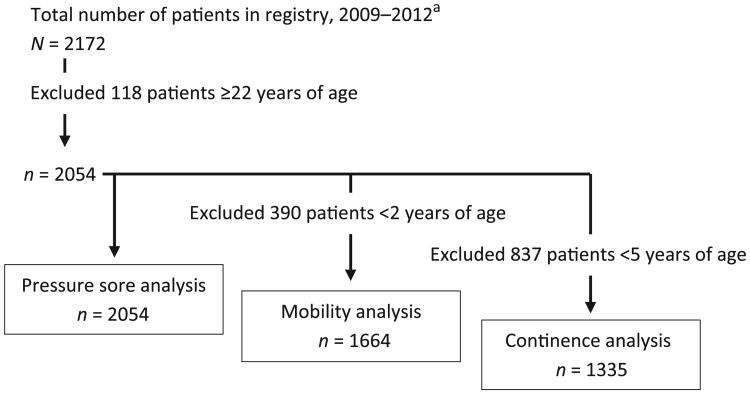
Methods: Using NSBPR data collected in 2009 to 2012, we examined the unadjusted association between demographic characteristics and 4 SB outcomes: bowel continence, bladder continence, mobility, and presence of pressure sores. We then developed multivariable logistic models to explore these relationships while controlling for SB clinic, SB type, and level of lesion.
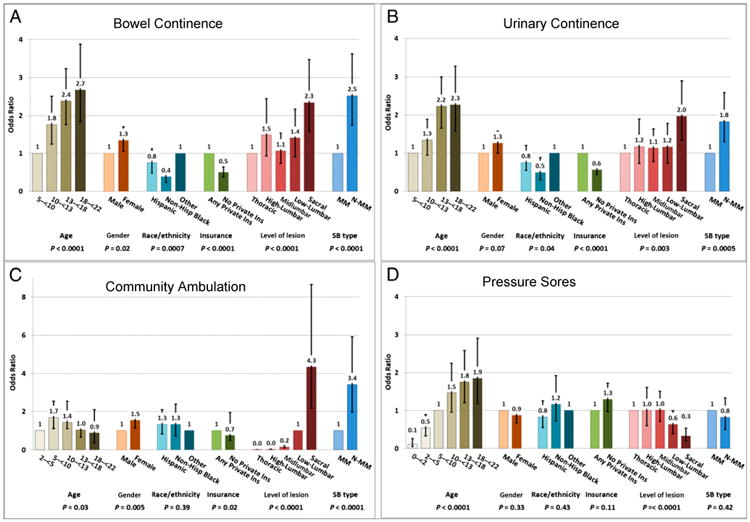
Results: Data were available on 2054 patients <22 years of age from 10 SB clinics. In the multivariable models, older age groups were more likely to have continence and pressure sores and less likely to be community ambulatory. Males and patients without private insurance were less likely to be continent and community ambulatory. Non-Hispanic blacks were less likely to be continent. Level of lesion was associated with all outcomes; SB type was associated with all but pressure sores; and all outcomes except community ambulation showed significant variation across clinic sites.
Conclusions: Sociodemographic attributes are associated with SB outcomes. In particular, males, non-Hispanic blacks, and patients without private insurance have less favorable outcomes, and age has an impact as well. These characteristics need to be considered by clinicians who care for this patient population and factored into case-mix adjustment when evaluating variation in clinical and functional outcomes among different SB clinics.
Keywords: case-mix adjustment; demography; registries; socioeconomic status; spinal dysraphism; treatment outcome.
Copyright © 2015 by the American Academy of Pediatrics.
Conflict of interest statement
Figures
References
-
- Bowman RM, McLone DG, Grant JA, Tomita T, Ito JA. Spina bifida outcome: a 25-year prospective. Pediatr Neurosurg. 2001;34(3):114–120. - PubMed
-
- Schechter MS, Gutierrez HH. Improving the quality of care for patients with cystic fibrosis. Curr Opin Pediatr. 2010;22(3):296–301. - PubMed
-
- Braveman PA, Cubbin C, Egerter S, et al. Socioeconomic status in health research: one size does not fit all. JAMA. 2005;294(22):2879–2888. - PubMed
Publication types
MeSH terms
Grants and funding
LinkOut - more resources
Full Text Sources
Other Literature Sources
Medical
