


Factors associated with young adults' pregnancy likelihood
- PMID: 25782849
- PMCID: PMC4367198
- DOI: 10.1111/jmwh.12258
Factors associated with young adults' pregnancy likelihood
Abstract
Introduction: Although progress has been made to reduce adolescent pregnancies in the United States, rates of unplanned pregnancy among young adults aged (aged 18-29 years) remain high. In this study, we assessed factors associated with perceived likelihood of pregnancy (likelihood of getting pregnant/getting partner pregnant in the next year) among sexually experienced young adults who were not trying to get pregnant and had previously used contraceptives.
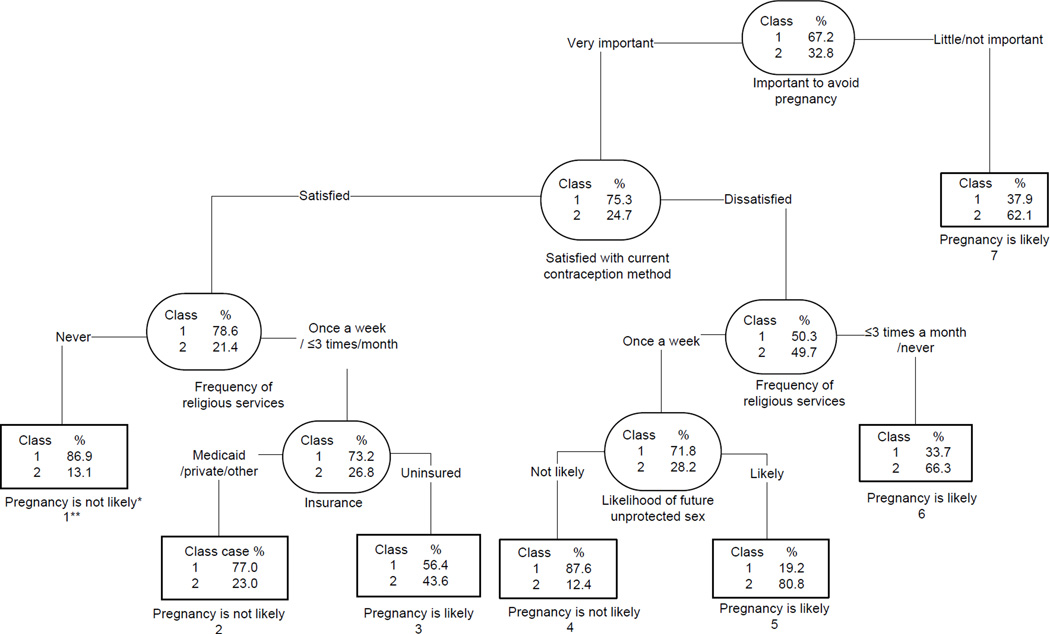
Methods: We conducted a secondary analysis of 660 young adults, aged 18 to 29 years in the United States, from the cross-sectional National Survey of Reproductive and Contraceptive Knowledge. Logistic regression and classification tree analyses were conducted to generate profiles of young adults most likely to report anticipating a pregnancy in the next year.
Results: Nearly one-third (32%) of young adults indicated that they believed they had at least some likelihood of becoming pregnant in the next year. Young adults who believed that avoiding pregnancy was not very important were most likely to report pregnancy likelihood (odds ratio [OR], 5.21; 95% confidence interval [CI], 2.80-9.69), as were young adults who considered avoiding a pregnancy to be important but who were not satisfied with their current contraceptive method (OR, 3.93; 95% CI, 1.67-9.24) and who attended religious services frequently (OR, 3.0; 95% CI, 1.52-5.94), were uninsured (OR, 2.63; 95% CI, 1.31-5.26), and were likely to have unprotected sex in the next 3 months (OR, 1.77; 95% CI, 1.04-3.01).
Discussion: These results may help guide future research and the development of pregnancy-prevention interventions targeting sexually experienced young adults.
Keywords: contraception; pregnancy in adolescence; unplanned pregnancy.
© 2015 by the American College of Nurse-Midwives.
Conflict of interest statement
Conflict of Interest
The authors have no conflicts of interest to disclose.
Figures
References
-
- The National Campaign to Prevent Teen and Unplanned Pregnancy. Briefly: unplanned pregnancy among unmarried young women. 2012 http://www.thenationalcampaign.org/resources/pdf/briefly-unplanned-pregn....
-
- The National Campaign to Prevent Teen and Unplanned Pregnancy. Fast facts: teen pregnancy in the United States. 2012 http://www.thenationalcampaign.org/resources/pdf/FastFacts_TeenPregnanci....
-
- Cheng D, Schwarz EB, Douglas E, Horon I. Unintended pregnancy and associated maternal preconception, prenatal and postpartum behaviors. Contraception. 2009;79(3):194–198. - PubMed
-
- Shah PS, Balkhair T, Ohlsson A, Beyene J, Scott F, Frick C. Intention to become pregnant and low birth weight and preterm birth: a systematic review. Maternal and child health journal. 2011;15(2):205–216. - PubMed
Publication types
MeSH terms
Substances
Grants and funding
LinkOut - more resources
Full Text Sources
Other Literature Sources
Medical
