


Incidence of respiratory viruses in Peruvian children with acute respiratory infections
- PMID: 25784285
- PMCID: PMC7167149
- DOI: 10.1002/jmv.24159
Incidence of respiratory viruses in Peruvian children with acute respiratory infections
Abstract
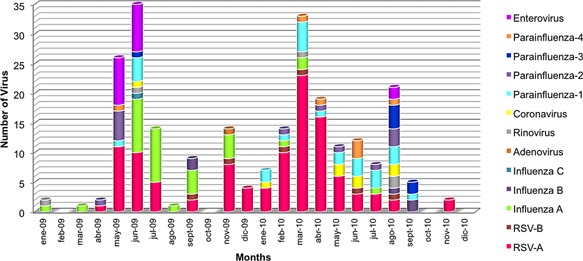
Acute respiratory infections are responsible for high morbi-mortality in Peruvian children. However, the etiological agents are poorly identified. This study, conducted during the pandemic outbreak of H1N1 influenza in 2009, aims to determine the main etiological agents responsible for acute respiratory infections in children from Lima, Peru. Nasopharyngeal swabs collected from 717 children with acute respiratory infections between January 2009 and December 2010 were analyzed by multiplex RT-PCR for 13 respiratory viruses: influenza A, B, and C virus; parainfluenza virus (PIV) 1, 2, 3, and 4; and human respiratory syncytial virus (RSV) A and B, among others. Samples were also tested with direct fluorescent-antibodies (DFA) for six respiratory viruses. RT-PCR and DFA detected respiratory viruses in 240 (33.5%) and 85 (11.9%) cases, respectively. The most common etiological agents were RSV-A (15.3%), followed by influenza A (4.6%), PIV-1 (3.6%), and PIV-2 (1.8%). The viruses identified by DFA corresponded to RSV (5.9%) and influenza A (1.8%). Therefore, respiratory syncytial viruses (RSV) were found to be the most common etiology of acute respiratory infections. The authors suggest that active surveillance be conducted to identify the causative agents and improve clinical management, especially in the context of possible circulation of pandemic viruses.
Keywords: acute respiratory infections; influenza viruses; respiratory infection; respiratory syncytial viruses; respiratory viruses; virus detection.
© 2015 Wiley Periodicals, Inc.
Figures
References
-
- Albuquerque M, Varella R, Santos N. 2012. Acute respiratory viral infections in children in Rio de Janeiro and Teresópolis, Brazil. Rev Inst Med Trop Sao Paulo 54:249–255. - PubMed
Publication types
MeSH terms
LinkOut - more resources
Full Text Sources
Other Literature Sources
