


Assessment of intravenous adipose-derived allogeneic mesenchymal stem cells for the treatment of feline chronic kidney disease: a randomized, placebo-controlled clinical trial in eight cats
- PMID: 25784460
- PMCID: PMC11149004
- DOI: 10.1177/1098612X15576980
Assessment of intravenous adipose-derived allogeneic mesenchymal stem cells for the treatment of feline chronic kidney disease: a randomized, placebo-controlled clinical trial in eight cats
Abstract
Objectives: Feline chronic kidney disease (CKD) is characterized by chronic tubulointerstitial nephritis, and inflammation contributes to the progression of renal fibrosis. Mesenchymal stem cells (MSCs) have demonstrated anti-inflammatory and antifibrotic effects in rodent CKD models. However, few randomized trials evaluating the effectiveness of MSC therapy for diseases in companion animals have been reported. The purpose of this study was to evaluate the effectiveness of allogeneic MSCs for the treatment of feline CKD using a randomized, placebo-controlled trial.
Methods: MSCs were isolated from the cryopreserved adipose tissues of specific pathogen-free research cats and culture expanded. CKD cats were enrolled in a randomized, placebo-controlled, blinded one-way crossover clinical study. Four CKD cats were randomized to receive 2 × 10(6) MSCs/kg intravenously at 2, 4 and 6 weeks. Four CKD cats were randomized to receive placebo, with two cats crossing over to the MSC treatment group and one cat failing to complete the trial. Complete blood counts, chemistry and urinalysis were performed at weeks 0, 2, 4, 6 and 8. Glomerular filtration rate (GFR) via nuclear scintigraphy and urine protein:creatinine ratio (UPC) were determined at weeks 0 and 8.
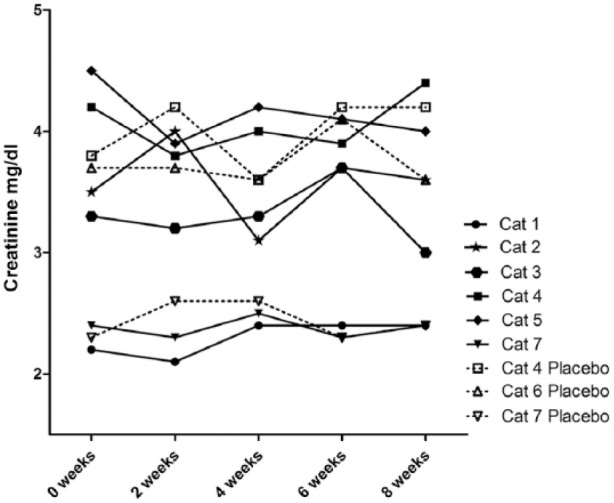
Results: Six cats received three doses of allogeneic MSC culture expanded from cryopreserved adipose without adverse effects. No significant change in serum creatinine, blood urea nitrogen, potassium, phosphorus, GFR by nuclear scintigraphy, UPC or packed cell volume was seen in cats treated with MSCs. Individual changes in GFR were 12%, 8%, 8%, 2%, -13% and -67% in treated cats compared with 16%, 36% and 0% in placebo-treated cats.
Conclusions and relevance: While administration of MSC culture expanded from cryopreserved adipose was not associated with adverse effects, significant improvement in renal function was not observed immediately after administration. Long-term follow-up is necessary to determine whether MSC administration affects disease progression in cats with CKD.
© ISFM and AAFP 2015.
Conflict of interest statement
The authors do not have any potential conflicts of interest to declare.
Figures


References
-
- DiBartola SP, Rutgers HC, Zack PM, et al.. Clinicopathologic findings associated with chronic renal disease in cats: 74 cases (1973–1984). J Am Vet Med Assoc 1987; 190: 1196–1202. - PubMed
-
- Chakrabarti S, Syme HM, Brown CA. Histomorphometry of feline chronic kidney disease and correlation with markers of renal dysfunction. Vet Pathol 2013; 50: 147–155. - PubMed
-
- Lee SR, Lee SH, Moon JY, et al.. Repeated administration of bone marrow-derived mesenchymal stem cells improved the protective effects on a remnant kidney model. Ren Fail 2010; 32: 840–848. - PubMed
-
- Semedo P, Correa-Costa M, Antonio Cenedeze M, et al.. Mesenchymal stem cells attenuate renal fibrosis through immune modulation and remodeling properties in a rat remnant kidney model. Stem Cells 2009; 27: 3063–3073. - PubMed
-
- Villanueva S, Ewertz E, Carrion F, et al.. Mesenchymal stem cell injection ameliorates chronic renal failure in a rat model. Clin Sci (Lond) 2011; 121: 489–499. - PubMed
Publication types
MeSH terms
LinkOut - more resources
Full Text Sources
Other Literature Sources
Medical
Miscellaneous
