


Transurethral radiofrequency collagen denaturation for the treatment of women with urinary incontinence
- PMID: 25785555
- PMCID: PMC11245747
- DOI: 10.1002/14651858.CD010217.pub2
Transurethral radiofrequency collagen denaturation for the treatment of women with urinary incontinence
Abstract
Background: Transurethral radiofrequency collagen denaturation is a relatively novel, minimally invasive device-based intervention used to treat individuals with urinary incontinence (UI). No systematic review of the evidence supporting its use has been published to date.
Objectives: To evaluate the efficacy of transurethral radiofrequency collagen denaturation, compared with other interventions, in the treatment of women with UI.Review authors sought to compare the following.• Transurethral radiofrequency collagen denaturation versus no treatment/sham treatment.• Transurethral radiofrequency collagen denaturation versus conservative physical treatment.• Transurethral radiofrequency collagen denaturation versus mechanical devices (pessaries for UI).• Transurethral radiofrequency collagen denaturation versus drug treatment.• Transurethral radiofrequency collagen denaturation versus injectable treatment for UI.• Transurethral radiofrequency collagen denaturation versus other surgery for UI.
Search methods: We conducted a systematic search of the Cochrane Incontinence Group Specialised Register (searched 19 December 2014), EMBASE and EMBASE Classic (January 1947 to 2014 Week 50), Google Scholar and three trials registries in December 2014, along with reference checking. We sought to identify unpublished studies by handsearching abstracts of major gynaecology and urology meetings, and by contacting experts in the field and the device manufacturer.
Selection criteria: Randomised and quasi-randomised trials of transurethral radiofrequency collagen denaturation versus no treatment/sham treatment, conservative physical treatment, mechanical devices, drug treatment, injectable treatment for UI or other surgery for UI in women were eligible.
Data collection and analysis: We screened search results and selected eligible studies for inclusion. We assessed risk of bias and analysed dichotomous variables as risk ratios (RRs) with 95% confidence intervals (CIs) and continuous variables as mean differences (MDs) with 95% CIs. We rated the quality of evidence using the GRADE (Grading of Recommendations Assessment, Development and Evaluation) approach.
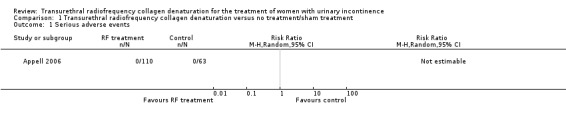
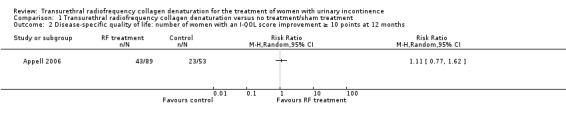
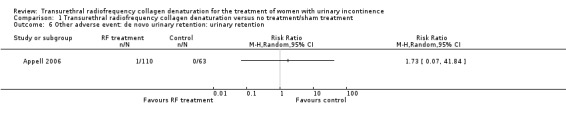
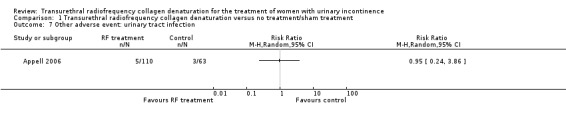
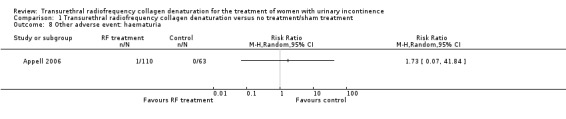
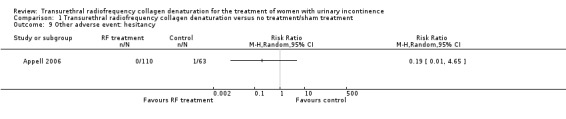
Main results: We included in the analysis one small sham-controlled randomised trial of 173 women performed in the United States. Participants enrolled in this study had been diagnosed with stress UI and were randomly assigned to transurethral radiofrequency collagen denaturation (treatment) or a sham surgery using a non-functioning catheter (no treatment). Mean age of participants in the 12-month multi-centre trial was 50 years (range 22 to 76 years).Of three patient-important primary outcomes selected for this systematic review, the number of women reporting UI symptoms after intervention was not reported. No serious adverse events were reported for the transurethral radiofrequency collagen denaturation arm or the sham treatment arm during the 12-month trial. Owing to high risk of bias and imprecision, we downgraded the quality of evidence for this outcome to low. The effect of transurethral radiofrequency collagen denaturation on the number of women with an incontinence quality of life (I-QOL) score improvement ≥ 10 points at 12 months was as follows: RR 1.11, 95% CI 0.77 to 1.62; participants = 142, but the confidence interval was wide. For this outcome, the quality of evidence was also low as the result of high risk of bias and imprecision.We found no evidence on the number of women undergoing repeat continence surgery. The risk of other adverse events (pain/dysuria (RR 5.73, 95% CI 0.75 to 43.70; participants = 173); new detrusor overactivity (RR 1.36, 95% CI 0.63 to 2.93; participants = 173); and urinary tract infection (RR 0.95, 95% CI 0.24 to 3.86; participants = 173) could not be established reliably as the trial was small. Evidence was insufficient for assessment of whether use of transurethral radiofrequency collagen denaturation was associated with an increased rate of urinary retention, haematuria and hesitancy compared with sham treatment in 173 participants. The GRADE quality of evidence for all other adverse events with available evidence was low as the result of high risk of bias and imprecision.We found no evidence to inform comparisons of transurethral radiofrequency collagen denaturation with conservative physical treatment, mechanical devices, drug treatment, injectable treatment for UI or other surgery for UI.
Authors' conclusions: It is not known whether transurethral radiofrequency collagen denaturation, as compared with sham treatment, improves patient-reported symptoms of UI. Evidence is insufficient to show whether the procedure improves disease-specific quality of life. Evidence is also insufficient to show whether the procedure causes serious adverse events or other adverse events in comparison with sham treatment, and no evidence was found for comparison with any other method of treatment for UI.
Conflict of interest statement
D Kang: none known.
J Han: none known.
MM Neuberger: none known.
ML Moy: none known.
SA Wallace: none known.
P Alonso‐Coello: none known.
P Dahm: none known.
Figures







Update of
References
References to studies included in this review
Appell 2006 {published data only (unpublished sought but not used)}
-
- Appell RA, Juma S, Wells WG, Lenihan JP, Klimberg IW, Kanellos A, et al. Transurethral radiofrequency energy collagen micro‐remodeling for the treatment of female stress urinary incontinence. Neurourology and Urodynamics 2006;25(4):331‐6. - PubMed
-
- Appell RA, Singh G, Klimberg IW, Graham C, Juma S, Wells WG, et al. Nonsurgical, radiofrequency collagen denaturation for stress urinary incontinence: retrospective 3‐year evaluation. Expert Review of Medical Devices 2007;4(4):455‐61. - PubMed
-
- Lenihan JP Jr. Comparison of the quality of life after nonsurgical radiofrequency energy tissue micro‐remodeling in premenopausal and postmenopausal women with moderate‐to‐severe stress urinary incontinence. American Journal of Obstetrics and Gynecology 2005;192(6):1995‐8. - PubMed
References to studies excluded from this review
Appell 2007 {published data only}
-
- Appell RA, Davila G. Treatment options for patients with suboptimal response to surgery for stress urinary incontinence. Current Medical Research and Opinion 2007;23(2):285‐92. - PubMed
Appell 2008 {published data only}
-
- Appell RA. Transurethral collagen denaturation for women with stress urinary incontinence. Current Urology Reports 2008;9(5):373‐9. - PubMed
Crivellaro 2009 {published data only}
Davila 2011 {published data only}
Dillon 2009 {published data only}
-
- Dillon B, Dmochowski R. Radiofrequency for the treatment of stress urinary incontinence in women. Current Urology Reports 2009;10(5):369‐74. - PubMed
Dmochowski 2002 {published data only}
-
- Dmochowski RR. Radiofrequency bladder neck suspension for the treatment of genuine stress urinary incontinence. Current Urology Reports 2002;3(5):378‐81. - PubMed
Edelstein 2006 {published data only}
-
- Edelstein PS. A preclinical study of nonsurgical radiofrequency collagen remodeling for the treatment of stress urinary incontinence. Expert Review of Medical Devices 2006;3(6):743‐8. - PubMed
Elser 2007 {published data only}
-
- Elser DM. Stress urinary incontinence in women: what options lie between traditional therapies and surgery?. Women's Health (London, England) 2007;3(6):725‐33. - PubMed
Elser 2009 {published data only}
-
- Elser DM, Mitchell GK, Miklos JR, Nickell KG, Cline K, Winkler H, et al. Nonsurgical transurethral collagen denaturation for stress urinary incontinence in women: 12‐month results from a prospective long‐term study. Journal of Minimally Invasive Gynecology 2009;16(1):56‐62. - PubMed
-
- Elser DM, Mitchell GK, Miklos JR, Nickell KG, Cline K, Winkler H, et al. Nonsurgical transurethral collagen denaturation for stress urinary incontinence in women: 18‐month results from a prospective long‐term study. Neurourology and Urodynamics 2010;29(8):1424‐8. - PubMed
Gilleran 2005 {published data only}
-
- Gilleran JP, Zimmern P. An evidence‐based approach to the evaluation and management of stress incontinence in women. Current Opinion in Urology 2005;15(4):236‐43. - PubMed
Juma 2007 {published data only}
-
- Juma S, Appell RA. Nonsurgical transurethral radiofrequency treatment of stress urinary incontinence in women. Women's Health (London, England) 2007;3(3):291‐9. - PubMed
Lenihan 2005 {published data only}
-
- Lenihan JP, Palacios P, Sotomayor M. Oral and local anesthesia in the nonsurgical radiofrequency‐energy treatment of stress urinary incontinence. Journal of Minimally Invasive Gynecology 2005;12(5):415‐9. - PubMed
Lukban 2012a {published data only}
Lukban 2013a {published data only}
-
- Lukban J, Takacs P, Crisell M, Drie D, Elser D, Bressman P, et al. Transurethral radiofrequency collagen denaturation in the treatment of mild to moderate female stress urinary incontinence: twelve‐month interim analysis. Journal of Urology 2014;191(4 Suppl):e402‐3.
-
- Lukban JC, Crisell MS, Drie D, Elser DM, Bressman PL, Adkins RT, et al. Transurethral radiofrequency collagen denaturation in the treatment of mild to moderate female stress urinary incontinence: six‐month interim analysis. Journal of Minimally Invasive Gynecology 2013;20(6 Suppl):S71‐2.
Lukban 2013b {published data only}
-
- Lukban JC, Adkins RT. Office‐based anesthesia for the Lyrette procedure for female stress urinary incontinence. http://lyrettemd.com/wp‐content/uploads/2013/03/Anesthesia_White_Paper.pdf (accessed 9 January 2014).
Miller 2007b {published data only}
-
- Miller D. Office management of stress incontinence: current and future role. Clinical Obstetrics and Gynecology 2007;50(2):376‐82. - PubMed
Sand 2014b {published data only}
Sotomayor 2003 {published data only}
-
- Sotomayor M, Bernal GF. Transurethral delivery of radiofrequency energy for tissue micro‐remodeling in the treatment of stress urinary incontinence. International Urogynecology Journal 2003;14(6):373‐9. - PubMed
-
- Sotomayor M, Bernal GF. Twelve‐month results of nonsurgical radiofrequency energy micro‐remodeling for stress incontinence. International Urogynecology Journal 2005;16(3):192‐6. - PubMed
Takacs 2013 {published data only}
-
- Takacs P, Nguyen A. Mechanism of action of the Lyrette™ treatment for stress urinary incontinence. http://lyrettemd.com/wp‐content/uploads/2013/03/Mechanism_White_Paper.pdf (accessed 9 January 2014).
Vianello 2007 {published data only}
-
- Vianello A, Costantini E, Zingaro M, Porena M. Mini‐invasive techniques for the treatment of female stress urinary incontinence. Minerva Ginecologica 2007;59(6):557‐69. - PubMed
Wells 2007 {published data only}
-
- Wells WG, Lenihan JP Jr. Use of in‐office anesthesia during non‐surgical radiofrequency collagen denaturation for stress urinary incontinence. Current Medical Research and Opinion 2007;23(6):1279‐84. - PubMed
Additional references
Abrams 2002
-
- Abrams P, Cardozo L, Fall M, Griffiths D, Rosier P, Ulmsten U, et al. The standardisation of terminology of lower urinary tract function: report from the Standardisation Sub‐committee of the International Continence Society. American Journal of Obstetrics and Gynecology 2002;187(1):116‐26. - PubMed
Allahdin 2008
-
- Allahdin S, Harrild K, Warraich QA, Bain C. Comparison of the long‐term effects of simple total abdominal hysterectomy with transcervical endometrial resection on urinary incontinence. BJOG 2008;115(2):199‐204. - PubMed
Anger 2006
-
- Anger JT, Saigal CS, Litwin MS, The Urologic Diseases of America Project. The prevalence of urinary incontinence among community dwelling adult women: results from the National Health and Nutrition Examination Survey. Journal of Urology 2006;175(2):601‐4. - PubMed
Avery 2004
-
- Avery K, Donovan J, Peters TJ, Shaw C, Gotoh M, Abrams P. ICIQ: a brief and robust measure for evaluating the symptoms and impact of urinary incontinence. Neurourology and Urodynamics 2004;23(4):322‐30. - PubMed
Ayeleke 2013
Chen 1998
-
- Chen SS, Humphrey JD. Heat‐induced changes in the mechanics of a collagenous tissue: pseudoelastic behavior at 37°C. Journal of Biomechanics 1998;31(3):211‐6. - PubMed
Cody 2012
Deeks 2011
-
- Deeks JJ, Higgins JPT, Altman DG (editors). Chapter 9. Analysing data and undertaking meta‐analyses. In: Higgins JPT, Green S (editors). Cochrane Handbook for Systematic Reviews of Interventions Version 5.1.0 [updated March 2011]. The Cochrane Collaboration, 2011. www.cochrane‐handbook.org.
Devereaux 2004
-
- Devereaux PJ, Choi PTL, El‐Dika S, Bhandari M, Montori VM, Schünemann HJ, et al. An observational study found that authors of randomized controlled trials frequently use concealment of randomization and blinding, despite the failure to report these methods. Journal of Clinical Epidemiology 2004;57(12):1232‐6. - PubMed
Dmochowski 2003
-
- Dmochowski RR, Avon M, Ross J, Cooper JM, Kaplan R, Love B, et al. Transvaginal radio frequency treatment of the endopelvic fascia: a prospective evaluation for the treatment of genuine stress urinary incontinence. Journal of Urology 2003;169(3):1028‐32. - PubMed
Dumoulin 2014
Fanelli 2003
-
- Fanelli RD, Gersin KS, Bakhsh A. The Stretta procedure: effective endoluminal therapy for GERD. Surgical Technology International 2003;11:129‐34. - PubMed
Glazener 2001
Glazener 2014
Guyatt 2008
Guyatt 2011
-
- Guyatt G, Oxman AD, Akl EA, Kunz R, Vist G, Brozek J, et al. GRADE guidelines: 1. Introduction‐GRADE evidence profiles and summary of findings tables. Journal of Clinical Epidemiology 2011;64(4):383‐94. - PubMed
Hampel 2004
-
- Hampel C, Artibani W, Espuña Pons M, Haab F, Jackson S, Romero J, et al. Understanding the burden of stress urinary incontinence in Europe: a qualitative review of the literature. European Urology 2004;46(1):15‐27. - PubMed
Herbison 2013
Higgins 2002
-
- Higgins JP, Thompson SG. Quantifying heterogeneity in a meta‐analysis. Statistics in Medicine 2002;21(11):1539‐58. - PubMed
Higgins 2003
Higgins 2011a
-
- Higgins JPT, Altman DG, Sterne JAC (editors). Chapter 8. Assessing risk of bias in included studies. In: Higgins JPT, Green S (editors). Cochrane Handbook for Systematic Reviews of Interventions. Version 5.1.0 [updated March 2011]. The Cochrane Collaboration, 2011. www.cochrane‐handbook.org.
Higgins 2011b
-
- Higgins JPT, Green S (editors). Cochrane Handbook for Systematic Reviews of Interventions Version 5.1.0 [updated March 2011]. The Cochrane Collaboration, 2011. www.cochrane‐handbook.org.
Higgins 2011c
-
- Higgins JPT, Deeks JJ, Altman DG (editors). Chapter 16. Special topics in statistics. In: Higgins JPT, Green S (editors). Cochrane Handbook for Systematic Reviews of Interventions. Version 5.1.0 [updated March 2011]. The Cochrane Collaboration, 2011. www.cochrane‐handbook.org.
Imamura 2010
-
- Imamura M, Abrams P, Bain C, Buckley B, Cardozo L, Cody J, et al. Systematic review and economic modelling of the effectiveness and cost‐effectiveness of non‐surgical treatments for women with stress urinary incontinence. Health Technology Assessment (Winchester, England) 2010;14(40):1‐188. - PubMed
Karliner 2008
-
- Karliner L. Radiofrequency micro‐remodeling for the treatment of female stress urinary incontinence. San Francisco (CA): California Technology Assessment Forum; 2008 October. ctaf.org/sites/default/files/assessments/930_file_Radiofrequency_for_SUI... (accessed 29 July 2014).
Kirchin 2012
Lapitan 2012
Larson 2002
-
- Larson TR. Rationale and assessment of minimally invasive approaches to benign prostatic hyperplasia therapy. Urology 2002;59(2 Suppl 1):12‐6. - PubMed
Long 2008
-
- Long RM, Giri SK, Flood HD. Current concepts in female stress urinary incontinence. Surgeon 2008;6(6):366‐72. - PubMed
Lukban 2012b
MacArthur 2006
-
- MacArthur C, Glazener CM, Wilson PD, Lancashire RJ, Herbison GP, Grant AM. Persistent urinary incontinence and delivery mode history: a six‐year longitudinal study. BJOG 2006;113(2):218‐24. - PubMed
MacLennan 2000
-
- MacLennan AH, Taylor AW, Wilson DH, Wilson D. The prevalence of pelvic floor disorders and their relationship to gender, age, parity and mode of delivery. BJOG 2007;107(12):1460‐70. - PubMed
Mariappan 2005
Miller 2007a
-
- Miller D. Office management of stress urinary incontinence: current and future role. Clinical Obstetrics and Gynecology 2007;50(2):376‐82. - PubMed
O'Connor 2011
-
- O'Connor D, Green S, Higgins JPT (editors). Chapter 5. Defining the review question and developing criteria for including studies. In: Higgins JPT, Green S (editors), Cochrane Handbook for Systematic Reviews of Interventions. Version 5.1.0 [updated March 2011]. The Cochrane Collaboration, 2011. www.cochrane‐handbook.org.
Ogah 2009
Reference Manager 2012
-
- Reference Manager Professional Edition Version 12. New York: Thomson Reuters, 2012.
Rehman 2011
RevMan 2014 [Computer program]
-
- The Nordic Cochrane Centre, The Cochrane Collaboration. Review Manager (RevMan). Version 5.3. Copenhagen: The Nordic Cochrane Centre, The Cochrane Collaboration, 2014.
Sand 2014a
Schorge 2008
-
- Schorge JO, Schaffer JI, Halvorson LM, Hoffman BL, Bradshaw KD, Cunningham FG. Williams Gynecology. 1st Edition. New York: McGraw Hill, 2008.
Schünemann 2011
-
- Schünemann HJ, Oxman AD, Vist GE, Higgins JPT, Deeks JJ, Glasziou P, et al. Chapter 12. Interpreting results and drawing conclusions. In: Higgins JPT, Green S (editors). Cochrane Handbook for Systematic Reviews of Interventions Version 5.1.0 [updated March 2011]. The Cochrane Collaboration, 2011. www.cochrane‐handbook.org.
Takacs 2010
-
- Takacs P, Nguyen A. Mechanism of action of the Renessa® treatment for stress urinary incontinence. http://renessamd.com/wp‐content/uploads/2010/10/MOA‐White‐Paper.pdf (accessed 9 August 2011).
Thom 1997
-
- Thom DH, Eeden SK, Brown JS. Evaluation of parturition and other reproductive variables as risk factors for urinary incontinence in later life. Obstetrics and Gynecology 1997;90(6):983‐9. - PubMed
Wallace 2004
Ware 1993
-
- Ware JE, Snow KK, Kosinski M, Gandek B. SF‐36 Health survey manual and interpretation guide. Boston, MA: The Health Institute, New England Medical Centre, 1993.
Wright 2002
-
- Wright NT, Humphrey JD. Denaturation of collagen via heating: an irreversible rate process. Annual Review of Biomedical Engineering 2002;4:109‐28. - PubMed
References to other published versions of this review
Publication types
MeSH terms
Substances
LinkOut - more resources
Full Text Sources
Medical
Research Materials
Miscellaneous
