. 2015 May 1;290(18):11591-600.
doi: 10.1074/jbc.M114.623264. Epub 2015 Mar 18.

Zinc inhibits Hedgehog autoprocessing: linking zinc deficiency with Hedgehog activation

Affiliations

Zinc inhibits Hedgehog autoprocessing: linking zinc deficiency with Hedgehog activation

Jian Xie et al. J Biol Chem. .

Abstract

Zinc is an essential trace element with wide-ranging biological functions, whereas the Hedgehog (Hh) signaling pathway plays crucial roles in both development and disease. Here we show that there is a mechanistic link between zinc and Hh signaling. The upstream activator of Hh signaling, the Hh ligand, originates from Hh autoprocessing, which converts the Hh precursor protein to the Hh ligand. In an in vitro Hh autoprocessing assay we show that zinc inhibits Hh autoprocessing with a Ki of 2 μm. We then demonstrate that zinc inhibits Hh autoprocessing in a cellular environment with experiments in primary rat astrocyte culture. Solution NMR reveals that zinc binds the active site residues of the Hh autoprocessing domain to inhibit autoprocessing, and isothermal titration calorimetry provided the thermodynamics of the binding. In normal physiology, zinc likely acts as a negative regulator of Hh autoprocessing and inhibits the generation of Hh ligand and Hh signaling. In many diseases, zinc deficiency and elevated level of Hh ligand co-exist, including prostate cancer, lung cancer, ovarian cancer, and autism. Our data suggest a causal relationship between zinc deficiency and the overproduction of Hh ligand.

Keywords: Cancer; Hedgehog Autoprocessing; Hedgehog Signaling Pathway; Isothermal Titration Calorimetry (ITC); Nuclear Magnetic Resonance (NMR); Zinc.


Figures

FIGURE 1.
FIGURE 1.
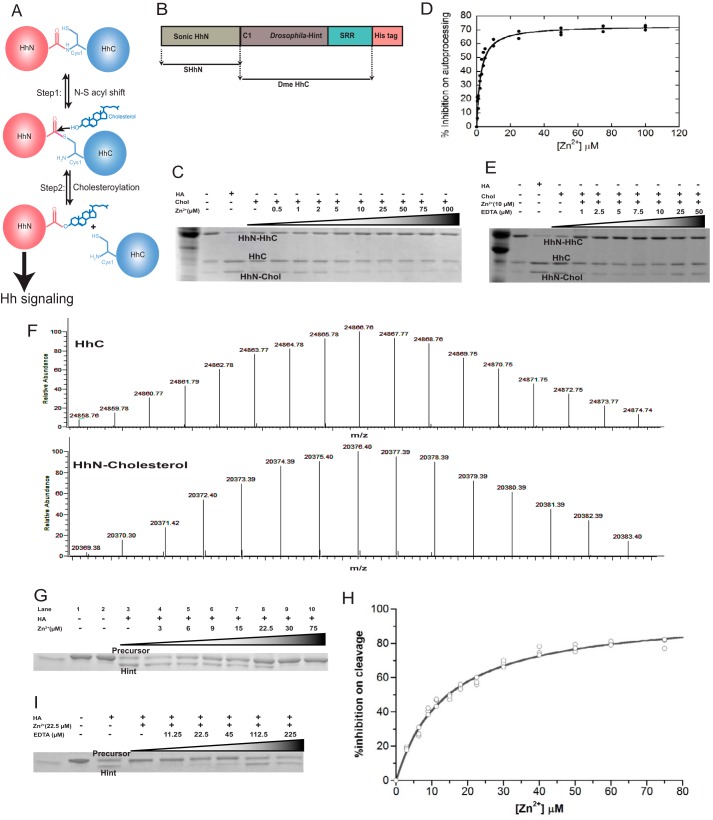
Zinc inhibits Hh autoprocessing in vitro. A, Hh autoprocessing mechanism. Hh is composed of two domains, the N terminus signaling domain (HhN) and C terminus autoprocessing domain (HhC). In the first step N-S acyl shift, the thiol group of Cys-1 initiates a nucleophilic attack on the carbonyl carbon of the preceding residue, Gly-(−1). This attack results in replacement of the peptide bond between Gly-1 and Cys-1 by a thioester linkage. In the second step cholesteroylation, the thioester is subject to a second nucleophilic attack from the hydroxyl group of a cholesterol molecule bound by the sterol recognition region (SRR) within HhC, resulting in a cholesterol-modified HhN and a free HhC. B, schematic diagram of the construct for cholesteroylation assay, composed of both HhN and HhC. It is a chimera fusion protein that contains SHhN at its N terminus and Drosophila melanogaster HhC at its C terminus. C, zinc inhibits Hh cholesteroylation in vitro. HA can induce the N-S acyl shift and initiate the cleavage of Hh. Chol, cholesterol; Zn2+: ZnCl2. D, quantitative analysis of zinc inhibition on Hh autoprocessing in vitro. The experiments were repeated 3 times, and the Ki was 2.3 ± 0.2 μm. E, EDTA reversal of zinc inhibition in cholesteroylation assay. F, LC/electrospray ionization-MS analysis of the products of the autoprocessing assay, cleaved HhC and cholesteroylated HhN. The upper portion shows one of the reaction products, the Drosophila melanogaster HhC. The calculated average mass (massaverage = 24867.29 Da) is between the two most abundant peaks in our experimental spectrum. The bottom portion shows the correct mass for cholesterol-modified SHhN (massaverage = 20377.15 Da). These data proved the cholesteroylation of HhC in our assay. G, zinc inhibits HA-induced N-S acyl shift at 25 °C for 3 h. HA can cleave the thioester formed by N-S acyl shift in shortened Hh precursor, which lacks sterol recognition region. Lane 1 is the precursor at 4 °C, and lane 2 is the precursor at 25 °C, which shows the precursor is stable at both temperatures for at least 3 h. H, quantitative analysis of zinc inhibition on Hh N-S acyl shift. The experiments were repeated 3 times, and Ki was calculated to be 14 ± 1 μm. I, EDTA reversal of zinc inhibition in N-S acyl shift.
FIGURE 2.
FIGURE 2.
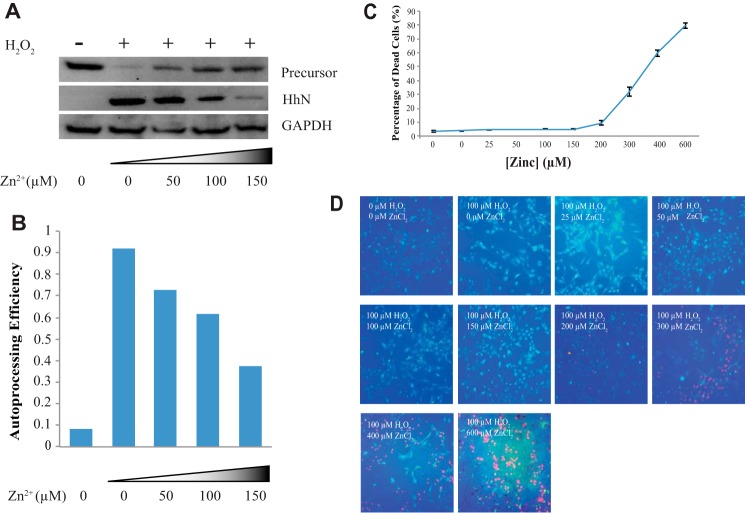
Zinc inhibits Hh autoprocessing in primary astrocyte cell culture. A, zinc inhibits Hh autoprocessing in astrocytes. Immunoblotting for GAPDH was used as a loading control. B, quantitative analysis was performed with ImageJ. The amounts of proteins were normalized to those of GAPDH. C, dose-response curve for percentage of dead rat primary astrocyte cells by varying concentrations of environmental zinc. Cultures were exposed to 0–600 μm zinc and 100 μm H2O2 for 40 h. The cell viability was assessed using the Live/Dead cell imaging kit, and the percentage of dead cells was determined by the Spot Detector BioApplication. Results are expressed as the mean derivations ± S.D. for two cultures. D, a representative figure for each condition. In each figure green fluorescence represents live cells and red fluorescence represents dead cells.
FIGURE 3.
FIGURE 3.
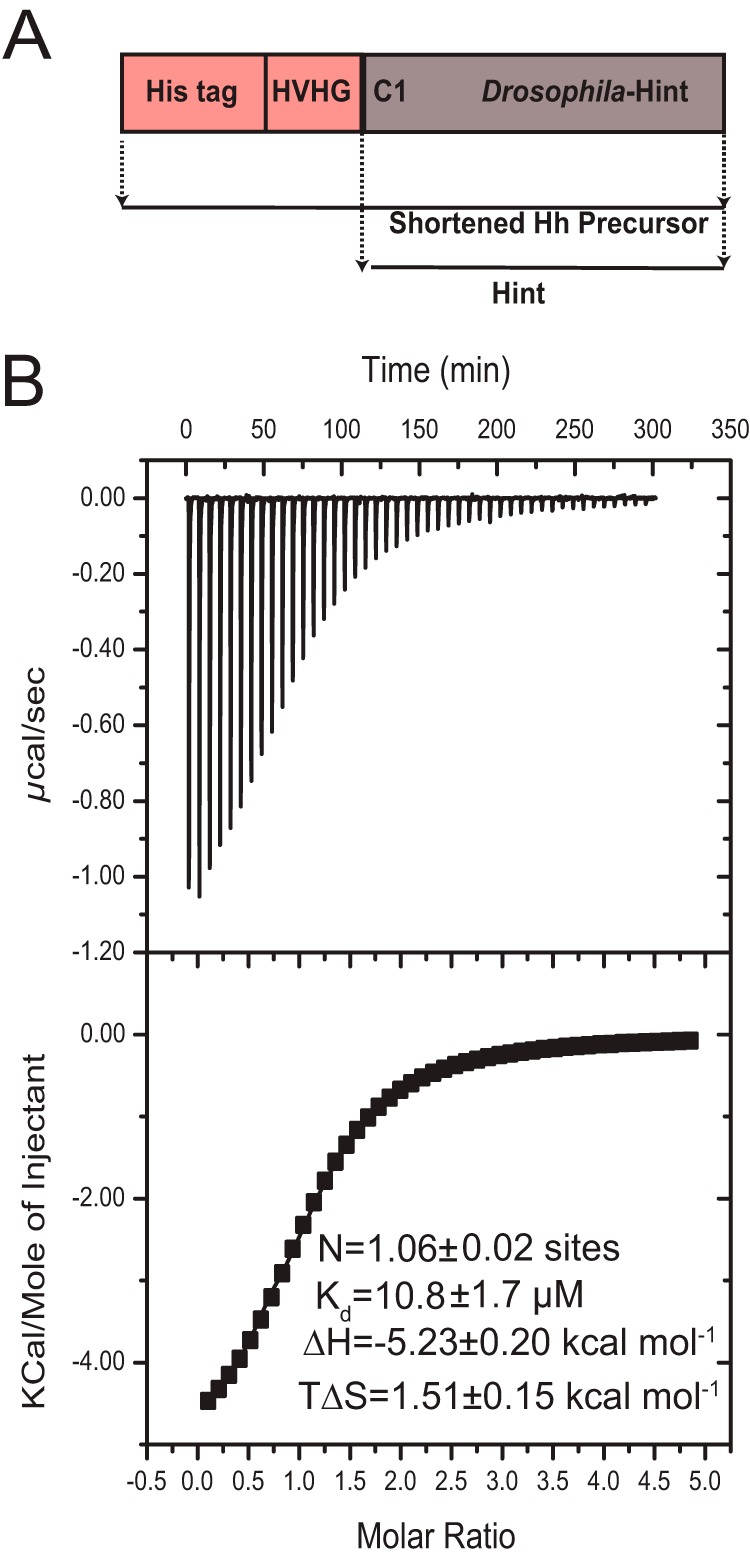
Thermodynamics of zinc-Hint binding. A, schematic diagram of the shortened precursor construct used for producing Hint sample in ITC and NMR studies. It contains a His tag and four native residues (HVHG) from HhN C terminus followed by Drosophila melanogaster Hint domain. The Hint domain is obtained after DTT induced cleavage from the precursor. B, ITC data for the titration of Zn2+ into Hint at 25 °C. The upper portion contains the baseline-corrected raw data, and the lower portion indicates the concentration normalized heat from titration at the molar ratio of Hint.
FIGURE 4.
FIGURE 4.
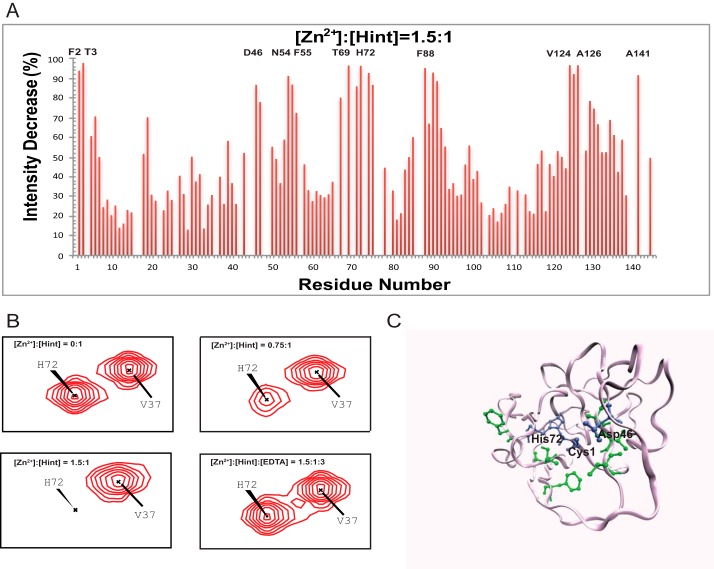
Structural basis of zinc-Hint binding. A, 1H,15N-HSQC signal intensity changes of Zn2+ binding to Hint at 25 °C. The residues with the biggest changes are labeled. B, chemical shift perturbation analysis for His-72 backbone in 15N-labeled Hint upon zinc binding. With increasing amount of zinc, the amide peak intensities of His-72 decreased during the titration. Adding 2 mol eq of EDTA resulted in the complete reappearance of the missing signals. C, structural model of Hint binding site of Zn2+ mapped onto the x-ray structure (PDB ID 1AT0) based on the NMR signal intensity change. Blue residues are the direct coordination sites, which have the biggest signal decrease, whereas green residues, with less signal reduction, likely play a secondary role in zinc binding.
FIGURE 5.
FIGURE 5.
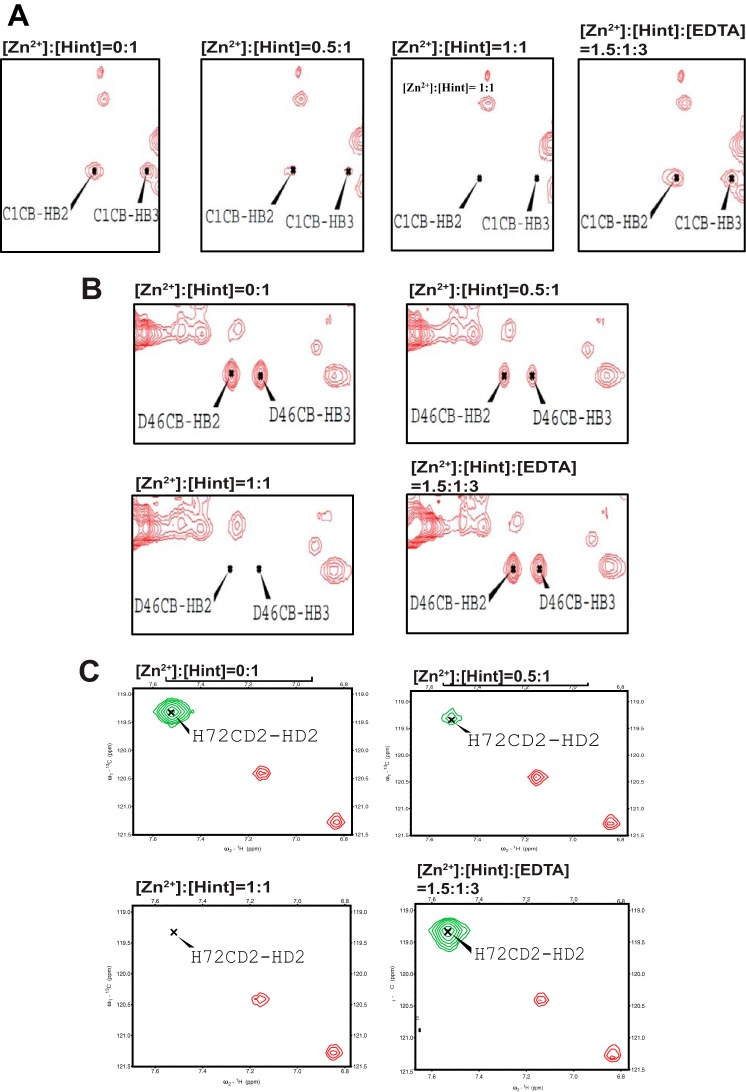
NMR studies of side-chain binding to zinc using 13C NMR experiments. A, the effect of Zn2+ titration on the Cys-1 side chain monitored by 13C-aliphatic HSQC, which can be reversed by adding EDTA. B, the effect of Zn2+ titration on the Asp-46 side chain by 13C-aliphatic HSQC, which can be reversed by adding EDTA. C, the effect of Zn2+ titration on the His-72 side chain by 13C-aromatic HSQC, which also can be reversed by adding EDTA.
FIGURE 6.
FIGURE 6.
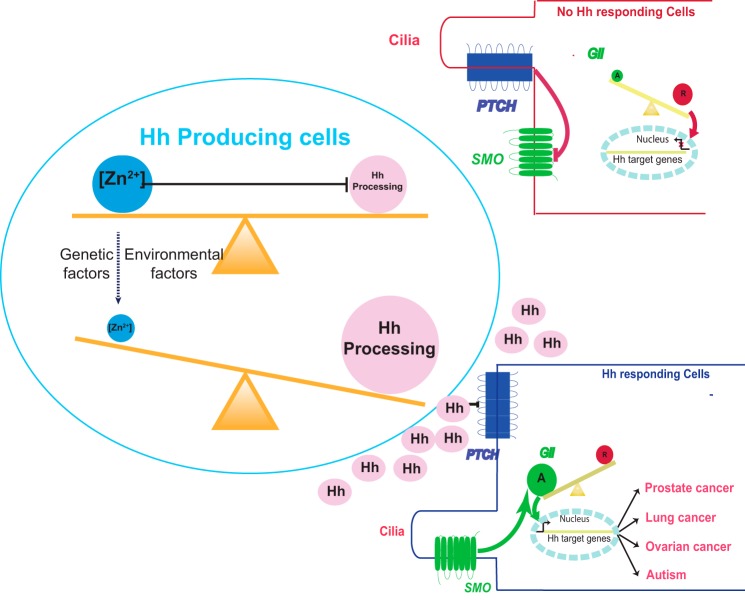
A new pathway in diseases; zinc deficiency leads to overproduction of Hh ligand and the activation of Hh signaling pathway. Under normal physiological conditions, zinc binds to Hint domain on Hh precursor and inhibits Hh autoprocessing and Hh signaling pathway. When the zinc level is low, Hh autoprocessing will be enhanced, leading to overproduction of Hh ligand. Hh ligand binds to Patched (PTCH), relieving its inhibition of Smoothened (SMO). Smoothened in turn activates Gli transcription factors, turning on the transcriptions of Hh target genes. The low zinc-high Hh axis may contribute to the pathogenic mechanisms of many types of cancer and ASD.

References

    1. Briscoe J., Thérond P. P. (2013) The mechanisms of Hedgehog signalling and its roles in development and disease. Nat. Rev. Mol. Cell Biol. 14, 416–429 - PubMed
    1. Karhadkar S. S., Bova G. S., Abdallah N., Dhara S., Gardner D., Maitra A., Isaacs J. T., Berman D. M., Beachy P. A. (2004) Hedgehog signalling in prostate regeneration, neoplasia, and metastasis. Nature 431, 707–712 - PubMed
    1. Sanchez P., Hernández A. M., Stecca B., Kahler A. J., DeGueme A. M., Barrett A., Beyna M., Datta M. W., Datta S., Ruiz i Altaba A. (2004) Inhibition of prostate cancer proliferation by interference with Sonic Hedgehog-Gli1 signaling. Proc. Natl. Acad. Sci. U.S.A. 101, 12561–12566 - PMC - PubMed
    1. Sheng T., Li C., Zhang X., Chi S., He N., Chen K., McCormick F., Gatalica Z., Xie J. (2004) Activation of the hedgehog pathway in advanced prostate cancer. Mol. Cancer 3, 29. - PMC - PubMed
    1. Watkins D. N., Berman D. M., Burkholder S. G., Wang B., Beachy P. A., Baylin S. B. (2003) Hedgehog signalling within airway epithelial progenitors and in small-cell lung cancer. Nature 422, 313–317 - PubMed

Publication types

Associated data

LinkOut - more resources