Do they hear what we speak? Assessing the effectiveness of communication to families of critically ill neurosurgical patients
- PMID: 25788773
- PMCID: PMC4353153
- DOI: 10.4103/0970-9185.150540
Do they hear what we speak? Assessing the effectiveness of communication to families of critically ill neurosurgical patients
Abstract
Background and aims: Clinician-family communication must be effective for medical decision making in any Intensive Care Unit (ICU) setting. We performed a prospective study to assess the effectiveness of communication to families of critically ill neurosurgical patients based on the two criteria of comprehension and satisfaction.
Materials and methods: The study was conducted on 75 patients in a 15 bedded neurosurgical ICU. An independent investigator assessed the comprehension and satisfaction of families between the 3(rd) and the 5(th) day of admission in ICU. Comprehension was tested using three components, that is, comprehension of diagnosis, prognosis and treatment. The satisfaction was measured using a modified version of the Critical Care Family Needs Inventory (CCFNI) (score of 56-extreme dissatisfaction and 14-extreme satisfaction).
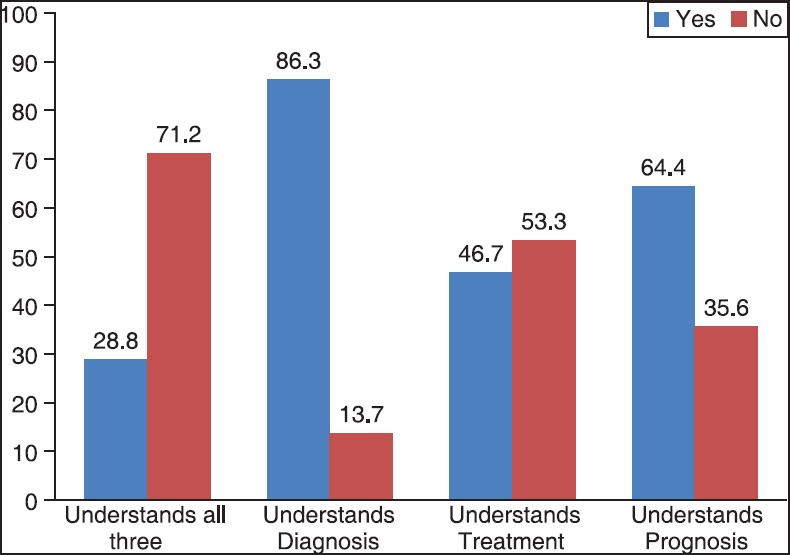
Results: Poor comprehension was noted in 52 representatives (71.2%). The mean satisfaction score as measured by the CCFNI score was 28. Factors associated with poor comprehension included increasing age of patient representative (P = 0.024), higher simplified acute physiology score (P = 0.26), nonoperated patients (P = 0.0087) and clinician estimation of poor prognosis (P = 0.01). Operated patients had significantly better satisfaction score (P = 0.04).
Conclusion: Families of patients were reasonably satisfied, but had poor comprehension levels of the patient's illness. The severity of the patient's illness, poor prognosis as estimated by the physician and nonoperated patients were independent predictors of poor comprehension. Extra effort to communicate with patient representatives at risk of poor comprehension and provision of a family information leaflet could possibly remedy this situation.
Keywords: Clinician; Intensive Care Unit; communication; comprehension; critical care; family representatives; satisfaction.
Conflict of interest statement
Figures
References
-
- Azoulay E, Chevret S, Leleu G, Pochard F, Barboteu M, Adrie C, et al. Half the families of intensive care unit patients experience inadequate communication with physicians. Crit Care Med. 2000;28:3044–9. - PubMed
-
- Rodriguez RM, Navarrete E, Schwaber J, McKleroy W, Clouse A, Kerrigan SF, et al. A prospective study of primary surrogate decision makers’ knowledge of intensive care. Crit Care Med. 2008;36:1633–6. - PubMed
-
- Harvey MA, Ninos NP, Adler DC, Goodnough-Hanneman SK, Kaye WE, Nikas DL. Results of the consensus conference on fostering more humane critical care: Creating a healing environment. Society of Critical Care Medicine. AACN Clin Issues Crit Care Nurs. 1993;4:484–549. - PubMed
-
- Le Gall JR, Lemeshow S, Saulnier F. A new simplified acute physiology score (SAPS II) based on a European/North American multicenter study. JAMA. 1993;270:2957–63. - PubMed
LinkOut - more resources
Full Text Sources
Other Literature Sources
Miscellaneous