


Purpose in life and cerebral infarcts in community-dwelling older people
- PMID: 25791714
- PMCID: PMC4461202
- DOI: 10.1161/STROKEAHA.114.008010
Purpose in life and cerebral infarcts in community-dwelling older people
Abstract
Background and purpose: Purpose in life, the sense that life has meaning and direction, is associated with reduced risks of adverse health outcomes. However, it remains unknown whether purpose in life protects against the risk of cerebral infarcts among community-dwelling older people. We tested the hypothesis that greater purpose in life is associated with lower risk of cerebral infarcts.
Methods: Participants came from the Rush Memory and Aging Project. Each participant completed a standard measure of purpose in life. Uniform neuropathologic examination identified macroscopic infarcts and microinfarcts, blinded to clinical information. Association of purpose in life with cerebral infarcts was examined in ordinal logistic regression models using a semiquantitative outcome.
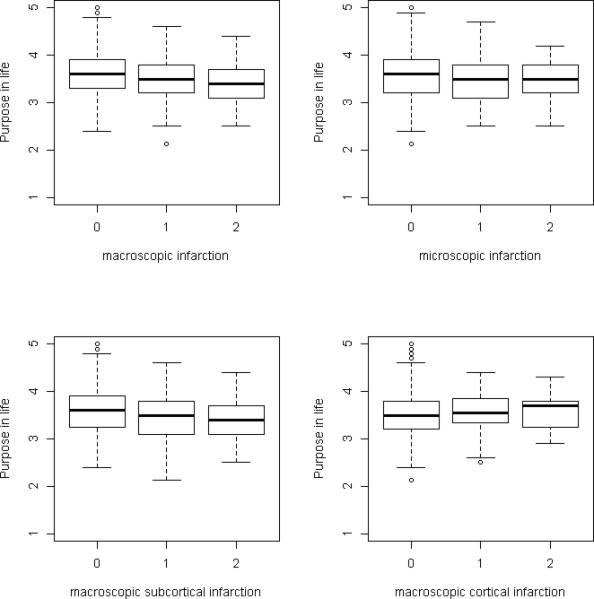
Results: Four hundred fifty-three participants were included in the analyses. The mean score on the measure of purpose was 3.5 (SD, 0.5; range, 2.1-5.0). Macroscopic infarcts were found in 154 (34.0%) people, and microinfarcts were found in 128 (28.3%) people. Greater purpose in life was associated with a lower odds of having more macroscopic infarcts (odds ratio, 0.535; 95% confidence interval, 0.346-0.826; P=0.005), but we did not find association with microinfarcts (odds ratio, 0.780; 95% confidence interval, 0.495-1.229; P=0.283). These results persisted after adjusting for vascular risk factors of body mass index, history of smoking, diabetes mellitus, and blood pressure, as well as measures of negative affect, physical activity, and clinical stroke. The association with macroscopic infarcts was driven by lacunar infarcts, and was independent of cerebral atherosclerosis and arteriolosclerosis.
Conclusions: Purpose in life may affect risk for cerebral infarcts, specifically macroscopic lacunar infarcts.
Keywords: aging; cerebral infarcts; lacunar; purpose in life.
© 2015 American Heart Association, Inc.
Figures
References
-
- Ryff CD, Keyes CL. The structure of psychological well-being revisited. J Pers Soc Psychol. 1995;69:719–727. - PubMed
Publication types
MeSH terms
Grants and funding
LinkOut - more resources
Full Text Sources
Medical
