


Differential Effect of Baseline Computed Tomographic Angiography Collaterals on Clinical Outcome in Patients Enrolled in the Interventional Management of Stroke III Trial
- PMID: 25791716
- PMCID: PMC4476381
- DOI: 10.1161/STROKEAHA.115.009009
Differential Effect of Baseline Computed Tomographic Angiography Collaterals on Clinical Outcome in Patients Enrolled in the Interventional Management of Stroke III Trial
Abstract
Background and purpose: In the Interventional Management of Stroke (IMS) III trial, we sought to demonstrate evidence of a differential treatment effect of endovascular treatment of acute ischemic stroke compared with intravenous tissue-type plasminogen activator, according to baseline collateral status measured using computed tomographic angiography.
Methods: Of 656 patients enrolled in Interventional Management of Stroke III trial, 306 had baseline computed tomographic angiography. Of these, 185 patients had M1 middle cerebral artery ± intracranial internal carotid artery occlusion, where baseline collateral status could be measured. Collateral status was assessed by consensus using 3 different ordinal scales and categorized as good, intermediate, and poor. Multivariable modeling was used to assess the effect of collateral status and treatment type on clinical outcome by modified Rankin Scale (mRS 0-2, mRS 0-1, and the ordinal mRS).
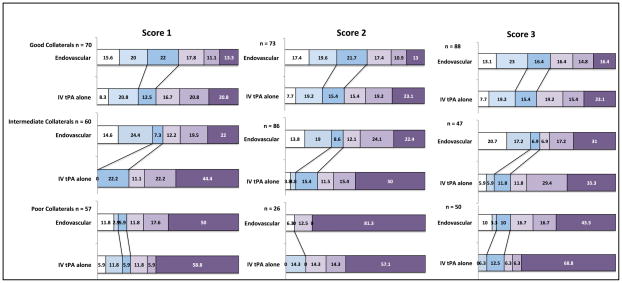
Results: Of 185 patients, 126 randomized to endovascular therapy (87.6% recanalized, 41.3% 90-day mRS 0-2) and 59 to intravenous tissue-type plasminogen activator only (60.5% recanalized, 30.5% 90-day mRS 0-2). In multivariable modeling, collateral status was a significant predictor of all clinical outcomes (P<0.05). Maximal benefit with endovascular treatment across all clinical outcomes was seen in patients with intermediate collaterals, some benefit in patients with good collaterals, and none in patients with poor collaterals, although small sample size limited the power of the analysis to show a statistically significant interaction between collateral status and treatment type (P>0.05).
Conclusion: Using data from a large randomized controlled trial (IMS III), we show that baseline computed tomographic angiography collaterals are a robust determinant of final clinical outcome and could be used to select patients for endovascular therapy.
Clinical trial registration: URL: http://www.clinicaltrials.gov/ct2/show/. Unique identifier: 0020NCT00359424.
Keywords: collateral circulation; endovascular techniques; stroke.
© 2015 American Heart Association, Inc.
Figures
References
-
- Liebeskind DS. Collateral circulation. Stroke. 2003;34:2279–2284. - PubMed
-
- Shuaib A, Butcher K, Mohammad AA, Saqqur M, Liebeskind DS. Collateral blood vessels in acute ischaemic stroke: A potential therapeutic target. Lancet neurology. 2011;10:909–921. - PubMed
-
- Miteff F, Levi CR, Bateman GA, Spratt N, McElduff P, Parsons MW. The independent predictive utility of computed tomography angiographic collateral status in acute ischaemic stroke. Brain. 2009;132:2231–2238. - PubMed
Publication types
MeSH terms
Substances
Associated data
Grants and funding
LinkOut - more resources
Full Text Sources
Medical
