


Language knowledge and event knowledge in language use
- PMID: 25791750
- PMCID: PMC5951625
- DOI: 10.1016/j.cogpsych.2015.02.002
Language knowledge and event knowledge in language use
Abstract
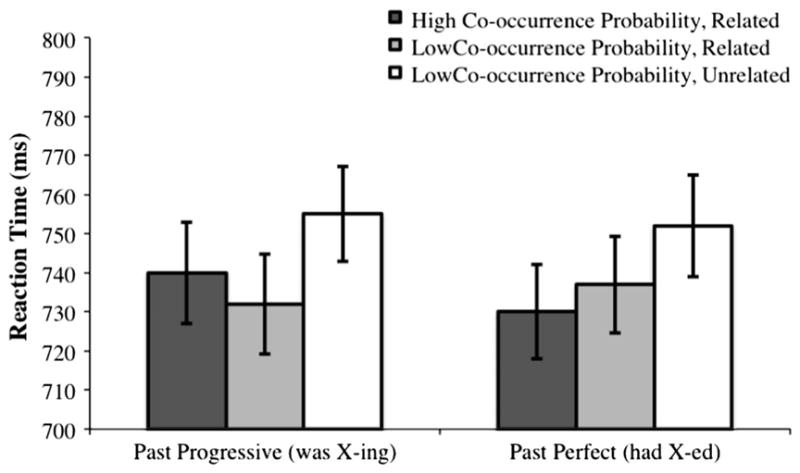
This paper examines how semantic knowledge is used in language comprehension and in making judgments about events in the world. We contrast knowledge gleaned from prior language experience ("language knowledge") and knowledge coming from prior experience with the world ("world knowledge"). In two corpus analyses, we show that previous research linking verb aspect and event representations have confounded language and world knowledge. Then, using carefully chosen stimuli that remove this confound, we performed four experiments that manipulated the degree to which language knowledge or world knowledge should be salient and relevant to performing a task, finding in each case that participants use the type of knowledge most appropriate to the task. These results provide evidence for a highly context-sensitive and interactionist perspective on how semantic knowledge is represented and used during language processing.
Keywords: Event representation; Language comprehension; Language production; Semantic memory; Word meaning.
Copyright © 2015. Published by Elsevier Inc.
Figures




References
-
- Andrews M, Vigliocco G, Vinson DP. Integrating experiential and distributional data to learn semantic representations. Psychological Review. 2009;116:463–498. - PubMed
-
- Arnon I, Snider N. More than words: Frequency effects for multi-word phrases. Journal of Memory and Language. 2010;62:67–82.
-
- Athanasopoulos P, Bylund E. Does grammatical aspect affect motion event cognition? A cross-linguistic comparison of English and Swedish speakers. Cognitive Science. 2013;37:286–309. - PubMed
-
- Barr DJ, Keysar B. Perspective taking and the coordination of meaning in language use. In: Traxler MJ, Gernsbacher MA, editors. Handbook of psycholinguistics. 2. New York: Academic Press; 2007. pp. 901–938.
Publication types
MeSH terms
Grants and funding
LinkOut - more resources
Full Text Sources
Other Literature Sources
