


Prednisolone-containing liposomes accumulate in human atherosclerotic macrophages upon intravenous administration
- PMID: 25791806
- PMCID: PMC4625798
- DOI: 10.1016/j.nano.2015.02.021
Prednisolone-containing liposomes accumulate in human atherosclerotic macrophages upon intravenous administration
Abstract
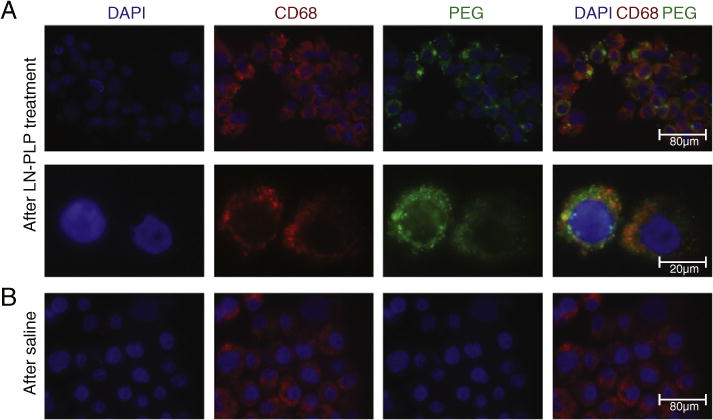
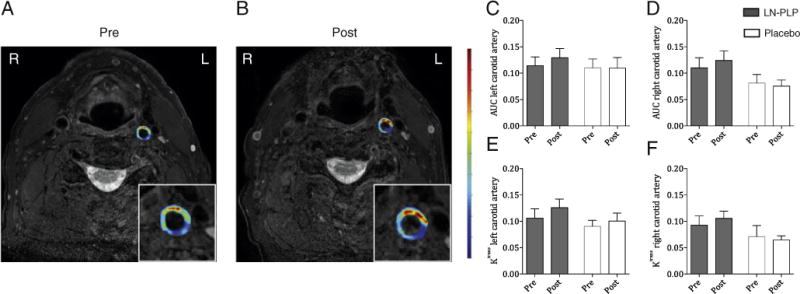
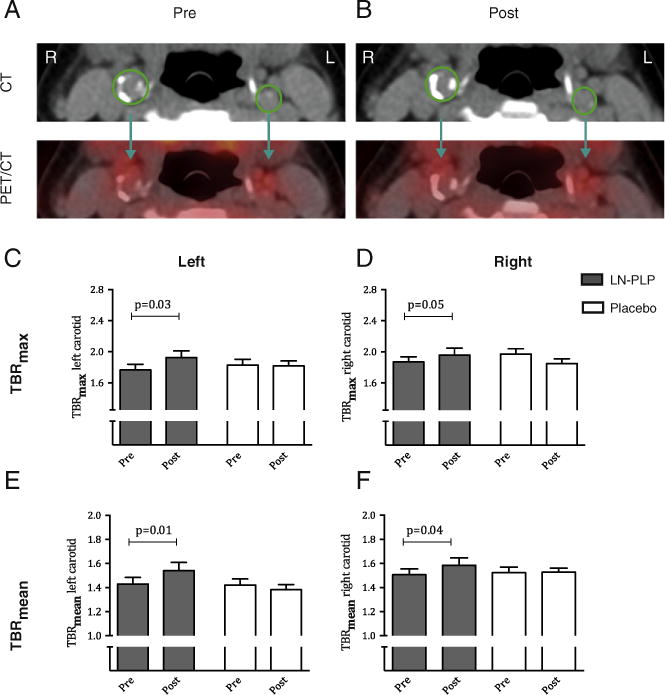
Drug delivery to atherosclerotic plaques via liposomal nanoparticles may improve therapeutic agents' risk-benefit ratios. Our paper details the first clinical studies of a liposomal nanoparticle encapsulating prednisolone (LN-PLP) in atherosclerosis. First, PLP's liposomal encapsulation improved its pharmacokinetic profile in humans (n=13) as attested by an increased plasma half-life of 63h (LN-PLP 1.5mg/kg). Second, intravenously infused LN-PLP appeared in 75% of the macrophages isolated from iliofemoral plaques of patients (n=14) referred for vascular surgery in a randomized, placebo-controlled trial. LN-PLP treatment did however not reduce arterial wall permeability or inflammation in patients with atherosclerotic disease (n=30), as assessed by multimodal imaging in a subsequent randomized, placebo-controlled study. In conclusion, we successfully delivered a long-circulating nanoparticle to atherosclerotic plaque macrophages in patients, whereas prednisolone accumulation in atherosclerotic lesions had no anti-inflammatory effect. Nonetheless, the present study provides guidance for development and imaging-assisted evaluation of future nanomedicine in atherosclerosis.
From the clinical editor: In this study, the authors undertook the first clinical trial using long-circulating liposomal nanoparticle encapsulating prednisolone in patients with atherosclerosis, based on previous animal studies. Despite little evidence of anti-inflammatory effect, the results have provided a starting point for future development of nanomedicine in cardiovascular diseases.
Keywords: Atherosclerosis; Glucocorticoids; Macrophages; Nanomedicine.
Copyright © 2015 Elsevier Inc. All rights reserved.
Conflict of interest statement
These other authors declare that they have no competing interests. All other authors declare that they have no conflict of interest and no relationships with industry relevant to this study.
Figures
References
-
- Libby P, Ridker PM, Hansson GK. Progress and challenges in translating the biology of atherosclerosis. Nature. 2011;473:317–25. - PubMed
-
- Van der Valk FM, van Wijk DF, Stroes ESG. Novel anti-inflammatory strategies in atherosclerosis. Curr Opin Lipidol. 2012;23:532–9. - PubMed
-
- Wagner V, Dullaart A, Bock A-K, Zweck A. The emerging nanomedicine landscape. Nat Biotechnol. 2006;24:1211–7. - PubMed
-
- Zhang L, et al. Nanoparticles in medicine: therapeutic applications and developments. Transl Med. 2008;83:761–9. - PubMed
Publication types
MeSH terms
Substances
Grants and funding
LinkOut - more resources
Full Text Sources
Other Literature Sources
Medical
Research Materials
