


Impact of patient programs on adherence and persistence in inflammatory and immunologic diseases: a meta-analysis
- PMID: 25792817
- PMCID: PMC4364594
- DOI: 10.2147/PPA.S77053
Impact of patient programs on adherence and persistence in inflammatory and immunologic diseases: a meta-analysis
Abstract
Objectives: Patient adherence and persistence is important to improve outcomes in chronic conditions, including inflammatory and immunologic (I&I) diseases. Patient programs that aim at improving medication adherence or persistence play an essential role in optimizing care. This meta-analysis assessed the effectiveness of patient programs in the therapeutic area of I&I diseases.
Methods: A global systematic literature review was conducted with inclusion criteria of: patient programs in I&I diseases; published in English language between January 2008 and September 2013; and reporting measures of adherence or persistence, including medication possession ratio >80% and persistence rate. A meta-analysis was performed using a random effects model. Subgroup analyses based on the type of program was performed whenever feasible.
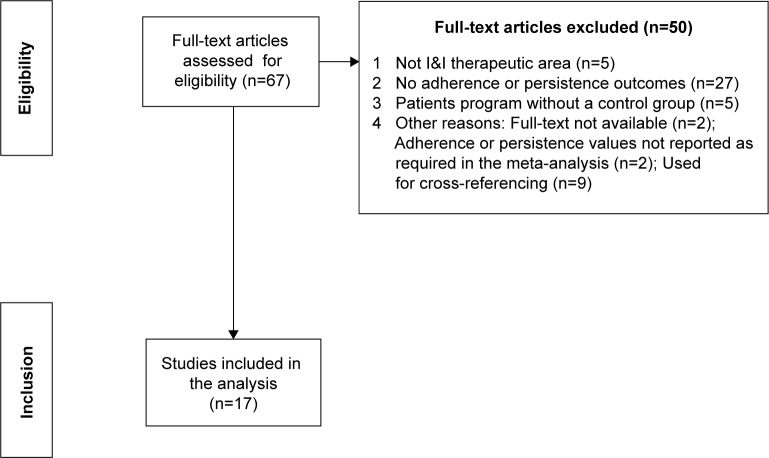
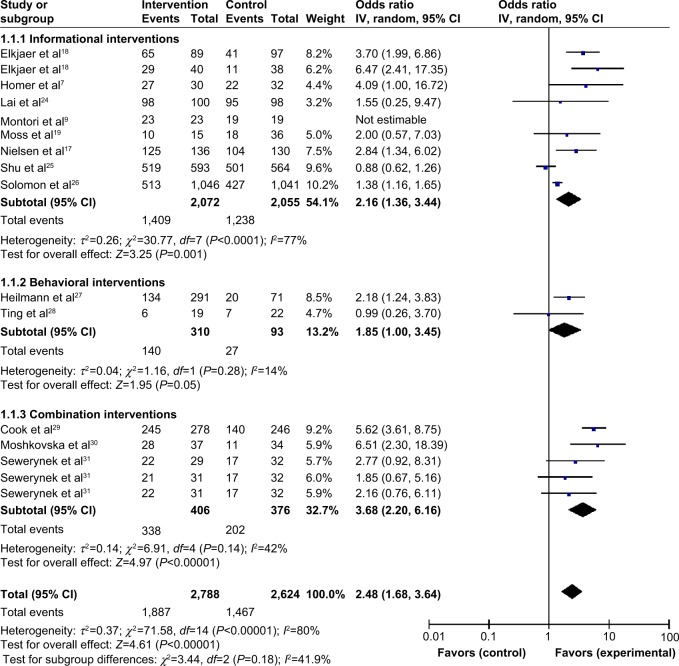
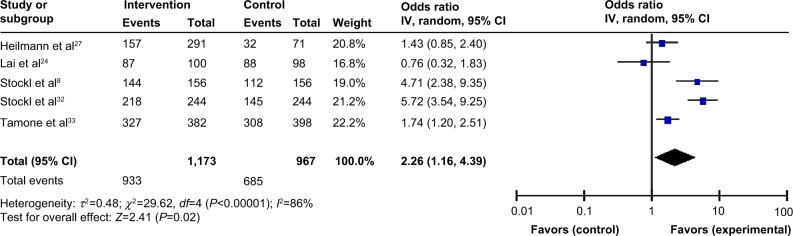
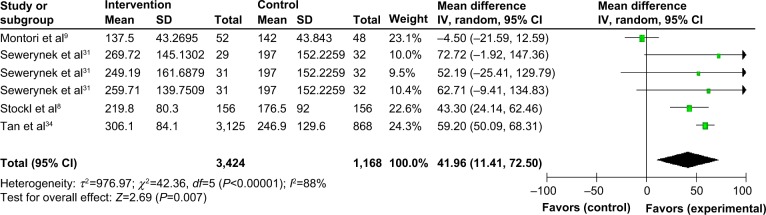
Results: Of 67 studies reviewed for eligibility, a total of 17 studies qualified for inclusion in the meta-analysis. Overall, patient programs increased adherence (odds ratio [OR]=2.48, 95% confidence interval [CI]=1.68-3.64, P<0.00001) as compared with standard of care. Combination patient programs that used both informational and behavioral strategies were superior in improving adherence (OR=3.68, 95% CI=2.20-6.16, P<0.00001) compared with programs that used only informational (OR=2.16, 95% CI=1.36-3.44, P=0.001) or only behavioral approaches (OR=1.85, 95% CI=1.00-3.45, P=0.05). Additionally, patients were more likely to be persistent (OR=2.26, 95% CI=1.16-4.39, P=0.02) in the intervention group as compared with the control group. Persistence (in days) was significantly (P=0.007) longer, by 42 additional days, in the intervention group than in the control group.
Conclusions: Patient programs can significantly improve adherence as well as persistence in the therapeutic area of I&I diseases. Programs employing a multimodal approach are more effective in improving adherence than programs with informational or behavioral strategies alone. This in turn may improve patient outcomes.
Keywords: behavioral; informational; patient interventions; systematic literature review.
Figures
References
-
- Cramer JA, Roy A, Burrell A, et al. Medication compliance and persistence: terminology and definitions. Value Health. 2008;11(1):44–47. - PubMed
-
- Ho PM, Bryson CL, Rumsfeld JS. Medication adherence: its importance in cardiovascular outcomes. Circulation. 2009;119(23):3028–3035. - PubMed
-
- Cooper GS, Stroehla BC. The epidemiology of autoimmune diseases. Autoimmun Rev. 2003;2(3):119–125. - PubMed
LinkOut - more resources
Full Text Sources
Medical
