


The effects of unsupervised exercise training on physical activity and physiological factors after supervised cardiac rehabilitation
- PMID: 25792944
- PMCID: PMC4316499
- DOI: 10.1298/jjpta.9.1
The effects of unsupervised exercise training on physical activity and physiological factors after supervised cardiac rehabilitation
Abstract
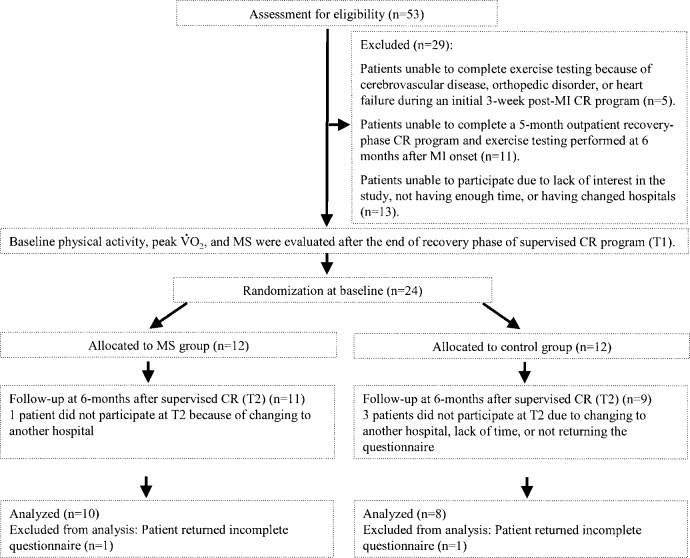
Exercise maintenance after supervised cardiac rehabilitation is important in maintaining both physical activity and physiological factors, such as peak and muscle strength (MS), associated with reduced mortality. However, there is no evidence of the effects of unsupervised exercise training and MS training on physical activity and physiological factors after supervised cardiac rehabilitation of Japanese cardiac patients. We conducted a randomized, controlled trial to evaluate the effect of unsupervised exercise training on physical activity and selected physiological factors after supervised cardiac rehabilitation. Eighteen myocardial infarction (MI) patients (16 men, 2 women; mean age 66.3 years) were recruited following completion of a supervised recovery-phase cardiac rehabilitation program. Patients were randomly assigned to a MS training (n=10) or control group (n=8). Baseline measurements of physical activity, peak , and MS were performed at the end of supervised recovery-phase cardiac rehabilitation (6 months after the onset of MI: T1). Six months later, after going through an unsupervised exercise program (12 months after the onset of MI: T2) exercise maintenance, peak , MS, and physical activity were remeasured. The MS training group performed low-intensity MS training and walking over the second 6-month period; the control group performed walking exercise only. All patients maintained their exercise training. At T2, there were no significant differences in peak values between the MS training and control groups. There was also no significant difference in physical activity (mean number of steps per week) between the MS training and control groups. However, MS was significantly higher in the MS training group than in the control group. We concluded that unsupervised exercise training and low-level MS training performed after supervised cardiac rehabilitation may effectively maintain not only physical activity and peak but increase MS.
Keywords: knee extension muscle strength; peak; physical activity; unsupervised exercise training.
Figures
References
-
- Oldridge NB, Guyatt GH, et al. : Cardiac rehabilitation after myocardial infarction. Combined experience of randomized clinical trials. JAMA 260: 945-950, 1988. - PubMed
-
- Izawa K, Hirano Y, et al. : Improvement in physiological outcomes and health-related quality of life following cardiac rehabilitation in patients with acute myocardial infarction. Circ J 68: 315-320, 2004. - PubMed
-
- Goto Y, Itoh H, et al. : Use of exercise cardiac rehabilitation after acute myocardial infarction. Circ J 67: 411-415, 2003. - PubMed
-
- Morganti CM, Nelson ME, et al. : Strength improvements with 1 yr of progressive resistance training in older women. Med Sci Sports Exerc 27: 906-912, 1995. - PubMed
-
- Oldridge NB: Cardiac rehabilitation services: what are they and are they worth it? Compr Ther 17: 59-66, 1991. - PubMed
LinkOut - more resources
Full Text Sources