


Sociodemographic and health characteristics, rather than primary care supply, are major drivers of geographic variation in preventable hospitalizations in Australia
- PMID: 25793270
- PMCID: PMC4396734
- DOI: 10.1097/MLR.0000000000000342
Sociodemographic and health characteristics, rather than primary care supply, are major drivers of geographic variation in preventable hospitalizations in Australia
Abstract
Background: Geographic rates of preventable hospitalization are used internationally as an indicator of accessibility and quality of primary care. Much research has correlated the indicator with the supply of primary care services, yet multiple other factors may influence these admissions.
Objective: To quantify the relative contributions of the supply of general practitioners (GPs) and personal sociodemographic and health characteristics, to geographic variation in preventable hospitalization.
Methods: Self-reported questionnaire data for 267,091 participants in the 45 and Up Study, Australia, were linked with administrative hospital data to identify preventable hospitalizations. Multilevel Poisson models, with participants clustered in their geographic area of residence, were used to explore factors that explain geographic variation in hospitalization.
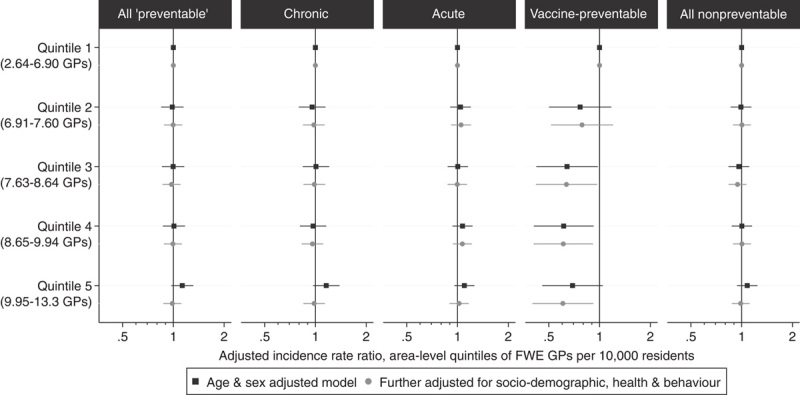
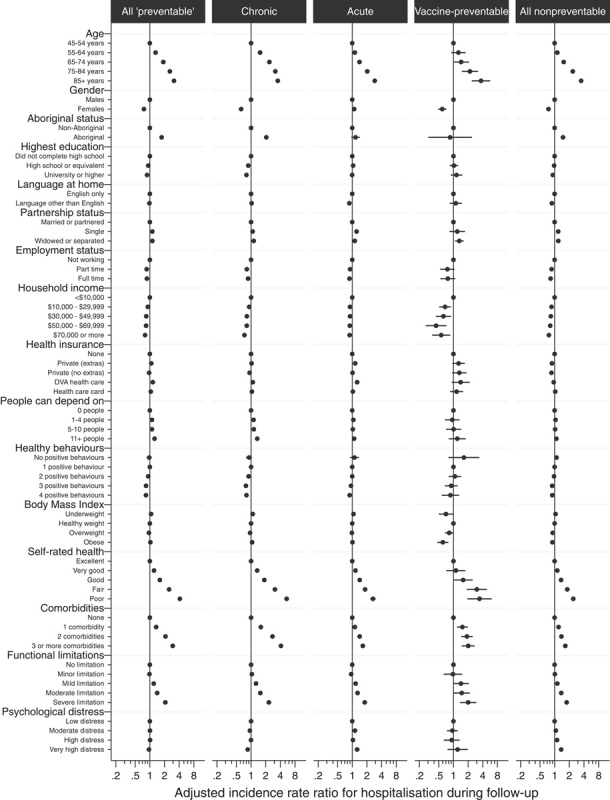
Results: GP supply, measured as full-time workload equivalents, was not a significant predictor of preventable hospitalization, and explained only a small amount (2.9%) of the geographic variation in hospitalization rates. Conversely, more than one-third (36.9%) of variation was driven by the sociodemographic composition, health, and behaviors of the population. These personal characteristics explained a greater amount of the variation for chronic conditions (37.5%) than acute (15.5%) or vaccine-preventable conditions (2.4%).
Conclusions: Personal sociodemographic and health characteristics, rather than GP supply, are major drivers of preventable hospitalization. Their contribution varies according to condition, and if used for performance comparison purposes, geographic rates of preventable hospitalization should be reported according to individual condition or potential pathways for intervention.
Conflict of interest statement
The authors declare no conflict of interest.
Figures
References
-
- Billings J, Zeitel L, Lukomnik J, et al. Impact of socioeconomic status on hospital use in New York City. Health Aff (Milwood). 1993;12:162–173. - PubMed
-
- Ansari Z. The concept and usefulness of ambulatory care sensitive conditions as indicators of quality and access to primary health care. Aust J Prim Health. 2007;13:91–110.
-
- Kruzikas DT, Jiang HJ, Remus D, et al. Preventable Hospitalisations: A Window into Primary and Preventive Care, 2000 HCUP Fact Book No 5; AHRQ Publication No 04-0056. 2004Rockville, MD: Agency for Healthcare Research and Quality.
-
- Council of Australian Governments. Intergovernmental Agreement (IGA) on Federal Financial Relations: Schedule F National Healthcare Agreement. 2012Council of Australian Governments; Available at: http://www.federalfinancialrelations.gov.au/content/national_agreements..... Accessed March 20, 2013.
-
- National Health Performance Authority. Healthy Communities: Selected Potentially Avoidable Hospitalisations in 2011–12. 2013Sydney: National Health Performance Authority.
Publication types
MeSH terms
Grants and funding
LinkOut - more resources
Full Text Sources
