


Air pollution and stillbirth risk: exposure to airborne particulate matter during pregnancy is associated with fetal death
- PMID: 25794052
- PMCID: PMC4368103
- DOI: 10.1371/journal.pone.0120594
Air pollution and stillbirth risk: exposure to airborne particulate matter during pregnancy is associated with fetal death
Abstract
Objective: To test the hypothesis that exposure to fine particulate air pollution (PM2.5) is associated with stillbirth.
Study design: Geo-spatial population-based cohort study using Ohio birth records (2006-2010) and local measures of PM2.5, recorded by the EPA (2005-2010) via 57 monitoring stations across Ohio. Geographic coordinates of the mother's residence for each birth were linked to the nearest PM2.5 monitoring station and monthly exposure averages calculated. The association between stillbirth and increased PM2.5 levels was estimated, with adjustment for maternal age, race, education level, quantity of prenatal care, smoking, and season of conception.
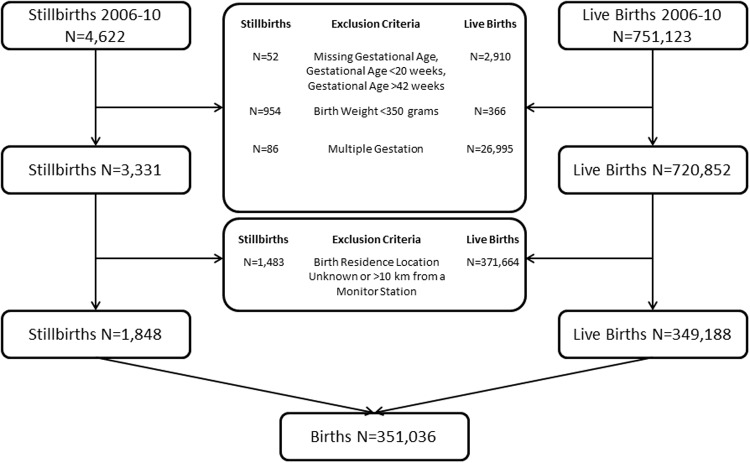
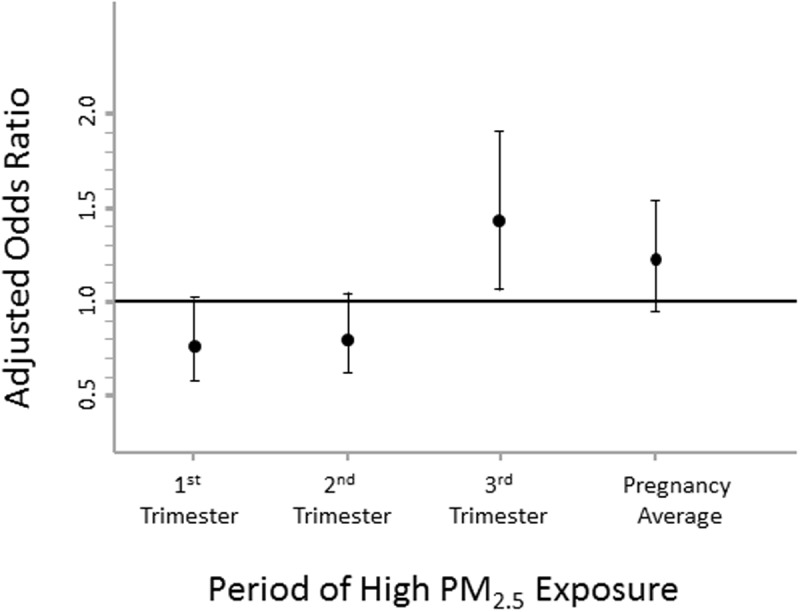
Results: There were 349,188 live births and 1,848 stillbirths of non-anomalous singletons (20-42 weeks) with residence ≤10 km of a monitor station in Ohio during the study period. The mean PM2.5 level in Ohio was 13.3 μg/m3 [±1.8 SD, IQR(Q1: 12.1, Q3: 14.4, IQR: 2.3)], higher than the current EPA standard of 12 μg/m3. High average PM2.5 exposure through pregnancy was not associated with a significant increase in stillbirth risk, adjOR 1.21(95% CI 0.96,1.53), nor was it increased with high exposure in the 1st or 2nd trimester. However, exposure to high levels of PM2.5 in the third trimester of pregnancy was associated with 42% increased stillbirth risk, adjOR 1.42(1.06,1.91).
Conclusions: Exposure to high levels of fine particulate air pollution in the third trimester of pregnancy is associated with increased stillbirth risk. Although the risk increase associated with high PM2.5 levels is modest, the potential impact on overall stillbirth rates could be robust as all pregnant women are potentially at risk.
Conflict of interest statement
Figures
References
-
- World Health Organization website. County stillbirth rates per 1000 total births for 2009 | World Health Organization, Save the Children. Available: http://who.int/pmnch/media/news/2011/stillbirths_countryrates.pdf. Accessed 23 Dec 2013.
-
- MacDorman MF, Kirmeyer S, Wilson EC. Fetal and Perinatal Mortality, United States, 2006. National Vital Statistics Reports, Vol. 60 No. 8; 2012. - PubMed
-
- Healthy People 2010 Home Page. Available: http://www.healthypeople.gov/2010/. Accessed 19 Dec 2013.
-
- Glinianaia SV, Rankin J, Bell R, Pless-Mulloli T, Howel D. Particulate air pollution and fetal health: A systematic review of the epidemiologic evidence. Epidemiology 2004; 15:36–45. - PubMed
Publication types
MeSH terms
Substances
Grants and funding
LinkOut - more resources
Full Text Sources
Other Literature Sources
Medical
Research Materials
