


Acute coronary syndromes in the community
- PMID: 25794453
- PMCID: PMC4420654
- DOI: 10.1016/j.mayocp.2015.02.015
Acute coronary syndromes in the community
Abstract
Objectives: To measure the incidence of acute coronary syndrome (ACS), defined as first-ever myocardial infarction (MI) or unstable angina (UA); evaluate recent temporal trends; and determine whether survival after ACS has changed over time and differs by type.
Patients and methods: This was a population surveillance study conducted in Olmsted County, Minnesota (population: 144,248). All persons hospitalized with incident ACS between January 1, 2005, and December 31, 2010, were identified using International Classification of Diseases, Ninth Revision codes, natural language processing of the medical records, and biomarkers. Myocardial infarction was validated by epidemiologic criteria and UA by the Braunwald classification. Patients were followed through June 30, 2013, for death.
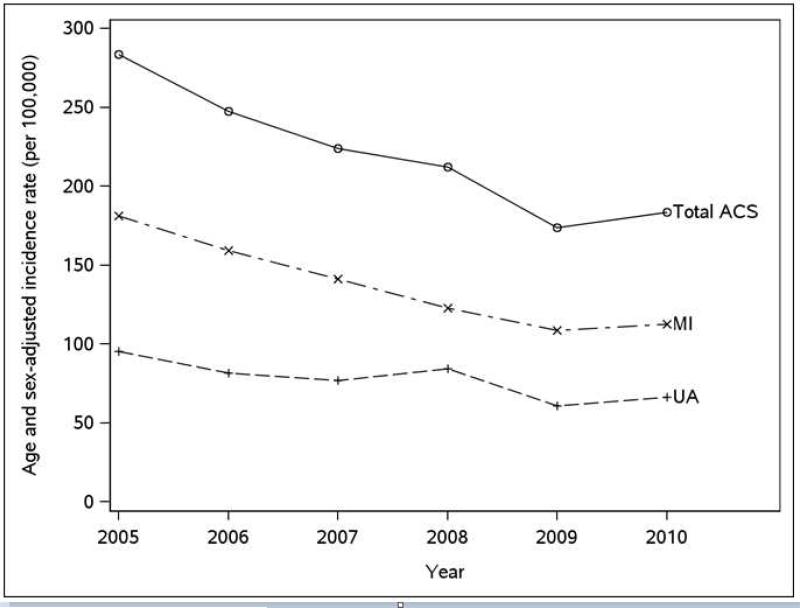
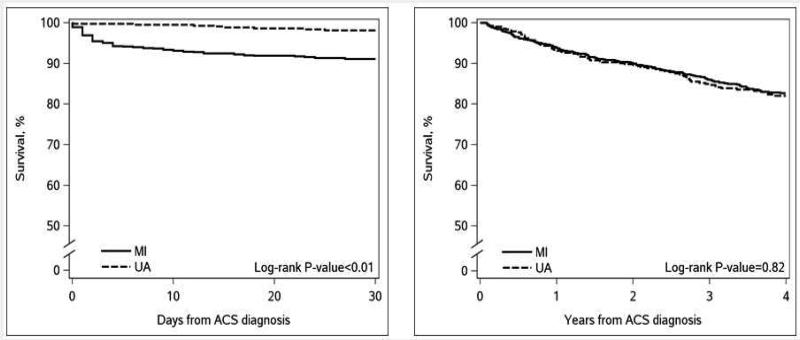
Results: Of 1244 incident ACS cases, 35% (n=438) were UA and 65% (n=806) were MI. The standardized rates (per 100,000) of ACS were 284 (95% CI, 248-319) in 2005 and 184 (95% CI, 157-210) in 2010 (2010 vs 2005: rate ratio, 0.62; 95% CI, 0.53-0.73), indicating a 38% decline (similar for MI and UA). The 30-day case fatality rates did not differ by year of diagnosis but were worse for MI (8.9%; 95% CI, 6.9%-10.9%) compared with UA (1.9%; 95% CI, 0.6%-3.1%). Among 30-day survivors, the risk of death did not differ by ACS type or diagnosis year.
Conclusion: In the community, UA constitutes 35% of ACS. The incidence of ACS has declined in recent years, and trends were similar for UA and MI, reaffirming a substantial decline in all acute manifestations of coronary disease. Survival after ACS did not change over time, but 30-day survival was worse for MI compared with UA.
Copyright © 2015 Mayo Foundation for Medical Education and Research. Published by Elsevier Inc. All rights reserved.
Figures
References
-
- Go AS, Mozaffarian D, Roger VL, Benjamin EJ, Berry JD, Borden WB, Bravata DM, Dai S, Ford ES, Fox CS, Franco S, Fullerton HJ, Gillespie C, Hailpern SM, Heit JA, Howard VJ, Huffman MD, Kissela BM, Kittner SJ, Lackland DT, Lichtman JH, Lisabeth LD, Magid D, Marcus GM, Marelli A, Matchar DB, McGuire DK, Mohler ER, Moy CS, Mussolino ME, Nichol G, Paynter NP, Schreiner PJ, Sorlie PD, Stein J, Turan TN, Virani SS, Wong ND, Woo D, Turner MB. Heart disease and stroke statistics--2013 update: a report from the American Heart Association. Circulation. 2013;127(1):e6–e245. - PMC - PubMed
-
- Goff DC, Jr., Brass L, Braun LT, Croft JB, Flesch JD, Fowkes FG, Hong Y, Howard V, Huston S, Jencks SF, Luepker R, Manolio T, O'Donnell C, Robertson RM, Rosamond W, Rumsfeld J, Sidney S, Zheng ZJ. Essential features of a surveillance system to support the prevention and management of heart disease and stroke: a scientific statement from the American Heart Association Councils on Epidemiology and Prevention, Stroke, and Cardiovascular Nursing and the Interdisciplinary Working Groups on Quality of Care and Outcomes Research and Atherosclerotic Peripheral Vascular Disease. Circulation. 2007;115(1):127–55. - PubMed
-
- Yeh RW, Sidney S, Chandra M, Sorel M, Selby JV, Go AS. Population trends in the incidence and outcomes of acute myocardial infarction. N Engl J Med. 2010;362(23):2155–65. - PubMed
Publication types
MeSH terms
Grants and funding
LinkOut - more resources
Full Text Sources
Other Literature Sources
Medical
