. 2015 Apr;6(2):241-60.
doi: 10.1007/s13244-015-0401-5. Epub 2015 Mar 21.

Magnetic resonance imaging of sellar and juxtasellar abnormalities in the paediatric population: an imaging review

Affiliations

Magnetic resonance imaging of sellar and juxtasellar abnormalities in the paediatric population: an imaging review

Rachel Shields et al. Insights Imaging. 2015 Apr.

Abstract

The sellar and juxtasellar regions in the paediatric population are complex both anatomically and pathologically, with magnetic resonance imaging (MRI) being the "gold standard" imaging modality due to the high contrast of detail. Assessment requires a detailed understanding of the anatomy, embryology, pathophysiology and normal signal characteristics of the pituitary gland and surrounding structures in order to appropriately characterise abnormalities. This article aims to provide an overview of the imaging characteristics of developmental/congenital and acquired disease processes which affect the sellar and juxtasellar region in the paediatric population. Main Messages • The sellar region is anatomically complex and covers a wide pathology spectrum. • MRI is the key imaging modality to assess sellar and juxtasellar pathology. • Numerous developmental anomalies may not be discovered until adulthood. • Knowledge of pathology alerts and guides the clinician towards appropriate management.


Figures
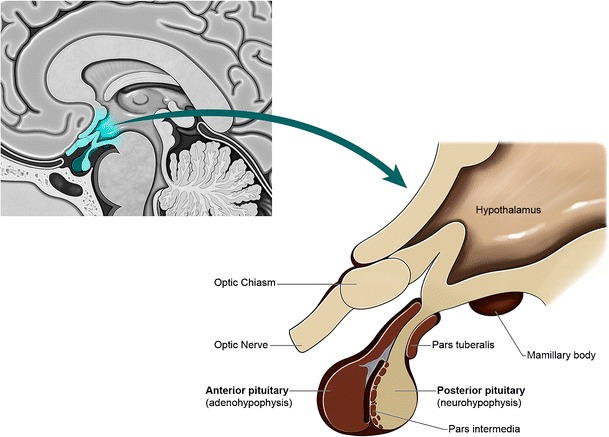
Fig. 1
Fig. 1
Normal pituitary anatomy
Fig. 2
Fig. 2
Normal development of the pituitary gland
Fig. 3
Fig. 3
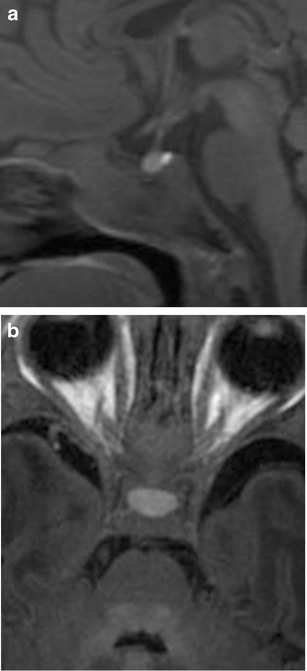
Normal physiological T1 sagittal (a) and axial (b) hyperintensity of the anterior pituitary in a 1-month-old baby
Fig. 4
Fig. 4
Agenesis of the anterior pituitary gland (adenohypophysis) in an infant with hypopituitarism. Sagittal T1-weighted imaging (T1WI) shows absence of the adenohypophisis. The stalk terminates into a bulbous neurohypophysis with high signal in the dorsal portion of the sella
Fig. 5
Fig. 5
Severe hypoplasia of the anterior pituitary gland. Pre-contrast (a) and post-contrast (b) MR images show severe hypoplasia of the anterior pituitary gland which shows only minimal contrast enhancement along the floor of the sella. The ectopic posterior pituitary is located adjacent to the optic chiasm
Fig. 6
Fig. 6
Ectopic posterior pituitary gland. Pre-contrast (a) and post-contrast (b) MR images show a normal anterior pituitary gland with contrast enhancement and an ectopic posterior pituitary located adjacent to the optic chiasm
Fig. 7
Fig. 7
Pituitary duplication. Coronal post-contrast images (a and b) show two pituitary stalks which extend inferiorly into separate duplicated pituitary glands. Sagittal T1WI (c) shows marked thickening of the hypothalamus, referred to as a pseudohamartoma, which has intermediate signal. The pseudohamartoma showed no contrast enhancement (not shown)
Fig. 8
Fig. 8
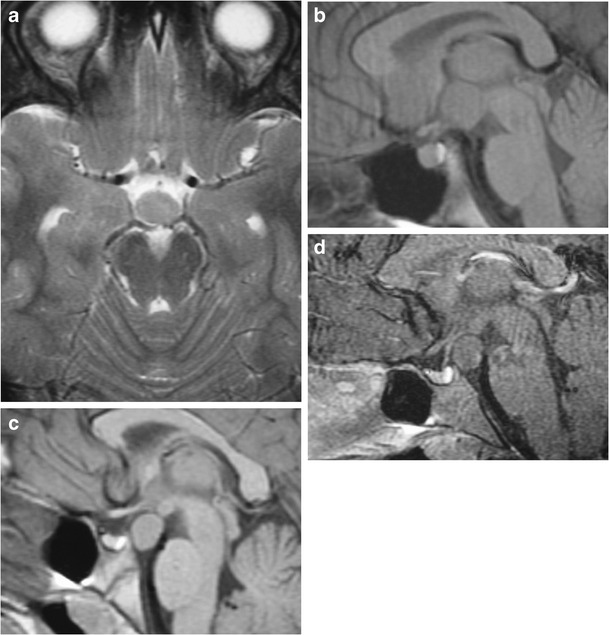
Hypothalamic hamartoma. Axial T2WI (a) and sagittal T1WI (b) shows a sessile type of hypothalamic hamartoma which has intermediate signal similar to grey matter. Pre-contrast (c) and post-contrast (d) sagittal T1WI in another patient shows a pedunculated hypothalamic hamartoma with intermediate signal and lacks contrast enhancement
Fig. 9
Fig. 9
Tuber cinerum hamartoma. Sagittal (a) and coronal (b) T1WI, and coronal post-contrast T1WI (c) show a non-enhancing bulky soft tissue mass in the region of the of the tuber cinerum
Fig. 10
Fig. 10
Persistent craniopharyngeal canal. Axial (a) and sagittal (b) CT shows a markedly enlarged persistent craniopharyngeal canal. Coronal fat-suppressed T1WI shows inferior extension of enhancing pituitary tissue within the abnormally enlarged craniopharyngeal canal (c)
Fig. 11
Fig. 11
Rathke’s cleft cyst. Sagittal T1WI (a) shows a lesion in the central portion of the pituitary gland which has high signal. Post-contrast sagittal fat-suppressed T1WI (b) shows lack of enhancement of the Rathke cleft cyst. The cyst has intermediate signal on T2WI (c) secondary to slightly elevated protein content
Fig. 12
Fig. 12
Pars intermedia cyst. Sagittal T1WI (a) and axial T2WI (b) shows a small cyst between the anterior and posterior pituitary which lacks contrast enhancement on axial fat-suppressed T1WI (c)
Fig. 13
Fig. 13
Cephalocele in a 17-year-old girl. Coronal T2WI (a) and sagittal T1WI (b) shows a meningocele extending inferiorly into the nasopharynx through an osseous defect in the sphenoid bone posterior to the pituitary gland
Fig. 14
Fig. 14
Epidermoid. Sagittal T1WI (a) shows an extra-axial lesion along the endocranial surface which has heterogeneous mostly low-intermdiate signal, and on T2WI has high signal (b). Diffusion-weighted imaging (DWI) (c) shows restricted diffusion
Fig. 15
Fig. 15
Dermoid. Sagittal (a) and axial (b) T1WI shows an extra-axial lesion in the suprasellar cistern which has high signal. Multiple small foci with high signal are seen in the sulci and within the left lateral ventricle representing ruptured dermoid contents in the leptomeninges
Fig. 16
Fig. 16
Arachnoid cyst. Sagittal T1WI (a) and coronal T2WI (b) show a well defined cystic mass with low T1 and high T2 signal intensity with sellar and suprasellar components
Fig. 17
Fig. 17
Lipoma. Sagittal T1WI (a) shows a lipoma with high signal along the inferior surface of the hypothalamus. The signal on the lipoma is nulled on coronal fat-suppressed T2WI (b)
Fig. 18
Fig. 18
Empty sella. Sagittal post-contrast T1WI with fat-suppression show an enlarged sella mostly filled with CSF. The enhancing flattened pituitary tissue is located along the floor of the sella
Fig. 19
Fig. 19
Pituitary adenomas. Sagittal post-contrast fat-suppressed T1WI (a) shows an heterogenously enhancing pituitary macroadenoma which contains a non-enhancing portion with high signal on T2WI (b). secondary to cystic degeneration. Coronal post-contrast fat-suppressed T1WI (c) shows a pituitary microadenoma which shows less early contrast enhancement than the normal pituitary tissue
Fig. 20
Fig. 20
Craniopharyngioma. Sagittal T1WI (a) shows a lobulated lesion filling the suprasellar cistern which contains zones of low, intermediate and high signal. Sagittal post-contrast T1WI (b) shows the lesion to have heterogeneous contrast enhancement
Fig. 21
Fig. 21
Glioma in a 2-year-old girl with neurofibromatosis type 1. Sagittal (a) and axial (b) post contrast T1WI shows a partially enhancing lesion enlarging the optic chiasm and proximal optic nerves
Fig. 22
Fig. 22
Pilomyxoid astrocytoma in a 4-month-old baby girl. Sagittal T1WI (a) shows a large hypothalamic lesion with intermediate signal which extends superiorly into and filling the third ventricle, and inferiorly into the suparsellar cistern. The tumour has mostly high signal on axial T2WI (b)
Fig. 23
Fig. 23
Germ cell tumours in two different children. Post-contrast T1WI (a) shows a large enhancing lesion in the suprasellar cistern extending superiorly into the third ventricle and posteriorly into the prepontine cistern. Sagittal post-contrast T1WI (b) in another child shows enhancing, disseminated germ-cell tumour in the suprasellar cistern, third and lateral ventricles, with involvement of the corpus callosum and optic chiasm
Fig. 24
Fig. 24
Teratoma. Sagittal T1WI (a) and axial T2WI (b) show a lesion at the undersurface of the hypothalamus which has mixed low, intermediate and high signal. Axial CT image (c) shows the lesion to contain zones of calcification, fat and intermediate soft-tissue attenuation
Fig. 25
Fig. 25
A 4-month-old baby boy with tuberculous meningitis. Axial (a, b) and coronal (c) post-contrast T1WI shows prominent extra-axial contrast-enhancement in the basal meninges, surrounding the brainstem, cerebellar sulci and Sylvian fissures. The leptomeningeal infection invades the left temporal lobe
Fig. 26
Fig. 26
Enthesioneuroblastoma. Sagittal T1WI (a) and post-contrast T1WI (b) show a destructive mass lesion involving the sphenoid bone which invades the sphenoid sinus and sella. The tumour shows prominent, mildly heterogeneous contrast enhancement
Fig. 27
Fig. 27
Fibrous dysplasia in a 5-year-old girl with McCune Albright syndrome. Axial CT (a) shows multiple expansile lesions involving the skull which have a “ground glass” appearance representing sites of polyostotic fibrous dysplasia. Sagittal T1WI shows expansion of the clivus which has diffuse low signal (b) with corresponding diffuse enhancement on sagittal post-contrast fat-suppressed T1WI (c)
Fig. 28
Fig. 28
Langerhans cell histiocytosis in a 6-year-old girl with headaches and diabetes insipidus. Coronal T1WI shows a lesion involving the upper pituitary gland and stalk which has intermediate signal (a). The lesion shows prominent enhancement on post-contrast coronal T1WI (b)
Fig. 29
Fig. 29
Lymphocytic hypophysitis in a 16-year-old boy who presented with frequent urination, which started when he was 9. Coronal T1WI (a) shows thickening of the pituitary stalk which has intermdiate signal. Post-contrast axial (b) and sagittal (c) T1WI shows thickening of the pituitary stalk with homogeneous enhancement
Fig. 30
Fig. 30
Leptomeningeal spread of lymphoma. Sagittal post contrast T1WI demonstrates diffuse intracranial and spinal leptomeningeal enhancement in a 22-month-old infant boy with lymphoma including the sella and parasellar subarachnoid space
Fig. 31
Fig. 31
Cavernous malformation: coronal T2WI (a) and axial gradient echo (GRE) (b) images in a 5-year-old girl show a large suprasellar lesion with mixed low, intermediate and high signal intensity with a thin rim of low signal on T2WI and foci of low T2* signal from susceptibility effects of blood products on GRE

References

    1. Delman BN. Imaging of pediatric pituitary abnormalities. Endocrinol Metab Clin N Am. 2009;38:673–698. doi: 10.1016/j.ecl.2009.09.001. - DOI - PubMed
    1. Dietrich RB, Lis LE, Greensite FS, Pitt D. Normal MR appearance of the pituitary gland in the first 2 years of life. AJNR Am J Neuroradiol. 1995;16:1413–1419. - PMC - PubMed
    1. Fujisawa I, Asato R, Nishimura K et al (1987) Anterior and posterior lobes of the pituitary gland: assessment by 1.5 T MR imaging. J Comput Assist Tomogr 11:214–220 - PubMed
    1. Nishimura K, Fujisawa I, Togashi K et al (1986) Posterior lobe of the pituitary: identification by lack of chemical shift artifact in MR imaging. J Comput Assist Tomogr 10:899–902 - PubMed
    1. Fujisawa I, Asato R, Kawata M et al (1989) Hyperintense signal of the posterior pituitary on T1-weighted MR images: an experimental study. J Comput Assist Tomogr 13:371–377 - PubMed

LinkOut - more resources