. 2015 Mar 19;57(6):1133-1141.
doi: 10.1016/j.molcel.2015.02.012.

TopBP1 interacts with BLM to maintain genome stability but is dispensable for preventing BLM degradation

Affiliations

TopBP1 interacts with BLM to maintain genome stability but is dispensable for preventing BLM degradation

Andrew N Blackford et al. Mol Cell. .

Abstract

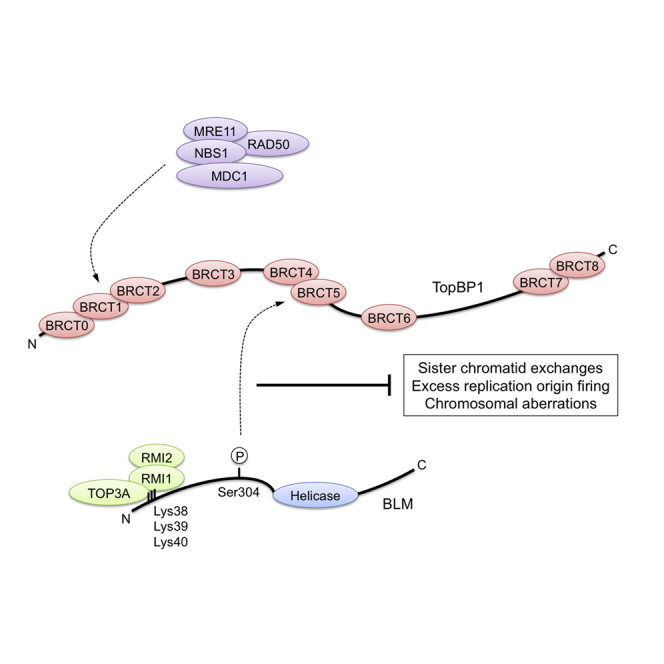
The Bloom syndrome helicase BLM and topoisomerase-IIβ-binding protein 1 (TopBP1) are key regulators of genome stability. It was recently proposed that BLM phosphorylation on Ser338 mediates its interaction with TopBP1, to protect BLM from ubiquitylation and degradation (Wang et al., 2013). Here, we show that the BLM-TopBP1 interaction does not involve Ser338 but instead requires BLM phosphorylation on Ser304. Furthermore, we establish that disrupting this interaction does not markedly affect BLM stability. However, BLM-TopBP1 binding is important for maintaining genome integrity, because in its absence cells display increased sister chromatid exchanges, replication origin firing and chromosomal aberrations. Therefore, the BLM-TopBP1 interaction maintains genome stability not by controlling BLM protein levels, but via another as-yet undetermined mechanism. Finally, we identify critical residues that mediate interactions between TopBP1 and MDC1, and between BLM and TOP3A/RMI1/RMI2. Taken together, our findings provide molecular insights into a key tumor suppressor and genome stability network.


Figures

None
Graphical abstract
Figure 1
Figure 1
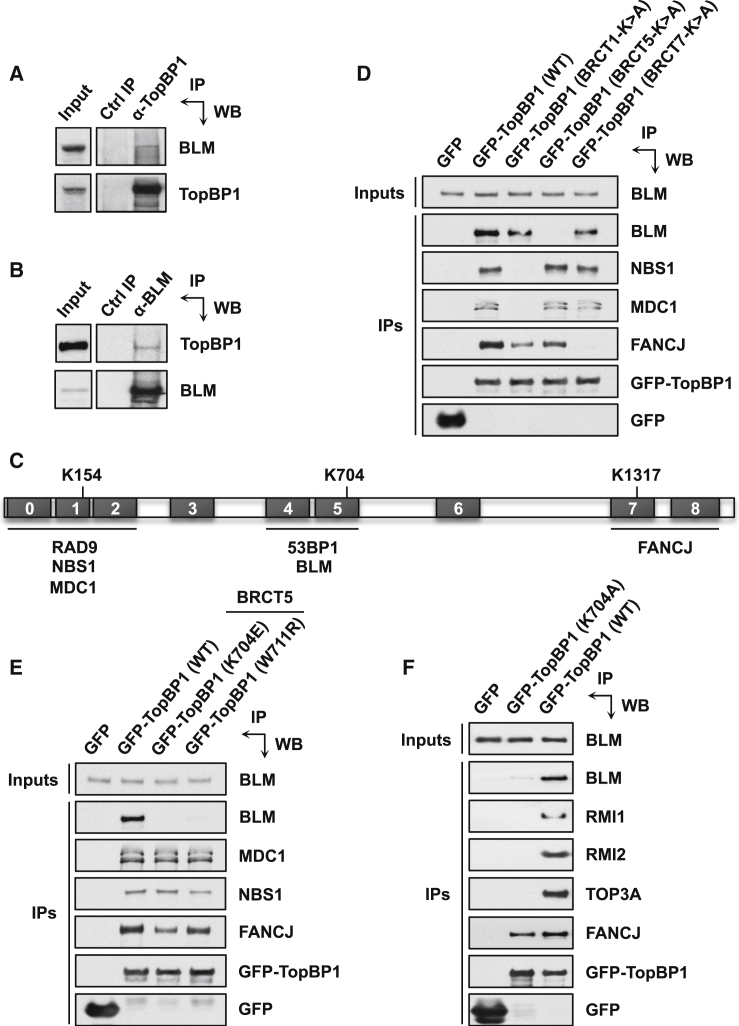
BLM Interacts with TopBP1 via BRCT5 (A) TopBP1 immunoprecipitates from 293FT cell extracts contain BLM. (B) BLM immunoprecipitates from 293FT cell extracts contain TopBP1. (C) Schematic showing TopBP1 BRCT domain layout. Black numbered boxes represent BRCT domains. K154, K704, and K1317 are the key phosphopeptide binding lysines in BRCT domains 1, 5, and 7, respectively. The names of known TopBP1-binding partners are shown below the BRCT domains they interact with. (D) Effect of point mutations in TopBP1 BRCT domains 1, 5, and 7 on its binding to NBS1, MDC1, FANCJ, and BLM compared to wild-type (WT). Pull-downs were carried out from 293FT cells transiently transfected with the indicated plasmids 24 hr later. (E) Effect of two different point mutations in TopBP1-BRCT5 on binding to MDC1 and BLM. NBS1 and FANCJ are positive controls as they bind to TopBP1 BRCT domains 1 and 7, respectively. (F) Mutation of TopBP1-BRCT5 abrogates binding to Bloom syndrome complex members. See also Figure S1.
Figure 2
Figure 2
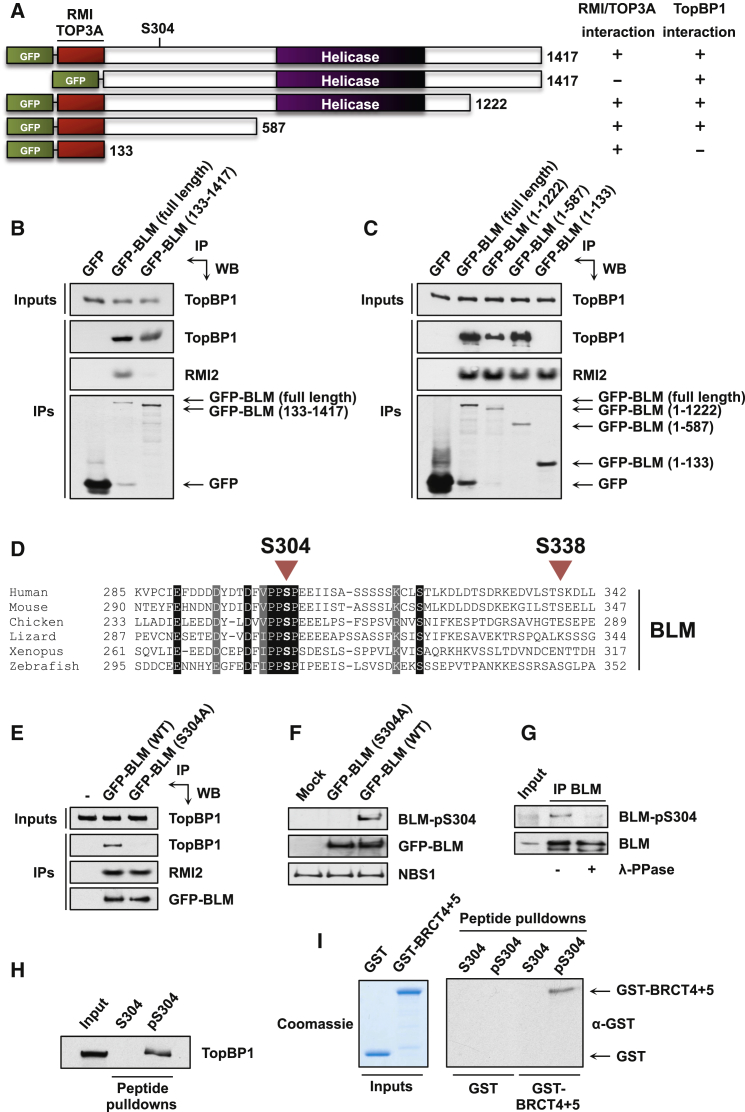
BLM Ser304 Phosphorylation Mediates Direct Binding to TopBP1-BRCT5 (A) Schematic of the GFP-tagged BLM constructs used in this study. (B) The N-terminal 132 residues of BLM are required for binding to TOP3A and RMI2 but not TopBP1. Pull-downs were carried out from 293FT cells transiently transfected with the indicated plasmids. (C) The binding site for TopBP1 is located within residues 133–587 of BLM. RMI2 is a positive control for binding to the N terminus of BLM. (D) Sequence alignment showing the evolutionary conservation of the BLM region containing Ser304 and Ser338. (E) Mutation of Ser304 specifically abrogates binding to TopBP1. Pull-downs were carried out from U2OS cells stably expressing the indicated proteins. (F) The BLM-pS304 antibody does not recognize BLM-S304A. 293FT cells were transiently transfected with the indicated plasmids. NBS1 is a loading control. (G) Ser304 is phosphorylated in vivo. BLM immunoprecipitates from U2OS cells were mock treated or treated with lambda phosphatase (λ-PPase). (H) BLM residues 297–311 are sufficient for interaction with TopBP1 when Ser304 is phosphorylated. Streptavidin beads were incubated with biotinylated peptides before addition to HeLa nuclear extracts for pull-downs. (I) TopBP1 BRCT domains 4 and 5 interact directly with BLM peptides phosphorylated on Ser304. Streptavidin beads were incubated with biotinylated peptides before mixing with GST-tagged BRCT domains 4 and 5 or GST alone. See also Figure S2.
Figure 3
Figure 3
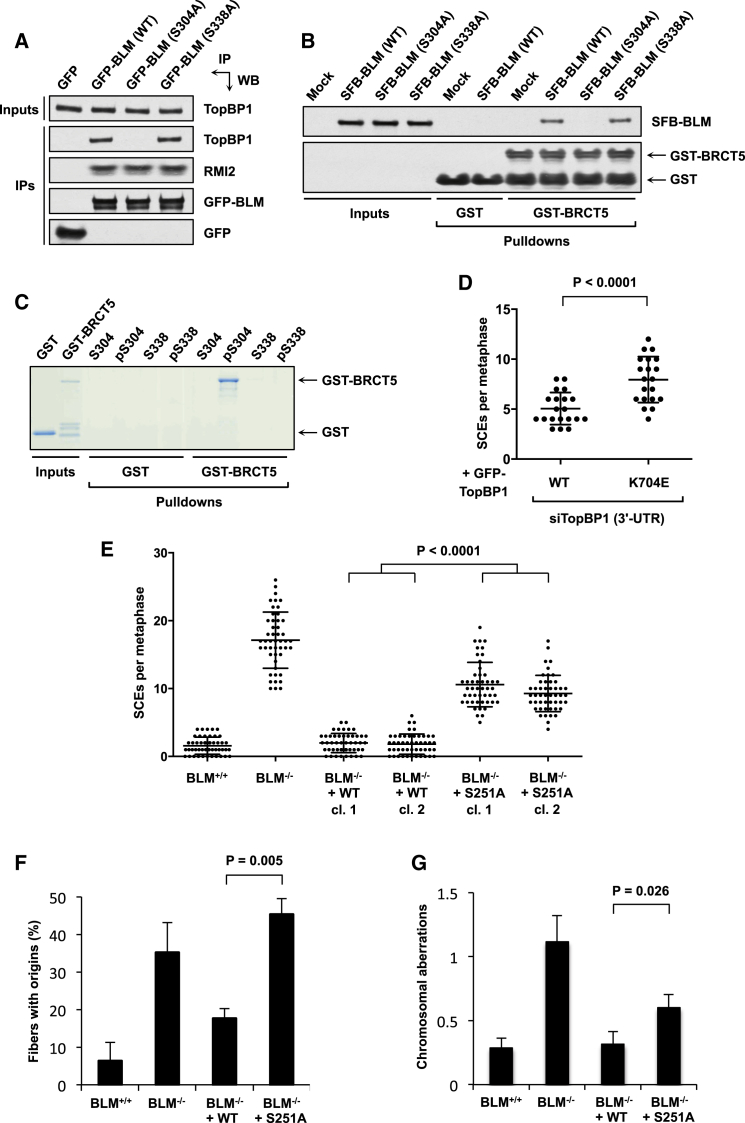
The BLM-TopBP1 Interaction Promotes Genome Stability and Requires Ser304 but Not Ser338 of BLM (A) Mutation of BLM Ser338 to alanine does not affect its interaction with endogenous TopBP1. Pull-downs were carried out from 293FT cells transiently transfected with the indicated plasmids. (B) Mutation of BLM Ser338 to alanine does not affect its interaction with recombinant GST-tagged TopBP1-BRCT5. Pull-downs were carried out using GST proteins bound to glutathione beads incubated with lysates from 293FT cells transiently transfected with the indicated plasmids. (C) TopBP1-BRCT5 interacts directly with BLM peptides encompassing phosphorylated Ser304 but not Ser338. Streptavidin beads were incubated with biotinylated peptides before mixing with GST-tagged BRCT5 or GST alone. (D) Analysis of SCEs in U2OS cells depleted of endogenous TopBP1 with siRNAs targeting the 3′ UTR and expressing wild-type or K704E TopBP1. A minimum of 20 metaphases was scored per experiment. Significance was determined using the Mann-Whitney U test. (E) Analysis of SCEs in DT40 cells. A minimum of 50 metaphases was scored per experiment. Significance was determined using the Mann-Whitney U test. “cl.,” clone. (F) DNA fiber analyses to measure origin firing. DT40 cells were treated with 2.5 μM camptothecin for 90 min in the presence of IdU, washed, and then released into drug-free medium containing CldU for 15 min. A minimum of 200 fibers were scored per experiment. Mean values of three independent experiments are shown ± SEM. Significance was determined using Student’s two-tailed t test. (G) Analysis of chromosomal aberrations. Mitotic spreads were prepared from DT40 cells treated with 2 μM aphidicolin for 12 hr. A minimum of 35 metaphases was scored per experiment. Significance was determined using Mann-Whitney U test. See also Figure S3.
Figure 4
Figure 4
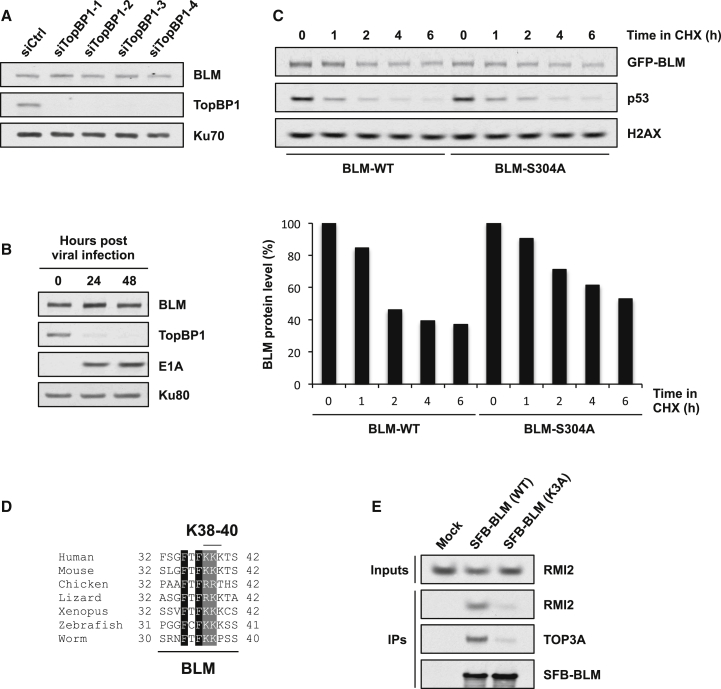
TopBP1 Does Not Protect BLM from Degradation (A) TopBP1 depletion does not affect BLM levels. HeLa cells were transfected with the indicated siRNAs and harvested for western blotting 3 days later. (B) Adenovirus-induced proteasomal degradation of TopBP1 does not affect BLM levels. U2OS cells were infected with the hr703 adenovirus and harvested at the indicated times for western blotting. E1A is a control for adenovirus infection. (C) BLM-TopBP1 interaction does not maintain BLM stability. Cycloheximide (CHX) was added to U2OS cells stably expressing GFP-BLM proteins for the indicated times before harvesting for western blotting. The graph shows the level of BLM at the time points indicated as a percentage of untreated (0 h). Quantification was performed using ImageJ. (D) Sequence alignment showing the evolutionary conservation of the BLM region containing Lys38, Lys39, and Lys40. (E) Mutation of BLM Lys38, Lys39, and Lys40 to alanine (K3A) disrupts binding to TOP3A and RMI2. 293FT cells were transfected with the indicated plasmids and harvested for pull-downs 24 hr later. See also Figure S4.

Comment in

References

    1. Bizard A.H., Hickson I.D. The dissolution of double Holliday junctions. Cold Spring Harb. Perspect. Biol. 2014;6:a016477. - PMC - PubMed
    1. Blackford A.N., Bruton R.K., Dirlik O., Stewart G.S., Taylor A.M.R., Dobner T., Grand R.J.A., Turnell A.S. A role for E1B-AP5 in ATR signaling pathways during adenovirus infection. J. Virol. 2008;82:7640–7652. - PMC - PubMed
    1. Blackford A.N., Patel R.N., Forrester N.A., Theil K., Groitl P., Stewart G.S., Taylor A.M.R., Morgan I.M., Dobner T., Grand R.J.A., Turnell A.S. Adenovirus 12 E4orf6 inhibits ATR activation by promoting TOPBP1 degradation. Proc. Natl. Acad. Sci. USA. 2010;107:12251–12256. - PMC - PubMed
    1. Blackford A.N., Schwab R.A., Nieminuszczy J., Deans A.J., West S.C., Niedzwiedz W. The DNA translocase activity of FANCM protects stalled replication forks. Hum. Mol. Genet. 2012;21:2005–2016. - PubMed
    1. Cescutti R., Negrini S., Kohzaki M., Halazonetis T.D. TopBP1 functions with 53BP1 in the G1 DNA damage checkpoint. EMBO J. 2010;29:3723–3732. - PMC - PubMed

Publication types

MeSH terms