


Serum Fractalkine (CX3CL1) and Cardiovascular Outcomes and Diabetes: Findings From the Chronic Renal Insufficiency Cohort (CRIC) Study
- PMID: 25795074
- PMCID: PMC4516570
- DOI: 10.1053/j.ajkd.2015.01.021
Serum Fractalkine (CX3CL1) and Cardiovascular Outcomes and Diabetes: Findings From the Chronic Renal Insufficiency Cohort (CRIC) Study
Abstract
Background: Cardiometabolic disease is a major cause of morbidity and mortality in persons with chronic kidney disease (CKD). Fractalkine (CX3CL1) is a potential mediator of both atherosclerosis and metabolic disease. Studies of the relationship of CX3CL1 with risk of cardiovascular disease (CVD) events and metabolic traits are lacking, particularly in the high-risk setting of CKD.
Study design: Cross-sectional and longitudinal observational analysis.
Setting & participants: Adults with CKD from 7 US sites participating in the Chronic Renal Insufficiency Cohort (CRIC) Study.
Predictor: Quartiles of plasma CX3CL1 levels at baseline.
Outcomes: Baseline estimated glomerular filtration rate from a creatinine and cystatin C-based equation, prevalent and incident CVD, diabetes, metabolic syndrome and its criteria, homeostatic model assessment of insulin resistance, hemoglobin A1c level, myocardial infarction, all-cause mortality, and the composite outcome of myocardial infarction/all-cause mortality.
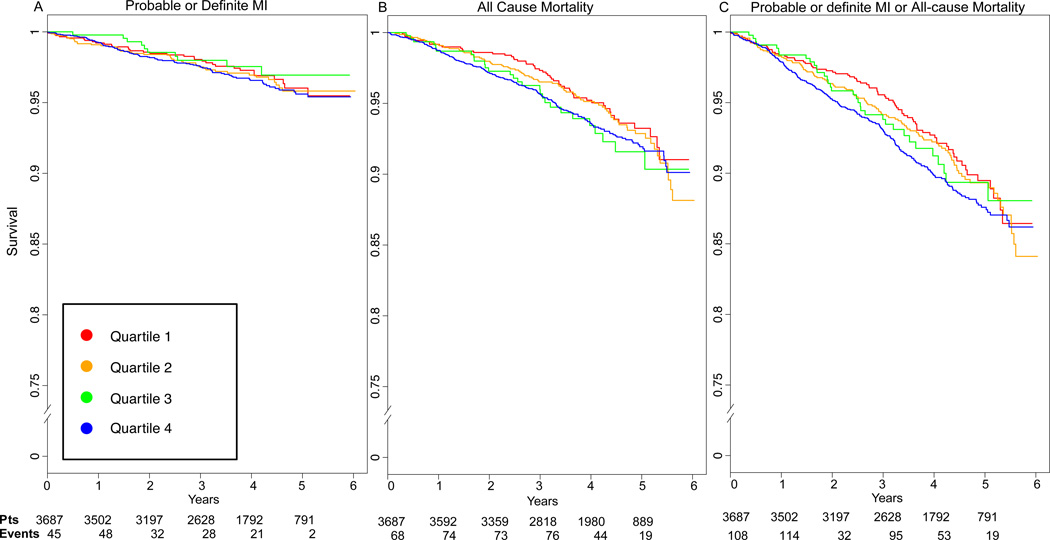
Results: Among 3,687 participants, baseline CX3CL1 levels were associated positively with several CVD risk factors and metabolic traits, lower estimated glomerular filtration rate, and higher levels of inflammatory cytokines, as well as prevalent CVD (OR, 1.09; 95% CI, 1.01-1.19; P=0.03). Higher CX3CL1 level also was associated with prevalent diabetes (OR, 1.26; 95% CI, 1.16-1.38; P<0.001) in adjusted models. During a mean follow-up of 6 years, there were 352 deaths, 176 myocardial infarctions, and 484 composite outcomes. In fully adjusted models, 1-SD higher CX3CL1 level increased the hazard for all-cause mortality (1.11; 95% CI, 1.00-1.22; P=0.02) and the composite outcome (1.09; 95% CI, 1.00-1.19; P=0.04).
Limitations: Study design did not allow evaluation of changes over time, correlation with progression of phenotypes, or determination of causality of effect.
Conclusions: Circulating CX3CL1 level may contribute to both atherosclerotic CVD and diabetes in a CKD cohort. Further studies are required to establish mechanisms through which CX3CL1 affects the pathogenesis of atherosclerosis and diabetes.
Keywords: Cardiometabolic disease; Chronic Renal Insufficiency Cohort; atherosclerosis; cardiovascular disease (CVD); chronic kidney disease (CKD); diabetes; fractalkine (CX3CL1); metabolic syndrome.
Copyright © 2015 National Kidney Foundation, Inc. All rights reserved.
Figures
Comment in
-
In Reply to 'Serum Fractalkines and Cardiovascular Outcomes in the CRIC Study Cohort'.Am J Kidney Dis. 2016 Feb;67(2):342. doi: 10.1053/j.ajkd.2015.10.028. Am J Kidney Dis. 2016. PMID: 26802331 No abstract available.
-
Serum Fractalkines and Cardiovascular Outcomes in the CRIC Study Cohort.Am J Kidney Dis. 2016 Feb;67(2):342. doi: 10.1053/j.ajkd.2015.05.027. Am J Kidney Dis. 2016. PMID: 26802332 No abstract available.
References
-
- Sarnak MJ, Levey AS, Schoolwerth AC, et al. Kidney disease as a risk factor for development of cardiovascular disease: a statement from the American Heart Association Councils on Kidney in Cardiovascular Disease, High Blood Pressure Research, Clinical Cardiology, and Epidemiology and Prevention. Circulation. 2003 Oct 28;108(17):2154–2169. - PubMed
-
- White GE, Greaves DR. Fractalkine: a survivor's guide: chemokines as antiapoptotic mediators. Arteriosclerosis, thrombosis, and vascular biology. 2012 Mar;32(3):589–594. - PubMed
-
- Chapman GA, Moores KE, Gohil J, et al. The role of fractalkine in the recruitment of monocytes to the endothelium. European journal of pharmacology. 2000 Mar 31;392(3):189–195. - PubMed
Publication types
MeSH terms
Substances
Grants and funding
- R01-DK090505/DK/NIDDK NIH HHS/United States
- R01 DK071224/DK/NIDDK NIH HHS/United States
- R01 DK139225/DK/NIDDK NIH HHS/United States
- R01 HL113147/HL/NHLBI NIH HHS/United States
- U01DK060980/DK/NIDDK NIH HHS/United States
- U01-HL108636/HL/NHLBI NIH HHS/United States
- U01DK060902/DK/NIDDK NIH HHS/United States
- K24 HL107643/HL/NHLBI NIH HHS/United States
- K23-DK095913/DK/NIDDK NIH HHS/United States
- M01 RR-16500/RR/NCRR NIH HHS/United States
- U01 DK061028/DK/NIDDK NIH HHS/United States
- UL1 TR000433/TR/NCATS NIH HHS/United States
- R01-DK071224/DK/NIDDK NIH HHS/United States
- U01DK060963/DK/NIDDK NIH HHS/United States
- K24 DK002651/DK/NIDDK NIH HHS/United States
- R01 HL107196/HL/NHLBI NIH HHS/United States
- U01 DK060984/DK/NIDDK NIH HHS/United States
- U01 DK061021/DK/NIDDK NIH HHS/United States
- U01DK061022/DK/NIDDK NIH HHS/United States
- K23 DK095913/DK/NIDDK NIH HHS/United States
- UL1 RR-024131/RR/NCRR NIH HHS/United States
- P30 GM103337/GM/NIGMS NIH HHS/United States
- U01 DK060980/DK/NIDDK NIH HHS/United States
- UL1TR000433/TR/NCATS NIH HHS/United States
- U01 DK060963/DK/NIDDK NIH HHS/United States
- UL1 TR-000424/TR/NCATS NIH HHS/United States
- UL1 RR024131/RR/NCRR NIH HHS/United States
- R01-HL107196/HL/NHLBI NIH HHS/United States
- U01 DK061022/DK/NIDDK NIH HHS/United States
- U01DK061021/DK/NIDDK NIH HHS/United States
- ImNIH/Intramural NIH HHS/United States
- P30GM103337/GM/NIGMS NIH HHS/United States
- U01DK060984/DK/NIDDK NIH HHS/United States
- UL1RR029879/RR/NCRR NIH HHS/United States
- U01DK060990/DK/NIDDK NIH HHS/United States
- UL1 TR000003/TR/NCATS NIH HHS/United States
- R01 DK090505/DK/NIDDK NIH HHS/United States
- U01DK061028/DK/NIDDK NIH HHS/United States
- R01-HL113147/HL/NHLBI NIH HHS/United States
- UL1TR000003/TR/NCATS NIH HHS/United States
- UL1 TR000439/TR/NCATS NIH HHS/United States
- U01 HL108636/HL/NHLBI NIH HHS/United States
- K24-DK002651/DK/NIDDK NIH HHS/United States
- UL1 TR000424/TR/NCATS NIH HHS/United States
- M01 RR016500/RR/NCRR NIH HHS/United States
- K24-HL107643/HL/NHLBI NIH HHS/United States
- U01 DK060902/DK/NIDDK NIH HHS/United States
- U01 DK060990/DK/NIDDK NIH HHS/United States
- UL1TR000439/TR/NCATS NIH HHS/United States
- HL-Z0000/HL/NHLBI NIH HHS/United States
- UL1 RR029879/RR/NCRR NIH HHS/United States
LinkOut - more resources
Full Text Sources
Other Literature Sources
Medical
Research Materials
Miscellaneous
