


Determination of risk factors for drug-related problems: a multidisciplinary triangulation process
- PMID: 25795686
- PMCID: PMC4368979
- DOI: 10.1136/bmjopen-2014-006376
Determination of risk factors for drug-related problems: a multidisciplinary triangulation process
Abstract
Introduction and objectives: Drug-related problems (DRPs) constitute a frequent safety issue among hospitalised patients leading to patient harm and increased healthcare costs. Because many DRPs are preventable, the specific risk factors that facilitate their occurrence are of considerable interest. The objective of our study was to assess risk factors for the occurrence of DRPs with the intention to identify patients at risk for DRPs to guide and target preventive measures where they are needed most in patients.
Design: Triangulation process using a mixed methods approach.
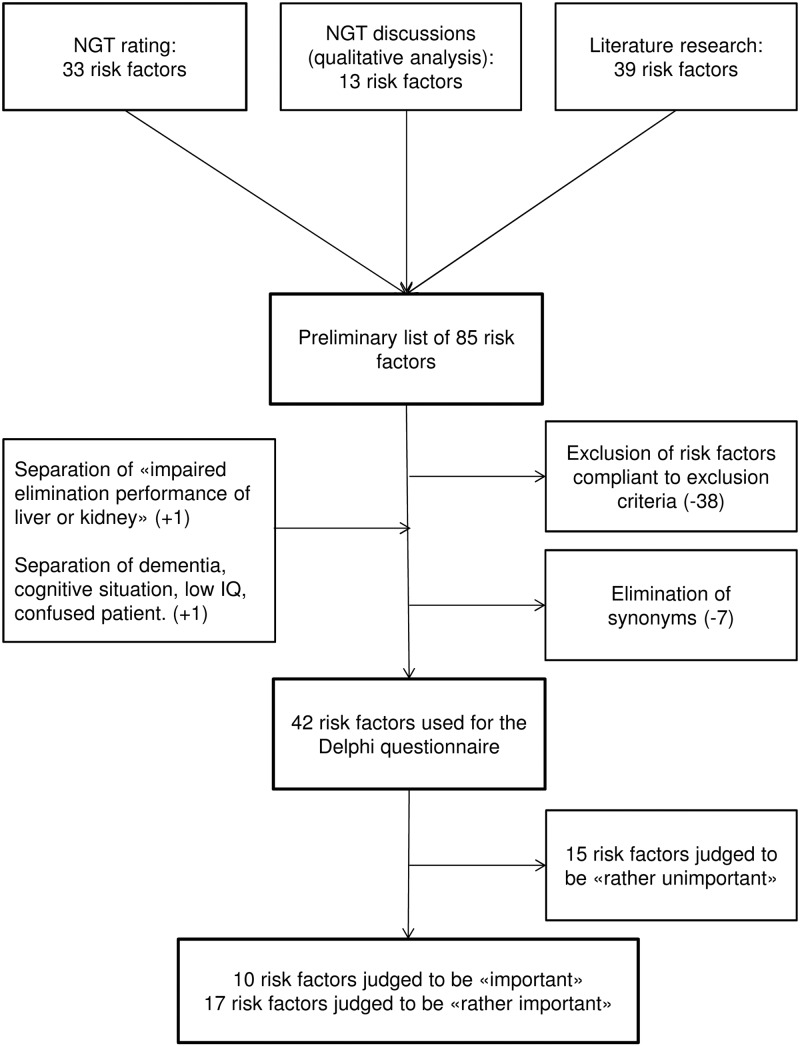
Methods: We conducted an expert panel, using the nominal group technique (NGT) and a qualitative analysis, to gather risk factors for DRPs. The expert panel consisted of two consultant hospital physicians (internal medicine and geriatrics), one emergency physician, one independent general practitioner, one clinical pharmacologist, one clinical pharmacist, one registered nurse, one home care nurse and two independent community pharmacists. The literature was searched for additional risk factors. Gathered factors from the literature search and the NGT were assembled and validated in a two-round Delphi questionnaire.
Results: The NGT resulted in the identification of 33 items with 13 additional risk factors from the qualitative analysis of the discussion. The literature search delivered another 39 risk factors. The 85 risk factors were refined to produce 42 statements for the Delphi online questionnaire. Of these, 27 risk factors were judged to be 'important' or 'rather important'.
Conclusions: The gathered risk factors may help to characterise and identify patients at risk for DRPs and may enable clinical pharmacists to guide and target preventive measures in order to limit the occurrence of DRPs. As a further step, these risk factors will serve as the basis for a screening tool to identify patients at risk for DRPs.
Published by the BMJ Publishing Group Limited. For permission to use (where not already granted under a licence) please go to http://group.bmj.com/group/rights-licensing/permissions.
Figures
References
-
- Pharmaceutical Care Network Europe (PCNE). The definition of drug-related problems 2009. http://www.pcne.org/sig/drp/drug-related-problems.php (accessed 22 Jun 2013).
-
- National Coordinating Council for Medication Error Reporting and Prevention (NCC MERP) About Medication Errors 2013. http://www.nccmerp.org/aboutMedErrors.html (accessed 22 Jun 2013).
-
- No authors listed]. International drug monitoring: the role of national centres. Report of a WHO meeting. World Health Organ Tech Rep Ser 1972;498:1–25. - PubMed
Publication types
MeSH terms
LinkOut - more resources
Full Text Sources
Other Literature Sources
Medical
Research Materials
