


Adolescent heavy drinkers' amplified brain responses to alcohol cues decrease over one month of abstinence
- PMID: 25796007
- PMCID: PMC4395544
- DOI: 10.1016/j.addbeh.2015.03.001
Adolescent heavy drinkers' amplified brain responses to alcohol cues decrease over one month of abstinence
Abstract
Introduction: Heavy drinking during adolescence is associated with increased reactivity to alcohol related stimuli and to differential neural development. Alcohol cue reactivity has been widely studied among adults with alcohol use disorders, but little is known about the neural substrates of cue reactivity in adolescent drinkers. The current study aimed to identify changes in blood-oxygen level dependent (BOLD) signal during a cue reactivity task pre- and post-monitored abstinence from alcohol.
Method: Demographically matched adolescents (16.0-18.9 years, 54% female) with histories of heavy episodic drinking (HD; n=22) and light or non-drinking control teens (CON; n=16) were recruited to participate in a month-long study. All participants completed a functional Magnetic Resonance Imaging (fMRI) scan with an alcohol cue reactivity task and substance use assessments at baseline and after 28 days of monitored abstinence from alcohol and drugs (i.e., urine toxicology testing every 48-72 h). Repeated-measure analysis of variance (ANOVA) examined main effects of group, time, and group×time interactions on BOLD signal response in regions of interest defined by functional differences at baseline.
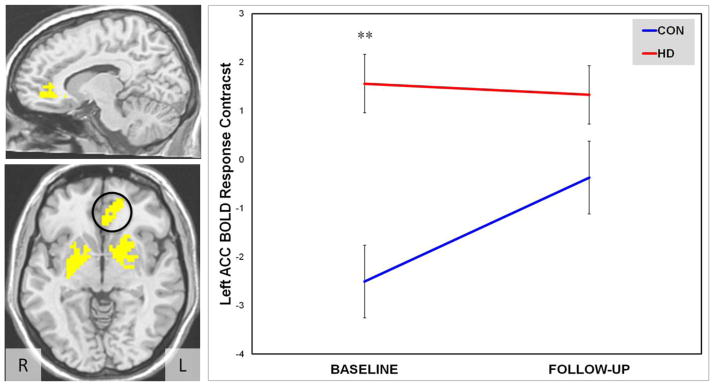
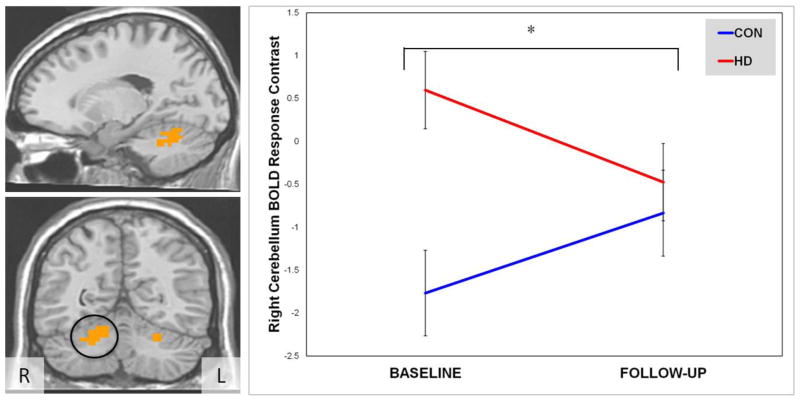
Results: The HD group exhibited greater (p<.01) BOLD activation than CON to alcohol cues relative to neutral cues in all regions of interest (ROIs; bilateral striatum/globus pallidus, left anterior cingulate, bilateral cerebellum, and parahippocampal gyrus extending to the thalamus/substantia nigra) across time points. Group×time effects showed that HD exhibited greater BOLD activation to alcohol cues than CON at baseline in left anterior cingulate cortex and in the right cerebellar region, but these decreased to non-significance after one month of monitored abstinence.
Conclusions: In all ROIs examined, HD exhibited greater BOLD response than CON to alcohol relative to neutral beverage picture cues at baseline, indicating heightened cue reactivity to alcohol cues in heavy drinking adolescents prior to the onset of any alcohol use diagnosis. Across the majority of these brain regions, differences in BOLD response were no longer apparent following a month of abstinence, suggesting a decrease in alcohol cue reactivity among adolescent non-dependent heavy drinkers as a consequence of abstaining from alcohol. These results highlight the malleability of adolescent brain function despite no formal intervention targeting cue reactivity. Increased understanding of the neural underpinnings of cue reactivity could have implications for prevention and intervention strategies in adolescent heavy alcohol users.
Keywords: Adolescence; Alcohol; Anterior cingulate cortex; Cerebellum; Cue reactivity; Heavy episodic drinking.
Copyright © 2015 Elsevier Ltd. All rights reserved.
Conflict of interest statement
None.
Figures
References
-
- Beatty WW, Hames KA, Blanco CR, Nixon SJ, Tivis LJ. Visuospatial perception, construction and memory in alcoholism. Journal of Studies on Alcohol. 1996;57(2):136–143. - PubMed
Publication types
MeSH terms
Grants and funding
LinkOut - more resources
Full Text Sources
Other Literature Sources
