Comparative Study
. 2015 May;76(5):329-338.
doi: 10.1016/j.humimm.2015.03.007. Epub 2015 Mar 20.

Preterm cord blood CD4⁺ T cells exhibit increased IL-6 production in chorioamnionitis and decreased CD4⁺ T cells in bronchopulmonary dysplasia

Affiliations
Comparative Study

Preterm cord blood CD4⁺ T cells exhibit increased IL-6 production in chorioamnionitis and decreased CD4⁺ T cells in bronchopulmonary dysplasia

Ravi Misra et al. Hum Immunol. 2015 May.

Abstract

Background: Chorioamnionitis (CA) is associated with premature delivery and bronchopulmonary dysplasia (BPD). We hypothesize that preterm infants exposed to CA have reduced suppressive regulatory T cells (Treg) and increased non-regulatory T cell pro-inflammatory cytokines, increasing risk for BPD.

Objective: To evaluate cord blood CD4(+) T cell regulatory phenotype and pro-inflammatory cytokine production in CA and BPD groups.

Study design: Cord blood mononuclear cells from infants (GA ⩽32 weeks), with or without placental histological evidence of CA (hChorio), were analyzed by flow cytometry. Clinical information was collected by retrospective chart review. Numbers of putative Treg (CD4(+)FoxP3(+)CD25(+)CD127Dim), CD4(+) non-Tregs, and CD4(+) T cell intracellular cytokine content following in vitro stimulation were compared with CA status and oxygen requirement at 36weeks postmenstrual age.

Result: Absolute Treg numbers were not different in CA and non-CA exposed samples. However, the infants who developed BPD had a significant decrease in Treg and non-regulatory T cell numbers. Greater IL-6 production was observed in hCA group.

Conclusion: A pro-inflammatory CD4(+) T cell status is noted in CA and BPD but the later disease is also associated with decrease in Tregs, suggesting that the development of BPD is marked by distinct inflammatory changes from those of CA exposed infants.

Keywords: Bronchopulmonary dysplasia; CD4(+) T cells; Chorioamnionitis; Cord blood mononuclear cell; IL-6.


Figures

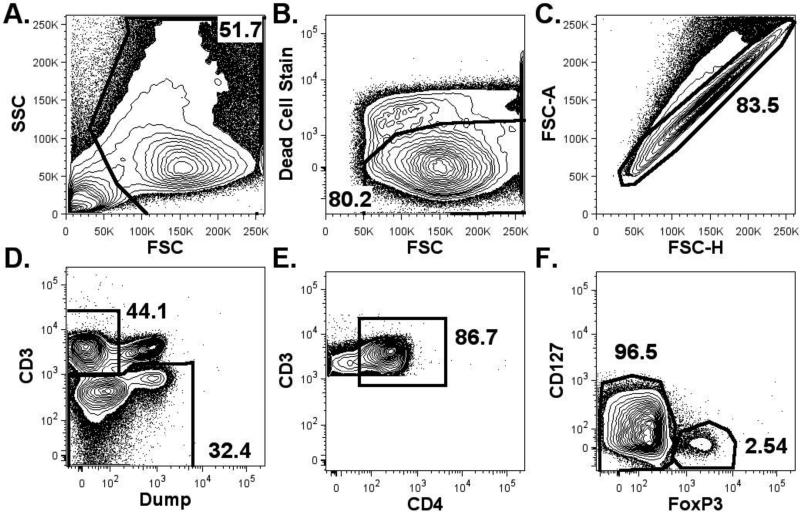
Figure 1
Figure 1. Representative Gating Scheme to Identify Regulatory and Non-regulatory CD4+ T Cells by Flow Cytometry
First, cellular debris was excluded by examining side scatter (SSC) and forward scatter (FCS) in order to identify the cell population (A; 51.7%). Next, a gate was placed on viable cells (B; retained 80.2%). A gate was then placed to include only cells that were not aggregated (C; retained 83.5%). A gate was then placed on the CD3pos&/dump negative cells (D; 44.1%) in order to identify non-CD8+ T cells. The CD4+ T cells were then identified (86.6%) and further sub-classified as either Tregs (FoxP3pos CD127low (2.54%)) or as non-Tregs (FoxP3neg CD127high/int (96.5%) (E). “Dump” = CD19, CD14, CD8.
Figure 2
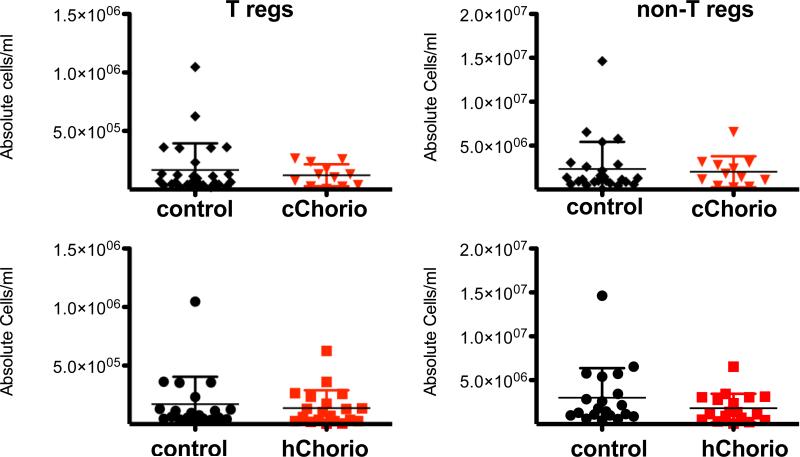
Figure 2. Absolute CD4+ T cell numbers in histological & clinical Chorio are similar to controls
The absolute number of CD4+ T regulatory cells and non-regulatory cells per milliliter of cord blood was calculated for each patient and graphed. Patients were grouped into cChorio (top; inverted red triangles) or hChorio (bottom; red squares) and controls. Means ± SD are shown. P= 0.58 and 0.36 for Tregs in hChorio and cChorio versus controls, respectively. P= 0.12 and 0.48 for non-Tregs in hChorio and cChorio versus controls, respectively.
Figure 3
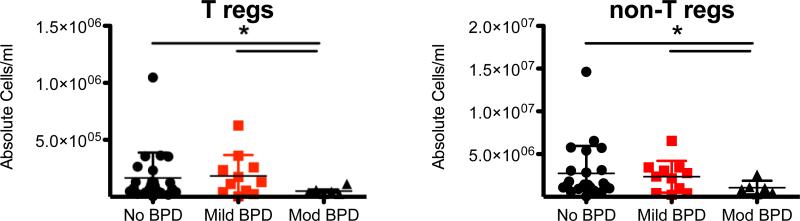
Figure 3. Fewer absolute CD4+ T cells in cord blood of subjects who develop moderate BPD patients versus control and mild BPD
The absolute number of T regulatory cells (left) and non-regulatory CD4+ T cells (right) from each subject cord blood sample was calculated and graphed according to BPD status. (Means ±SD; p- values are derived from GEE estimation; * represents a statistically significant difference. Control vs. Mod BPD (p =0.01), Mild BPD vs. Mod BPD (p = 0.01) and control vs. Mild BPD (0.80) for T regulatory cells. Control vs. Mod BPD (p =0.02), Mild BPD vs. Mod BPD (p = 0.04) and control vs. Mild BPD (0.64) for non-regulatory T cells.
Figure 4
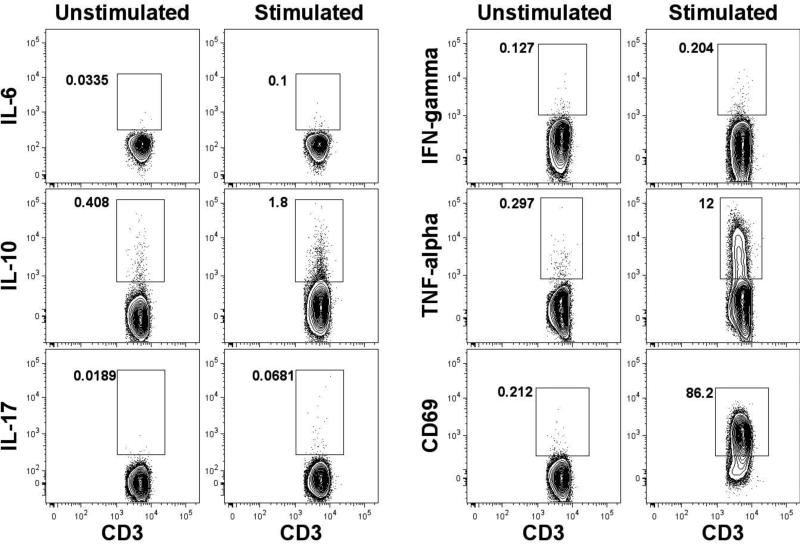
Figure 4. Detection of intracellular cytokine production by non-regulatory T cells
Umbilical cord blood cells were stimulated using PMA/ionomycin or left un-stimulated, both in the presence of monensin. The flow cytometery gating strategy illustrated in Figure 1 was used to identify the non-T regulatory cells (Dead-Dump- CD3+CD4+CD127+FoxP3-). A gate was then placed to identify the frequency of cytokine producing or activated (CD69+) T cells. Representative data are shown from matched stimulated and un-stimulated patient samples.
Figure 5
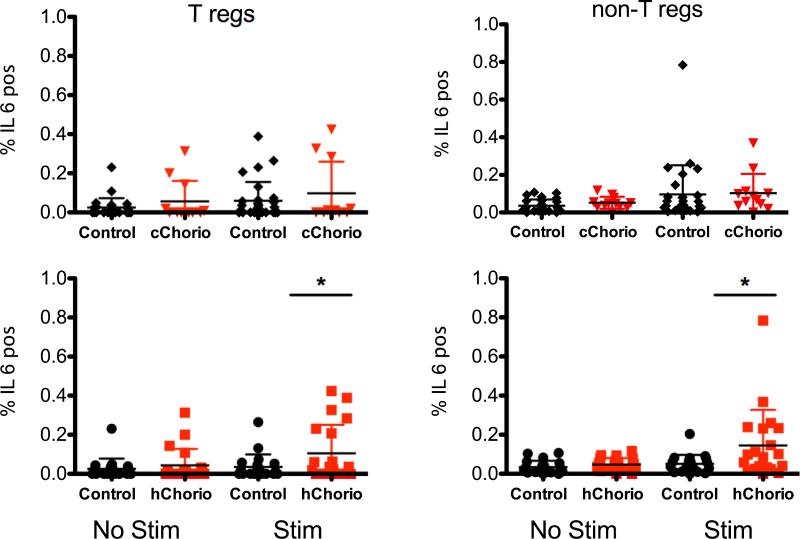
Figure 5. Increased frequency of IL-6 producing CD4+ T cells in hChorio, but not in cChorio subjects
T regulatory cells (T regs) and non regulatory T cells (non-T regs) were identified using flow cytometry and the frequency of IL-6 positive cells was determined from stimulated and unstimulated samples. Data are graphed as mean ± SD. * indicates statistical significance by GEE test (p=0.02).
Figure 6
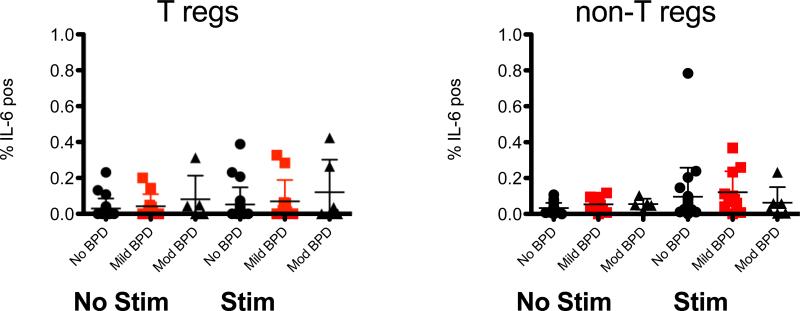
Figure 6. No difference in IL-6 producing CD4+ T cells in BPD subjects
T regulatory cells (T regs) and non regulatory T cells (non-T regs) were identified using flow cytometry and the frequencty of IL-6 positive cells was determined from stimulated and unstimulated samples from subjects with No BPD and those with Mild or Moderate disease. Data are graphed as mean ± SD.

References

    1. Fanaroff AA, et al. Trends in neonatal morbidity and mortality for very low birthweight infants. Am J Obstet Gynecol. 2007;196(2):147, e1–8. - PubMed
    1. Wong PM, et al. Emphysema in young adult survivors of moderate-to-severe bronchopulmonary dysplasia. Eur Respir J. 2008;32(2):321–8. - PubMed
    1. Baraldi E, et al. Pulmonary function until two years of life in infants with bronchopulmonary dysplasia. Am J Respir Crit Care Med. 1997;155(1):149–55. - PubMed
    1. Chan KN, et al. Lung function in children of low birth weight. Arch Dis Child. 1989;64(9):1284–93. - PMC - PubMed
    1. Kennedy JD, et al. Effects of birthweight and oxygen supplementation on lung function in late childhood in children of very low birth weight. Pediatr Pulmonol. 2000;30(1):32–40. - PubMed

Publication types

MeSH terms