


Education mitigates age-related decline in N-Acetylaspartate levels
- PMID: 25798329
- PMCID: PMC4356844
- DOI: 10.1002/brb3.311
Education mitigates age-related decline in N-Acetylaspartate levels
Abstract
Background: Greater educational attainment is associated with better neurocognitive health in older adults and is thought to reflect a measure of cognitive reserve. In vivo neuroimaging tools have begun to identify the brain systems and networks potentially responsible for reserve.
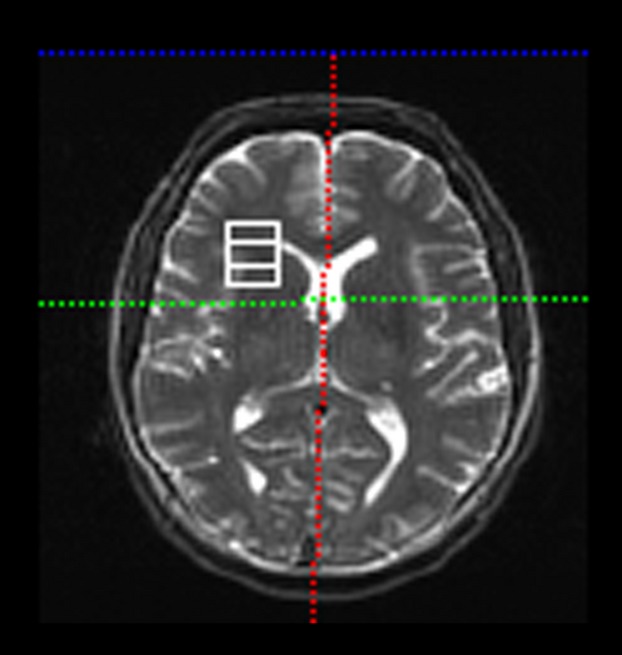
Methods: We examined the relationship between education, a commonly used proxy for cognitive reserve, and N-acetylaspartate (NAA) in neurologically healthy older adults (N=135; mean age=66 years). Using single voxel MR spectroscopy, we predicted that higher levels of education would moderate an age-related decline in NAA in the frontal cortex.
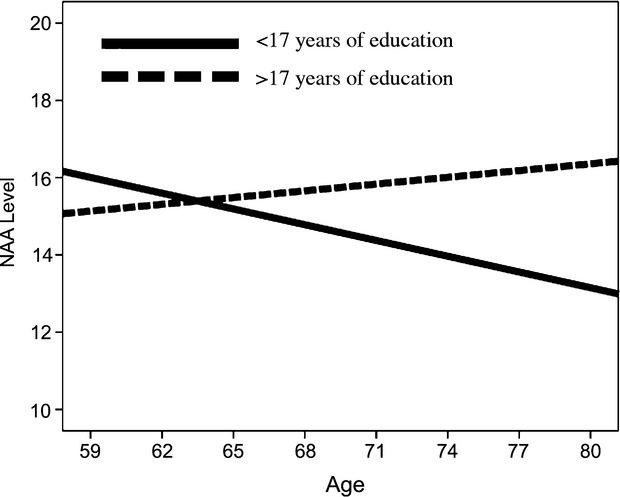
Results: After controlling for the variance associated with cardiorespiratory fitness, sex, annual income, and creatine levels, there were no significant main effects of education (B=0.016, P=0.787) or age (B=-0.058, P=0.204) on NAA levels. However, consistent with our predictions, there was a significant education X age interaction such that more years of education offset an age-related decline in NAA (B=0.025, P=0.031). When examining working memory via the backwards digit span task, longer span length was associated with greater education (P<0.01) and showed a trend with greater NAA concentrations (P<0.06); however, there was no age X education interaction on digit span performance nor a significant moderated mediation effect between age, education, and NAA on digit span performance.
Conclusions: Taken together, these results suggest that higher levels of education may attenuate an age-related reduction in neuronal viability in the frontal cortex.
Keywords: Aging; brain reserve; cognitive reserve; education; fitness.
Figures
References
-
- Arenaza-Urquijo EM, Landeau B, La Joie R, Mevel K, Mezenge F, Perrotin A, et al. Relationships between years of education and gray matter volume, metabolism and functional connectivity in healthy elders. NeuroImage. 2013a;83:450–457. - PubMed
-
- Arenaza-Urquijo EM, Molinuevo JL, Sala-Llonch R, Sole-Padulles C, Balasa M, Bosch B, et al. Cognitive reserve proxies relate to gray matter loss in cognitively healthy elderly with abnormal cerebrospinal fluid amyloid-beta levels. J. Alzheimers Dis. 2013b;35:715–726. - PubMed
-
- Bartres-Faz D, Arenaza-Urquijo EM. Structural and functional imaging correlates of cognitive and brain reserve hypotheses in healthy and pathological aging. Brain Topogr. 2011;24:340–357. - PubMed
Publication types
MeSH terms
Substances
Grants and funding
LinkOut - more resources
Full Text Sources
Other Literature Sources
Medical
