Clinical characteristics and perinatal outcome of fetal hydrops
- PMID: 25798421
- PMCID: PMC4366875
- DOI: 10.5468/ogs.2015.58.2.90
Clinical characteristics and perinatal outcome of fetal hydrops
Abstract
Objective: To investigate the clinical characteristics of fetal hydrops and to find the antenatal ultrasound findings predictive of adverse perinatal outcome.
Methods: This is a retrospective study of 42 women with fetal hydrops who delivered in a tertiary-referral center from 2005 to 2013. Fetal hydrops was defined as the presence of fluid collection in ≥2 body cavities: ascites, pleural effusion, pericardial effusion, and skin edema. Predictor variables recorded included: maternal characteristics, gestational age at diagnosis, ultrasound findings, and identifiable causes. Primary outcome variables analyzed were fetal death and neonatal death.
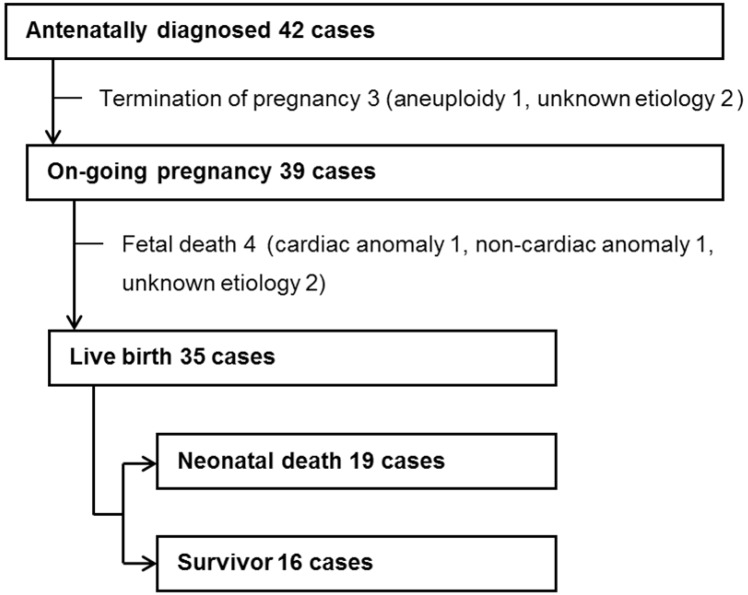
Results: The mean gestational age at diagnosis was 29.3±5.4 weeks (range, 18 to 39 weeks). The most common identifiable causes were cardiac abnormality (10), followed by syndrome (4), aneuploidy (3), congenital infection (3), twin-to-twin transfusion syndrome (3), non-cardiac anormaly (2), chorioangioma (2), inborn errors of metabolism (1), and immune hydrops by anti-E antibody isoimmunization (1). Thirteen cases had no definite identifiable causes. Three women elected termination of pregnancy. Fetal death occurred in 4 cases. Among the 35 live-born babies, only 16 survived (54.0% neonatal mortality rate). Fetal death and neonatal mortality rate was not significantly associated with Doppler velocimetry indices or location of fluid collection, but increasing numbers of fluid collection site was significantly associated with a higher risk of neonatal death.
Conclusion: The incidence of fetal hydrops in our retrospective study was 24.4 per 10,000 deliveries and the perinatal mortality rate was 61.9% (26/42). The number of fluid collection sites was the significant antenatal risk factor to predict neonatal death.
Keywords: Fetal death in utero; Hydrops fetalis; Infant mortality; Ultrasonography.
Conflict of interest statement
No potential conflict of interest relevant to this article was reported.
Figures
References
-
- Bellini C, Hennekam RC. Non-immune hydrops fetalis: a short review of etiology and pathophysiology. Am J Med Genet A. 2012;158A:597–605. - PubMed
-
- Randenberg AL. Nonimmune hydrops fetalis part I: etiology and pathophysiology. Neonatal Netw. 2010;29:281–295. - PubMed
-
- Favre R, Dreux S, Dommergues M, Dumez Y, Luton D, Oury JF, et al. Nonimmune fetal ascites: a series of 79 cases. Am J Obstet Gynecol. 2004;190:407–412. - PubMed
-
- Randenberg AL. Nonimmune hydrops fetalis part II: does etiology influence mortality? Neonatal Netw. 2010;29:367–380. - PubMed
-
- Abrams ME, Meredith KS, Kinnard P, Clark RH. Hydrops fetalis: a retrospective review of cases reported to a large national database and identification of risk factors associated with death. Pediatrics. 2007;120:84–89. - PubMed
LinkOut - more resources
Full Text Sources
Other Literature Sources