Clinicopathological aspects of patients with recurrence of borderline ovarian tumors
- PMID: 25798422
- PMCID: PMC4366876
- DOI: 10.5468/ogs.2015.58.2.98
Clinicopathological aspects of patients with recurrence of borderline ovarian tumors
Abstract
Objective: Despite the good prognosis of borderline ovarian tumors (BOTs), a few BOT patients experience the relapse of disease, either borderline or malignant. However, the risk of recurrence of BOTs is somewhat controversial. We intended to find out the specific characteristics and prognosis of the recurrence of BOTs.
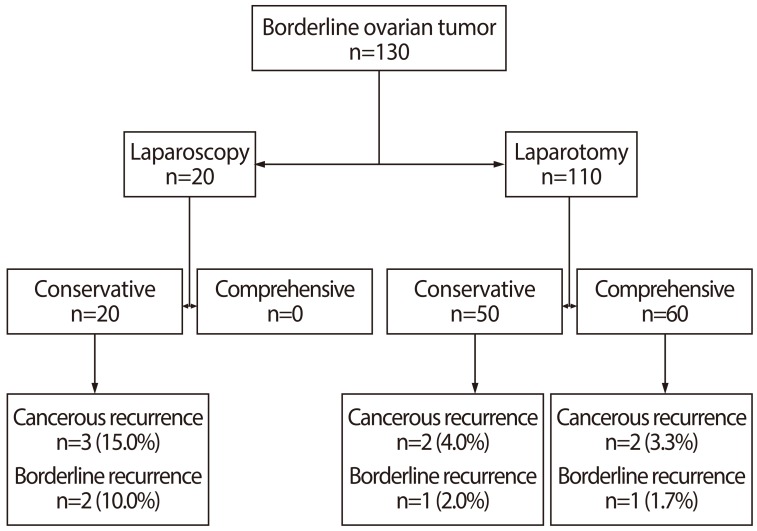
Methods: Between 1995 and 2012, 130 women were diagnosed with BOTs at a single institution. Eleven patients diagnosed and treated for the recurrence of BOTs including seven cancerous and four borderline relapses were included for the analysis in this retrospective study. Clinicopathological characteristics and surgical procedures as well as follow-up data with overall survival were assessed. Statistical analyses was performed using the χ(2) test, t-test and log-rank test with Cox regression.
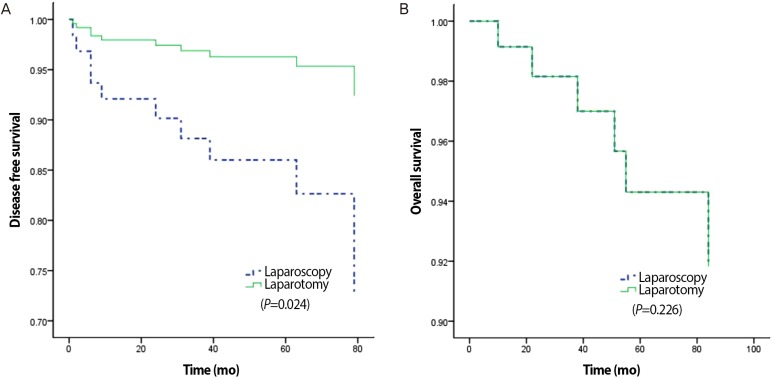
Results: One hundred and thirty patients with mean follow-up of 65.8 months were evaluated, of whom half were below 40 years old at their first diagnosis of BOTs. Among 11 recurrent cases (8.5%), 7 cancerous transformations (5.4%) and 4 borderline recurrences (3.1%) were detected with median time of 6 and 71 months after the primary surgery, respectively. Nine out of 11 recurrences were happened at their equal or below 40-years-old age at the primary diagnosis (P=0.027). Also, all 7 cancerous relapses arose from premenopausal women of median age of 35 years old. Twenty (15%) patients had laparoscopic surgery and they were all treated conservatively. Among those 20, 5 were suffered from relapse of BOTs and laparoscopic approach was proved to be a significant risk factor for disease relapse in our study (P=0.013). Although laparoscopic surgery was revealed had meaningful influence on disease free survival (P=0.024), it was not significant on overall survival (P=0.226).
Conclusion: Laparoscopic conservative surgery for BOTs can be accepted under close follow-ups. And younger patients should be followed for long period to evaluate recurrence.
Keywords: Epithelial-mesenchymal transformation; Laparoscopy; Ovarian neoplasms; Recurrence.
Conflict of interest statement
No potential conflict of interest relevant to this article was reported.
Figures
References
-
- Trimble CL, Kosary C, Trimble EL. Long-term survival and patterns of care in women with ovarian tumors of low malignant potential. Gynecol Oncol. 2002;86:34–37. - PubMed
-
- Suh-Burgmann E. Long-term outcomes following conservative surgery for borderline tumor of the ovary: a large population-based study. Gynecol Oncol. 2006;103:841–847. - PubMed
-
- Lenhard MS, Mitterer S, Kumper C, Stieber P, Mayr D, Ditsch N, et al. Long-term follow-up after ovarian borderline tumor: relapse and survival in a large patient cohort. Eur J Obstet Gynecol Reprod Biol. 2009;145:189–194. - PubMed
-
- Park JY, Kim DY, Kim JH, Kim YM, Kim YT, Nam JH. Surgical management of borderline ovarian tumors: the role of fertility-sparing surgery. Gynecol Oncol. 2009;113:75–82. - PubMed
-
- Obermair A, Tang A, Kondalsamy-Chennakesavan S, Ngan H, Zusterzeel P, Quinn M, et al. Nomogram to predict the probability of relapse in patients diagnosed with borderline ovarian tumors. Int J Gynecol Cancer. 2013;23:264–267. - PubMed
LinkOut - more resources
Full Text Sources
Other Literature Sources