


Comment
doi: 10.1172/JCI81504.
Epub 2015 Mar 23.
Transcriptional regulation of autophagy in RAS-driven cancers
- PMID: 25798614
- PMCID: PMC4409024
- DOI: 10.1172/JCI81504
Item in Clipboard
Comment
Transcriptional regulation of autophagy in RAS-driven cancers
J Clin Invest.
2015 Apr.
Abstract
RAS-driven cancers exhibit variable dependency on autophagy for survival; however, it is not fully understood how. In this issue of the JCI, Cheong and colleagues demonstrate that RAS-dependent elevation of casein kinase 1α (CK1α) negatively regulates autophagy at the level of autophagy gene transcription. Moreover, combined inhibition of both CK1α and autophagy reduced proliferation of RAS-driven tumors. The results of this study provide insight into the connection between mutant RAS and autophagy, and suggest targeting CK1α as a potential therapeutic strategy to modulate autophagy in RAS-driven cancers.
Figures
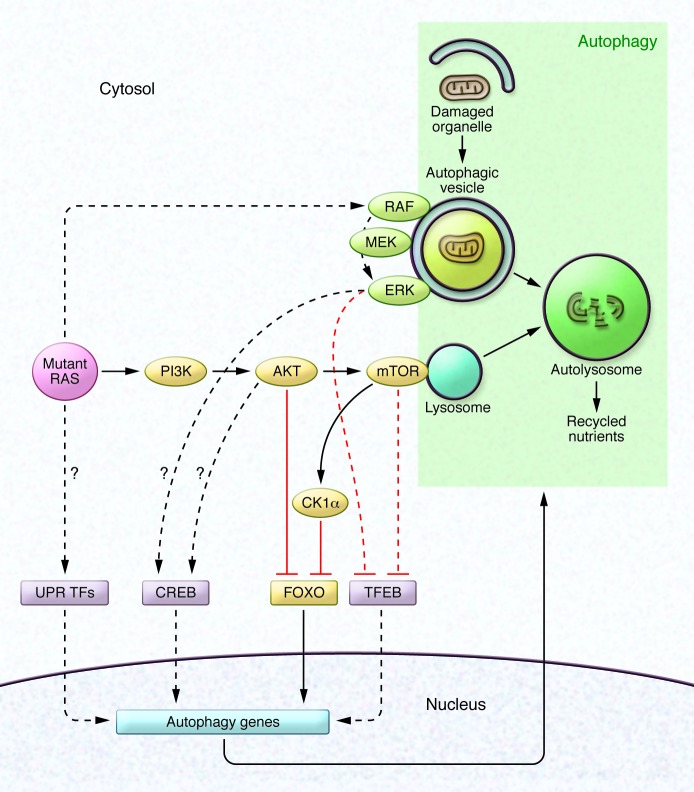
Mutant RAS activates several canonical growth factor signaling pathways, including the MAPK pathway (RAF/MEK/ERK) and the PI3K pathway (PI3K/AKT/mTOR). MAPK and PI3K signaling events take place in part on the surface of autophagic vesicles and lysosomes, respectively. Autophagy consists of the sequestration of damaged organelles within autophagic vesicles followed by fusion with the lysosome. A subset of known transcriptional regulators of autophagy genes are depicted, along with their regulation by growth factor kinase signaling pathways under the control of RAS. In this issue, Cheong et al. demonstrate that RAS-driven PI3K signaling increases levels of CK1α, which in turn phosphorylates and inhibits nuclear localization of FOXO3A, a transcription factor that positively regulates the expression of key autophagy genes (this pathway is denoted in yellow). Dashed lines indicate pathways described in other reports. Arrows indicate activation; lines ending in T indicate inhibition. UPR, unfolded protein response; TF, transcription factor.
Comment on
-
Casein kinase 1α-dependent feedback loop controls autophagy in RAS-driven cancers.J Clin Invest. 2015 Apr;125(4):1401-18. doi: 10.1172/JCI78018. Epub 2015 Mar 23. J Clin Invest. 2015. PMID: 25798617 Free PMC article.
