Persistence of transmitted HIV-1 drug resistance mutations associated with fitness costs and viral genetic backgrounds
- PMID: 25798934
- PMCID: PMC4370492
- DOI: 10.1371/journal.ppat.1004722
Persistence of transmitted HIV-1 drug resistance mutations associated with fitness costs and viral genetic backgrounds
Abstract
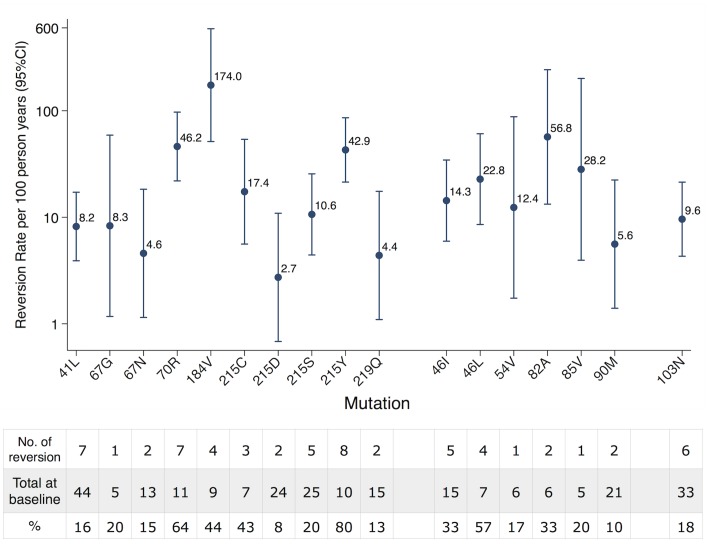
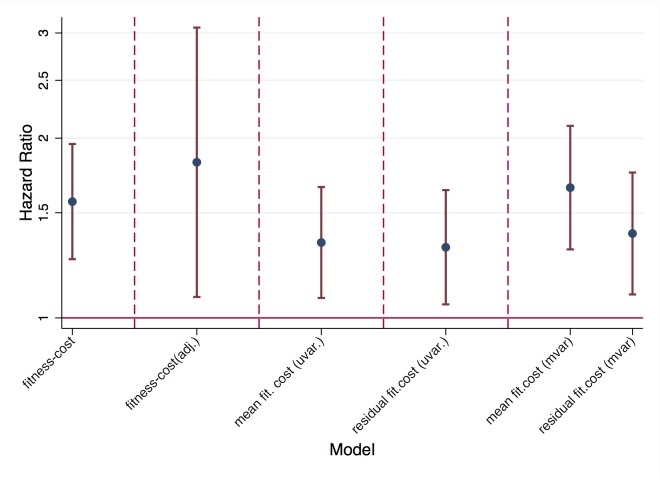
Transmission of drug-resistant pathogens presents an almost-universal challenge for fighting infectious diseases. Transmitted drug resistance mutations (TDRM) can persist in the absence of drugs for considerable time. It is generally believed that differential TDRM-persistence is caused, at least partially, by variations in TDRM-fitness-costs. However, in vivo epidemiological evidence for the impact of fitness costs on TDRM-persistence is rare. Here, we studied the persistence of TDRM in HIV-1 using longitudinally-sampled nucleotide sequences from the Swiss-HIV-Cohort-Study (SHCS). All treatment-naïve individuals with TDRM at baseline were included. Persistence of TDRM was quantified via reversion rates (RR) determined with interval-censored survival models. Fitness costs of TDRM were estimated in the genetic background in which they occurred using a previously published and validated machine-learning algorithm (based on in vitro replicative capacities) and were included in the survival models as explanatory variables. In 857 sequential samples from 168 treatment-naïve patients, 17 TDRM were analyzed. RR varied substantially and ranged from 174.0/100-person-years;CI=[51.4, 588.8] (for 184V) to 2.7/100-person-years;[0.7, 10.9] (for 215D). RR increased significantly with fitness cost (increase by 1.6[1.3,2.0] per standard deviation of fitness costs). When subdividing fitness costs into the average fitness cost of a given mutation and the deviation from the average fitness cost of a mutation in a given genetic background, we found that both components were significantly associated with reversion-rates. Our results show that the substantial variations of TDRM persistence in the absence of drugs are associated with fitness-cost differences both among mutations and among different genetic backgrounds for the same mutation.
Conflict of interest statement
HFG has been an adviser and/or consultant for the following companies: GlaxoSmithKline, Abbott, Gilead, Novartis, Boehringer Ingelheim, Roche, Tibotec, Pfizer and Bristol-Myers Squibb, and has received unrestricted research and educational grants from Roche, Abbott, Bristol-Myers Squibb, Gilead, Astra-Zeneca, GlaxoSmithKline, and Merck Sharp & Dohme (all money went to institution). SY has been consultant for BMS, has received unrestricted research and educational grants from Roche, ViiV and Gilead. TK served as advisor for Bristol-Myers Squibb and Pfizer and has received travel support from Abbott and Pfizer. CP is an employee of Monogram Biosciences. This does not alter our adherence to all PLOS Pathogens policies on sharing data and materials.
Figures
References
-
- Palella FJ, Delaney KM, Moorman AC, Loveless MO, Fuhrer J, Satten GA, et al. Declining morbidity and mortality among patients with advanced human immunodeficiency virus infection. HIV Outpatient Study Investigators. The new England journal of medicine 1998; 338:853–860. - PubMed
-
- Yerly S, Vora S, Rizzardi P, Chave JP, Vernazza PL, Flepp M, et al. Acute HIV infection: impact on the spread of HIV and transmission of drug resistance. AIDS 2001; 15:2287–2292. - PubMed
-
- Yerly S, von Wyl V, Ledergerber B, Böni J, Schüpbach J, Bürgisser P, et al. Transmission of HIV-1 drug resistance in Switzerland: a 10-year molecular epidemiology survey. AIDS 2007; 21:2223–2229. - PubMed
Publication types
MeSH terms
LinkOut - more resources
Full Text Sources
Other Literature Sources
Medical