Effects of choice architecture and chef-enhanced meals on the selection and consumption of healthier school foods: a randomized clinical trial
- PMID: 25798990
- PMCID: PMC4540052
- DOI: 10.1001/jamapediatrics.2014.3805
Effects of choice architecture and chef-enhanced meals on the selection and consumption of healthier school foods: a randomized clinical trial
Erratum in
-
Errors in Abstract and Text.JAMA Pediatr. 2015 Aug;169(8):791. doi: 10.1001/jamapediatrics.2015.1820. JAMA Pediatr. 2015. PMID: 26237459 No abstract available.
Abstract
Importance: Little is known about the long-term effect of a chef-enhanced menu on healthier food selection and consumption in school lunchrooms. In addition, it remains unclear if extended exposure to other strategies to promote healthier foods (eg, choice architecture) also improves food selection or consumption.
Objective: To evaluate the short- and long-term effects of chef-enhanced meals and extended exposure to choice architecture on healthier school food selection and consumption.
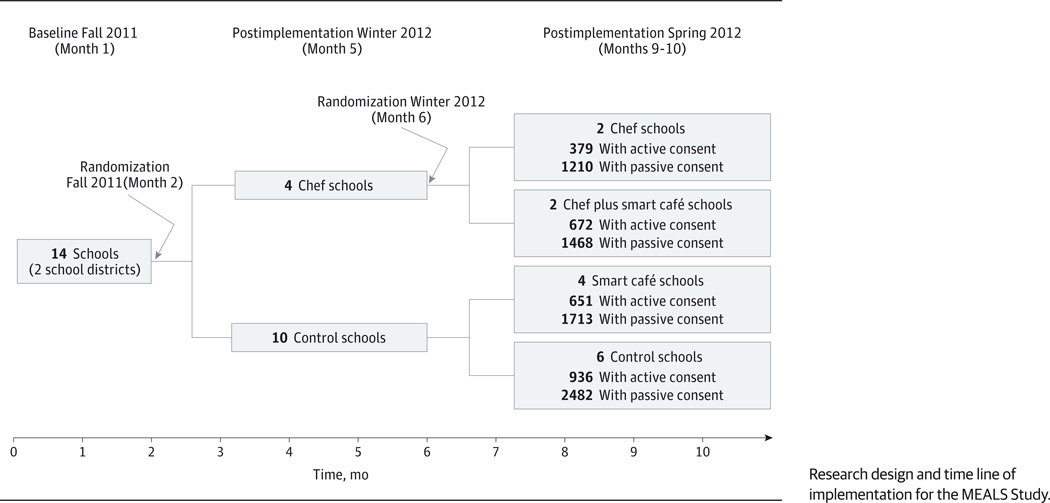
Design, setting, and participants: A school-based randomized clinical trial was conducted during the 2011-2012 school year among 14 elementary and middle schools in 2 urban, low-income school districts (intent-to-treat analysis). Included in the study were 2638 students in grades 3 through 8 attending participating schools (38.4% of eligible participants).
Interventions: Schools were first randomized to receive a professional chef to improve school meal palatability (chef schools) or to a delayed intervention (control group). To assess the effect of choice architecture (smart café), all schools after 3 months were then randomized to the smart café intervention or to the control group.
Main outcomes and measures: School food selection was recorded, and consumption was measured using plate waste methods.
Results: After 3 months, vegetable selection increased in chef vs control schools (odds ratio [OR], 1.75; 95% CI, 1.36-2.24), but there was no effect on the selection of other components or on meal consumption. After long-term or extended exposure to the chef or smart café intervention, fruit selection increased in the chef (OR, 3.08; 95% CI, 2.23-4.25), smart café (OR, 1.45; 95% CI, 1.13-1.87), and chef plus smart café (OR, 3.10; 95% CI, 2.26-4.25) schools compared with the control schools, and consumption increased in the chef schools (OR, 0.17; 95% CI, 0.03-0.30 cups/d). Vegetable selection increased in the chef (OR, 2.54; 95% CI, 1.83-3.54), smart café (OR, 1.91; 95% CI, 1.46-2.50), and chef plus smart café schools (OR, 7.38, 95% CI, 5.26-10.35) compared with the control schools, and consumption also increased in the chef (OR, 0.16; 95% CI, 0.09-0.22 cups/d) and chef plus smart café (OR, 0.13; 95% CI, 0.05-0.19 cups/d) schools; however, the smart café intervention alone had no effect on consumption.
Conclusions and relevance: Schools should consider both collaborating with chefs and using choice architecture to increase fruit and vegetable selection. Efforts to improve the taste of school foods through chef-enhanced meals should remain a priority because this was the only method that also increased consumption. This was observed only after students were repeatedly exposed to the new foods for 7 months. Therefore, schools should not abandon healthier options if they are initially met with resistance.
Trial registration: clinicaltrials.gov Identifier: NCT02309840.
Conflict of interest statement
Figures
Comment in
-
Nudging students toward healthier food choices--applying insights from behavioral economics.JAMA Pediatr. 2015 May;169(5):425-6. doi: 10.1001/jamapediatrics.2015.0217. JAMA Pediatr. 2015. PMID: 25798795 No abstract available.
References
-
- US Department of Agriculture. National School Lunch Program: participation and lunches served. [Accessed February 20, 2014]; http://www.fns.usda.gov/pd/01slfypart.htm.
-
- Briefel RR, Crepinsek MK, Cabili C, Wilson A, Gleason PM. School food environments and practices affect dietary behaviors of US public school children. J Am Diet Assoc. 2009;109(2) suppl:S91–S107. - PubMed
-
- US Department of Agriculture, Food and Nutrition Service, Office of Analysis, Nutrition, and Evaluation (USDA/FNS) Alexandria, VA: USDA/FNS; 1992. Jun, Child Nutrition Program Operations Study, Second Year Report: Executive Summary.
-
- US Department of Agriculture. School Lunch and Breakfast Cost Study, II: summary of findings. [Accessed February 8, 2015]; http://www.fns.usda.gov/sites/default/files/MealCostStudy.pdf.
-
- Story M. The third School Nutrition Dietary Assessment Study: findings and policy implications for improving the health of US children. J Am Diet Assoc. 2009;109(2) suppl:S7–S13. - PubMed
Publication types
MeSH terms
Associated data
Grants and funding
LinkOut - more resources
Full Text Sources
Other Literature Sources
Medical
Miscellaneous