


Web-based psychotherapy for posttraumatic stress disorder in war-traumatized Arab patients: randomized controlled trial
- PMID: 25799024
- PMCID: PMC4385175
- DOI: 10.2196/jmir.3582
Web-based psychotherapy for posttraumatic stress disorder in war-traumatized Arab patients: randomized controlled trial
Abstract
Background: In recent years, armed conflicts in the Middle East have resulted in high rates of exposure to traumatic events. Despite the increasing demand of mental health care provision, ongoing violence limits conventional approaches of mental health care provision. Internet-based interventions for posttraumatic stress disorder (PTSD) have proved feasible and effective in Western countries, but their applicability and efficacy in war and conflict regions remains unknown.
Objective: This study investigated the efficacy of a cognitive behavioral Internet-based intervention for war-traumatized Arab patients, with focus on Iraq.
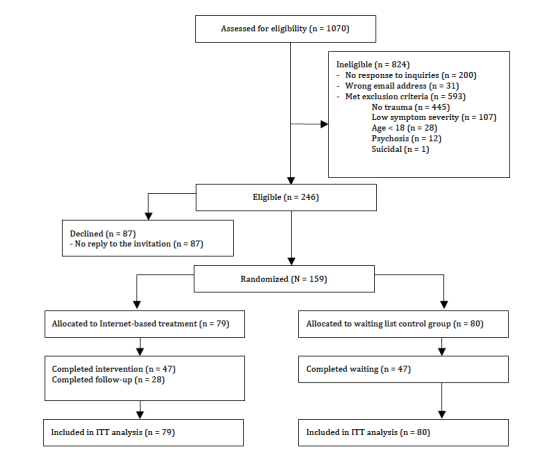
Methods: A total of 159 individuals with PTSD participated in a parallel group randomized trial. Participants were randomly allocated by a computer-generated sequence to a treatment group (n=79) or a waiting list control group (n=80). The treatment group received 2 weekly 45-minute cognitive behavioral interventions via Internet over a 5-week period (10 sessions in total). The primary outcome was recovery from posttraumatic stress symptoms.
Results: Posttraumatic stress symptoms were significantly reduced from baseline to posttreatment (intention-to-treat analysis) in the treatment group relative to the control group (F1,157=44.29, P<.001, d=0.92). Treatment effects were sustained at 3-month follow-up. Completer analysis indicated that 29 of 47 patients (62%) in the treatment group had recovered from posttraumatic stress symptoms at posttreatment (reliable change and Posttraumatic Stress Diagnostic Scale score <20) versus 1 patient (2%) in the control group (OR 74.19, 95% CI 9.93-585.8, P<.001) indicating that the chance of recovering was 74.19 times higher in the treatment than in the control group.
Conclusions: The results indicate, even in unstable and insecure settings with ongoing exposure to human rights violations through war and dictatorships, people with posttraumatic stress symptoms benefit from a cognitive behavioral treatment provided entirely through the Internet. This method of delivery could improve patients' access to humanitarian aid in the form of e-mental health services.
Trial registration: Australian New Zealand Clinical Trial Registry, ACTRN12611001019998; https://www.anzctr.org.au/Trial/Registration/TrialReview.aspx?id=347505 (Archived by WebCite at http://www.webcitation.org/6Wto4HCdH).
Keywords: Internet; Middle East; cognitive therapy; mental health service; posttraumatic stress disorders; violence; war.
Conflict of interest statement
Conflicts of Interest: None declared.
Figures

References
-
- el Sarraj E, Punamäki RL, Salmi S, Summerfield D. Experiences of torture and ill-treatment and posttraumatic stress disorder symptoms among Palestinian political prisoners. J Trauma Stress. 1996 Jul;9(3):595–606. - PubMed
-
- Laban CJ, Gernaat HB, Komproe IH, Schreuders BA, De Jong Joop TVM. Impact of a long asylum procedure on the prevalence of psychiatric disorders in Iraqi asylum seekers in The Netherlands. J Nerv Ment Dis. 2004 Dec;192(12):843–51. - PubMed
-
- Al-Jawadi AA, Abdul-Rhman S. Prevalence of childhood and early adolescence mental disorders among children attending primary health care centers in Mosul, Iraq: a cross-sectional study. BMC Public Health. 2007;7:274. doi: 10.1186/1471-2458-7-274. http://www.biomedcentral.com/1471-2458/7/274 - DOI - PMC - PubMed
-
- Hicks MH, Dardagan H, Guerrero SG, Bagnall PM, Sloboda JA, Spagat M. Violent deaths of Iraqi civilians, 2003-2008: analysis by perpetrator, weapon, time, and location. PLoS Med. 2011;8(2):e1000415. doi: 10.1371/journal.pmed.1000415. http://dx.plos.org/10.1371/journal.pmed.1000415 - DOI - DOI - PMC - PubMed
Publication types
MeSH terms
Associated data
LinkOut - more resources
Full Text Sources
Other Literature Sources
Medical
