


Adaptation of sensorimotor coupling in postural control is impaired by sleep deprivation
- PMID: 25799560
- PMCID: PMC4370556
- DOI: 10.1371/journal.pone.0122340
Adaptation of sensorimotor coupling in postural control is impaired by sleep deprivation
Abstract
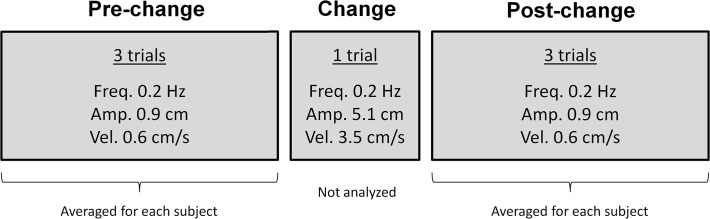
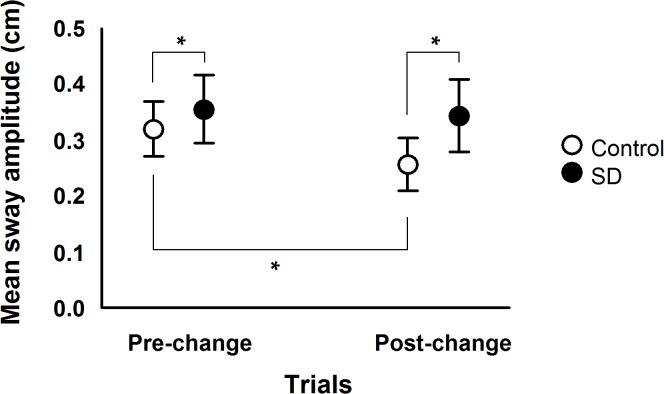
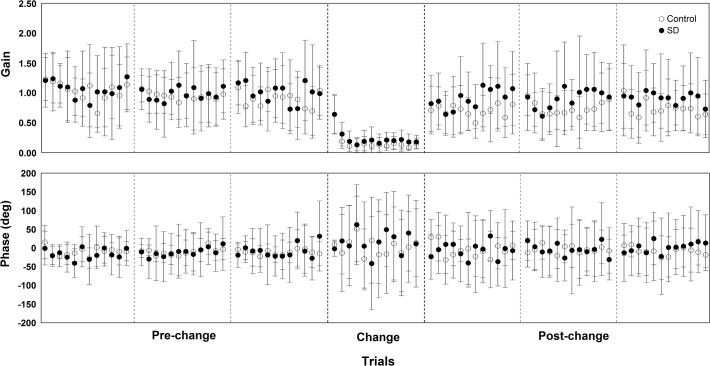
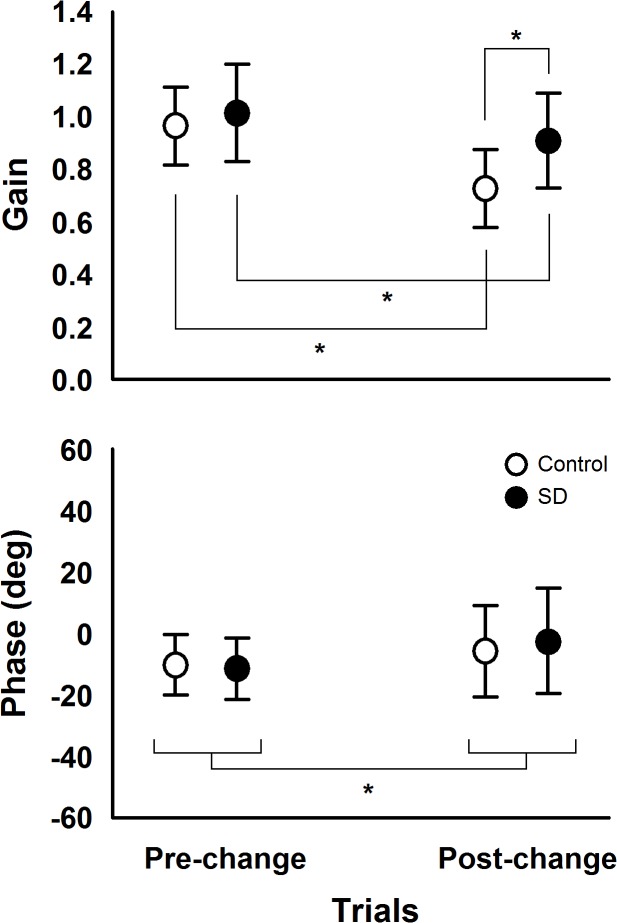
The purpose of the study was to investigate the effects of sleep deprivation (SD) in adaptation of the coupling between visual information and body sway in young adults' postural control due to changes in optic flow characteristics. Fifteen young adults were kept awake for approximately 25 hours and formed the SD group, while fifteen adults who slept normally the night before the experiment participated as part of the control group. All participants stood as still as possible in a moving room before and after being exposed to one trial with higher amplitude and velocity of room movement. Postural performance and the coupling between visual information, provided by a moving room, and body sway were examined. Results showed that after an abrupt change in visual cues, larger amplitude, and higher velocity of the room, the influence of room motion on body sway was decreased in both groups. However, such a decrease was less pronounced in sleep deprived as compared to control subjects. Sleep deprived adults were able to adapt motor responses to the environmental change provided by the increase in room motion amplitude. Nevertheless, they were not as efficient as control subjects in doing so, which demonstrates that SD impairs the ability to adapt sensorimotor coupling while controlling posture when a perturbation occurs.
Conflict of interest statement
Figures


References
-
- Hublin C, Kaprio J, Partinen M, Koskenvuo M. Insufficient sleep—a population-based study in adults. Sleep. 2001;24(4): 392–400. - PubMed
-
- Haghighatdoost F, Karimi G, Esmaillzadeh A, Azadbakht L. Sleep deprivation is associated with lower diet quality indices and higher rate of general and central obesity among young female students in Iran. Nutrition. 2012;28(11–12): 1146–1150. - PubMed
Publication types
MeSH terms
LinkOut - more resources
Full Text Sources
Other Literature Sources
Medical
