. 2015 Apr 20;43(7):3490-7.
doi: 10.1093/nar/gkv249. Epub 2015 Mar 23.

Pathway analysis from lists of microRNAs: common pitfalls and alternative strategy

Affiliations

Pathway analysis from lists of microRNAs: common pitfalls and alternative strategy

Patrice Godard et al. Nucleic Acids Res. .

Abstract

MicroRNAs (miRNAs) are involved in the regulation of gene expression at a post-transcriptional level. As such, monitoring miRNA expression has been increasingly used to assess their role in regulatory mechanisms of biological processes. In large scale studies, once miRNAs of interest have been identified, the target genes they regulate are often inferred using algorithms or databases. A pathway analysis is then often performed in order to generate hypotheses about the relevant biological functions controlled by the miRNA signature. Here we show that the method widely used in scientific literature to identify these pathways is biased and leads to inaccurate results. In addition to describing the bias and its origin we present an alternative strategy to identify potential biological functions specifically impacted by a miRNA signature. More generally, our study exemplifies the crucial need of relevant negative controls when developing, and using, bioinformatics methods.


Figures

Figure 1.
Figure 1.
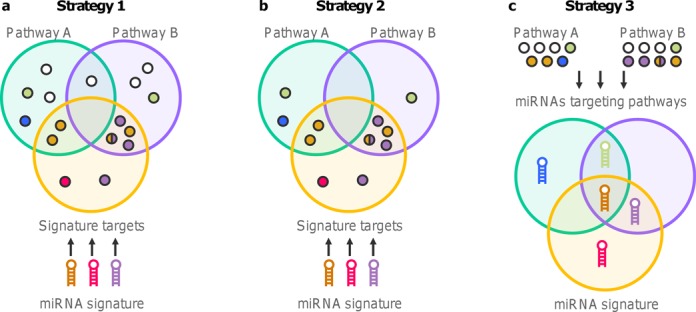
Strategies to identify pathways associated to a miRNA signature. Circles represent protein coding genes and hairpins miRNAs. Gene having the same color of a miRNA are targeted by this miRNA. White genes are not known to be targeted by any miRNA. (a) Strategy 1: targets of the miRNAs of interest are identified using in silico resources and then compared to protein coding genes belonging to each native pathway. (b) Strategy 2: same as strategy 1 but pathways are tailored to only keep genes targeted by at least one miRNA. (c) Strategy 3: pathways of protein coding genes are converted in lists of miRNAs that target at least one of their genes. Then the miRNA signature is directly compared to miRNAs-converted pathways.
Figure 2.
Figure 2.
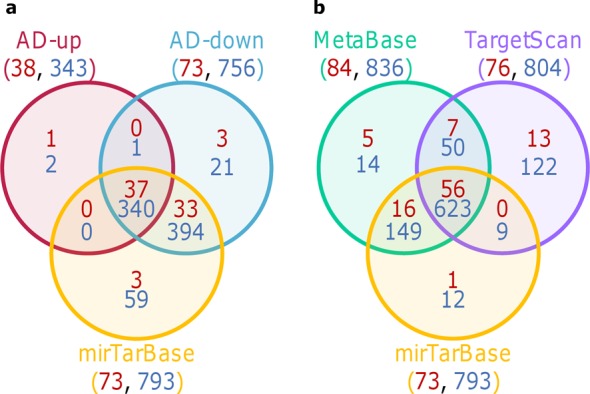
Pathways associated to miRNA signatures when applying strategy 1. (a) AD-up S1 pathways, AD-down S1 pathways and pathways enriched in genes targeted by at least one miRNA according to mirTarBase. (b) Pathways enriched in genes targeted by at least one miRNA according to MetaBase, TargetScan or mirTarBase. Numbers in red correspond to KEGG pathways and those in blue to MetaBase pathways.
Figure 3.
Figure 3.
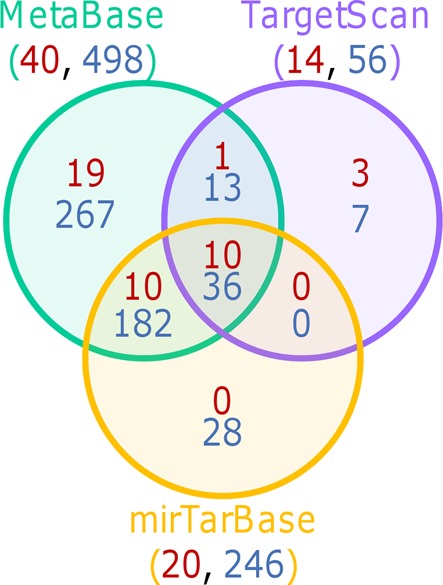
Pathways enriched in the top 500 genes targeted by miRNAs according to MetaBase, TargetScan or mirTarBase when applying strategy 2. Numbers in red correspond to KEGG pathways and those in blue to MetaBase pathways.
Figure 4.
Figure 4.
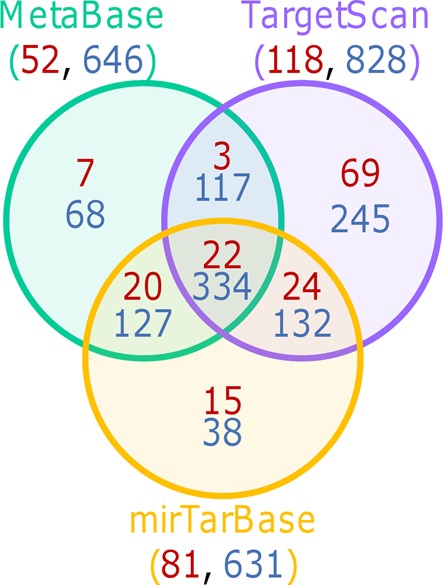
Pathways associated to AD-down miRNAs when applying strategy 3. miRNAs targeting protein coding genes in the different pathways were identified using either MetaBase, TargetScan or mirTarBase. Numbers in red correspond to KEGG pathways and those in blue to MetaBase pathways.
Figure 5.
Figure 5.
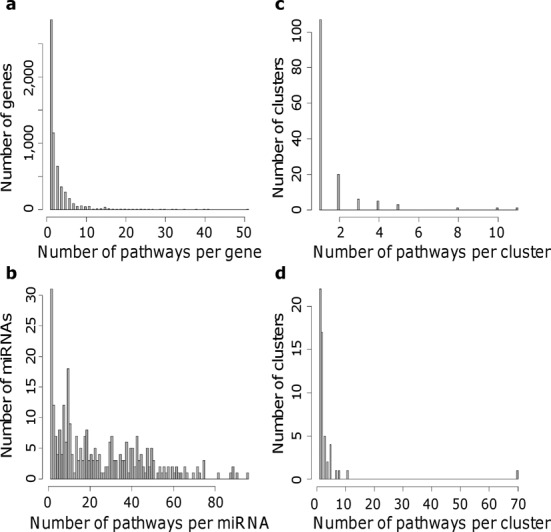
KEGG pathway redundancy at the levels of protein coding genes and miRNAs. (a) Distribution of the number of pathways associated to each Entrez gene ID in the KEGG.db package. (b) Distribution of the number of pathways associated to each miRNA using mirTarBase information. (c) Distribution of the number of pathways per cluster of pathways sharing on average at least 20% of Entrez gene ID. (d) Distribution of the number of pathways per cluster of pathways sharing on average at least 20% of associated miRNAs using mirTarBase information.

References

    1. Pasquinelli A.E. MicroRNAs and their targets: recognition, regulation and an emerging reciprocal relationship. Nat. Rev. Genet. 2012;13:271–282. - PubMed
    1. Pritchard C.C., Cheng H.H., Tewari M. MicroRNA profiling: approaches and considerations. Nat. Rev. Genet. 2012;13:358–369. - PMC - PubMed
    1. Long C., Jiang L., Wei F., Ma C., Zhou H., Yang S., Liu X., Liu Z. Integrated miRNA-mRNA analysis revealing the potential roles of miRNAs in chordomas. PloS One. 2013;8:e66676. - PMC - PubMed
    1. Bang-Berthelsen C.H., Pedersen L., Fløyel T., Hagedorn P.H., Gylvin T., Pociot F. Independent component and pathway-based analysis of miRNA-regulated gene expression in a model of type 1 diabetes. BMC Genomics. 2011;12:97. - PMC - PubMed
    1. Song H., Wang Q., Guo Y., Liu S., Song R., Gao X., Dai L., Li B., Zhang D., Cheng J. Microarray analysis of microRNA expression in peripheral blood mononuclear cells of critically ill patients with influenza A (H1N1) BMC Infect. Dis. 2013;13:257. - PMC - PubMed

Publication types