Review
. 2015 Jul;17(4):780-7.
doi: 10.1208/s12248-015-9719-7. Epub 2015 Mar 24.

Intranasal Delivery of Proteins and Peptides in the Treatment of Neurodegenerative Diseases

Affiliations
Review

Intranasal Delivery of Proteins and Peptides in the Treatment of Neurodegenerative Diseases

M Elizabeth Meredith et al. AAPS J. 2015 Jul.

Abstract

The blood-brain barrier (BBB) is a major impediment to the therapeutic delivery of peptides and proteins to the brain. Intranasal delivery often provides a non-invasive means to bypass the BBB. Advantages of using intranasal delivery include minimizing exposure to peripheral organs and tissues, thus reducing systemic side effects. It also allows substances that typically have rapid degradation in the blood time to exert their effect. Intranasal delivery provides the ability to target proteins and peptides to specific regions of the brain when administered with substrates like cyclodextrins. In this review, we examined the use of intranasal delivery of various proteins and peptides that have implications in the treatment of neurodegenerative diseases, focusing especially on albumin, exendin/GLP-1, GALP, insulin, leptin, and PACAP. We have described their rationale for use, distribution in the brain after intranasal injection, how intranasal administration differed from other modes of delivery, and their use in clinical trials, if applicable. Intranasal delivery of drugs, peptides, and other proteins could be very useful in the future for the prevention or treatment of brain related diseases.


Figures
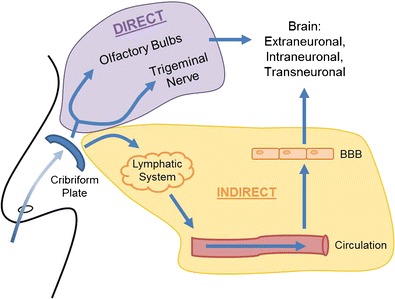
Fig. 1
Fig. 1
Pathways for intranasal transport. Proteins and peptides delivered into the nasal cavity come into contact with the cribriform plate. The substrates reach the brain via direct and indirect pathways. The direct pathway can occur through the olfactory bulbs or trigeminal nerve. The indirect pathway transports the substrates into the lymphatic system, which then drains into the circulation. The proteins and peptides can then enter the brain if able to navigate the BBB. Once in the brain, the substances are transported to various regions by extranueronal, intraneuronal, or transneuronal transport
Fig. 2
Fig. 2
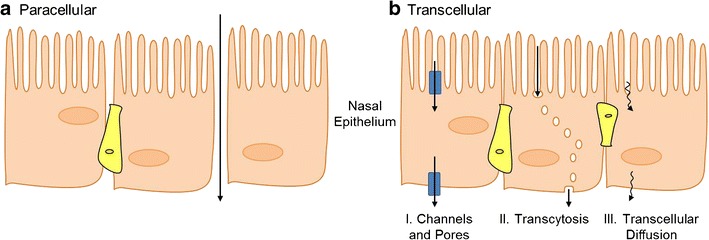
Transport across the nasal epithelium. Transport across the nasal epithelium can occur by a paracellular transport in which proteins and peptides leak through the intercellular spaces. Transport through the cells can also occur in a b transceullar manner by specific I channels and pores for the substrates, II transcytosis, and by III transcellular diffusion depending on the physiochemical characteristics of the substrate

References

    1. Lochhead JJ, Thorne RG. Intranasal delivery of biologics to the central nervous system. Adv Drug Deliv Rev. 2012;64(7):614–28. doi: 10.1016/j.addr.2011.11.002. - DOI - PubMed
    1. Banks WA, During MJ, Niehoff ML. Brain uptake of the glucagon-like peptide-1 antagonist exendin(9-39) after intranasal administration. J Pharmacol Exp Ther. 2004;309(2):469–75. doi: 10.1124/jpet.103.063222. - DOI - PubMed
    1. Falcone JA, Salameh TS, Yi X, Cordy BJ, Mortell WG, Kabanov AV, et al. Intranasal administration as a route for drug delivery to the brain: evidence for a unique pathway for albumin. Journal of Pharmacology and Experimental Therapeutics. 2014;351(1):54–60. - PMC - PubMed
    1. Nonaka N, Farr SA, Nakamachi T, Morley JE, Nakamura M, Shioda S, et al. Intranasal administration of PACAP: Uptake by brain and regional brain targeting with cyclodextrins. Peptides. 2012;36(2):168–75. doi: 10.1016/j.peptides.2012.05.021. - DOI - PMC - PubMed
    1. Nonaka N, Farr SA, Kageyama H, Shioda S, Banks WA. Delivery of galanin-like peptide to the brain: targeting with intranasal delivery and cyclodextrins. J Pharmacol Exp Ther. 2008;325(2):513–9. doi: 10.1124/jpet.107.132381. - DOI - PubMed