


Flavonoid metabolites reduce tumor necrosis factor-α secretion to a greater extent than their precursor compounds in human THP-1 monocytes
- PMID: 25801720
- PMCID: PMC4973837
- DOI: 10.1002/mnfr.201400799
Flavonoid metabolites reduce tumor necrosis factor-α secretion to a greater extent than their precursor compounds in human THP-1 monocytes
Abstract
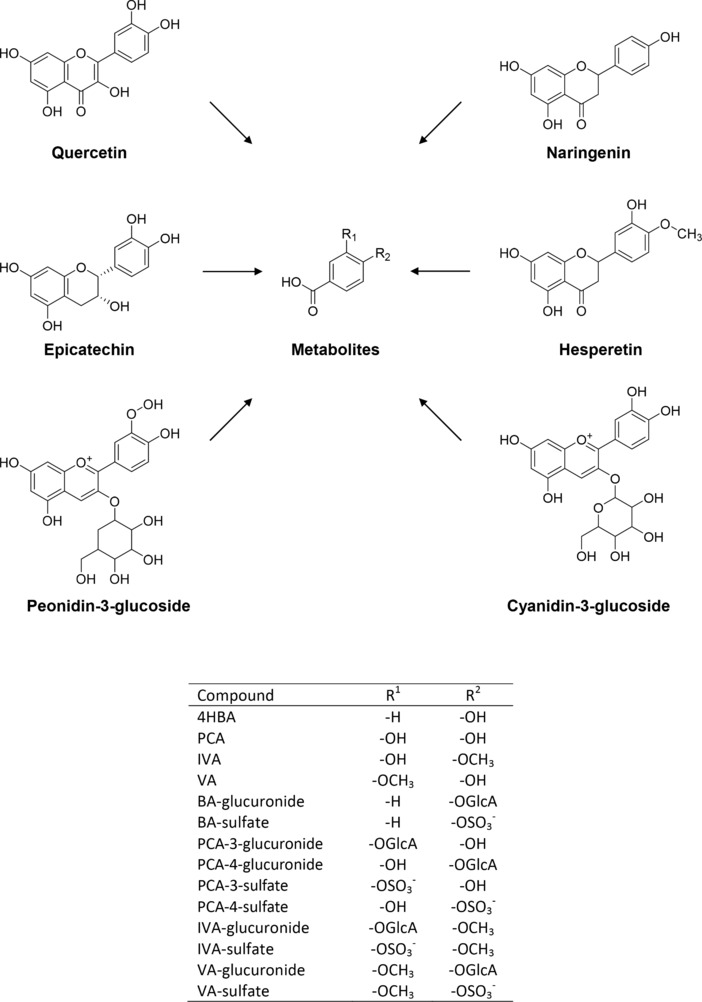
Scope: Flavonoids are generally studied in vitro, in isolation, and as unmetabolized precursor structures. However, in the habitual diet, multiple flavonoids are consumed together and found present in the circulation as complex mixtures of metabolites. Using a unique study design, we investigated the potential for singular or additive anti-inflammatory effects of flavonoid metabolites relative to their precursor structures.
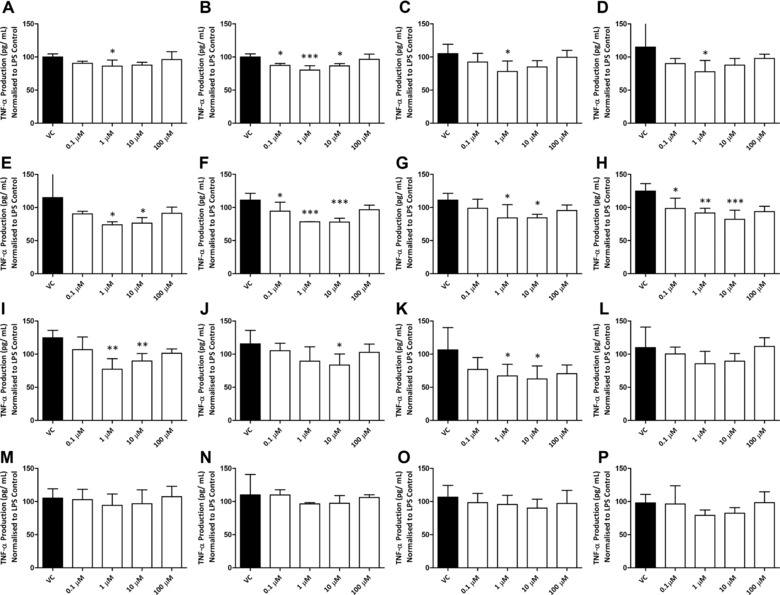
Methods and results: Six flavonoids, 14 flavonoid metabolites, and 29 combinations of flavonoids and their metabolites (0.1-10 μM) were screened for their ability to reduce LPS-induced tumor necrosis factor-α (TNF-α) secretion in THP-1 monocytes. One micromolar peonidin-3-glucoside, cyanidin-3-glucoside, and the metabolites isovanillic acid (IVA), IVA-glucuronide, vanillic acid-glucuronide, protocatechuic acid-3-sulfate, and benzoic acid-sulfate significantly reduced TNF-α secretion when in isolation, while there was no effect on TNF-α mRNA expression. Four combinations of metabolites that included 4-hydroxybenzoic acid (4HBA) and/or protocatechuic acid also significantly reduced TNF-α secretion to a greater extent than the precursors or metabolites alone. The effects on LPS-induced IL-1β and IL-10 secretion and mRNA expression were also examined. 4HBA significantly reduced IL-1β secretion but none of the flavonoids or metabolites significantly modified IL-10 secretion.
Conclusion: This study provides novel evidence suggesting flavonoid bioactivity results from cumulative or additive effects of circulating metabolites.
Keywords: Cytokine; Inflammation; Metabolism; Phase 2 conjugates; Polyphenol.
© 2015 The Authors. Molecular Nutrition & Food Research published by Wiley-VCH Verlag GmbH & Co. KGaA, Weinheim.
Figures
References
-
- Perez‐Jimenez, J. , Neveu, V. , Vos, F. , Scalbert, A. , Systematic analysis of the content of 502 polyphenols in 452 foods and beverages: an application of the phenol‐explorer database. J. Agr. Food Chem. 2010, 58, 4959–4969. - PubMed
-
- Manach, C. , Scalbert, A. , Morand, C. , Remesy, C. et al., Polyphenols: food sources and bioavailability. Am. J. Clin. Nutr. 2004, 79, 727–747. - PubMed
-
- Spatafora, C. , Tringali, C. , Natural‐derived polyphenols as potential anticancer agents. Anticancer Agents Med. Chem. 2012, 12, 902–918. - PubMed
Publication types
MeSH terms
Substances
Grants and funding
- BB/H004726/1/BB_/Biotechnology and Biological Sciences Research Council/United Kingdom
- BB/H004963/1/BB_/Biotechnology and Biological Sciences Research Council/United Kingdom
- BB/I006028/1/BB_/Biotechnology and Biological Sciences Research Council/United Kingdom
- BB/J500100/1/BB_/Biotechnology and Biological Sciences Research Council/United Kingdom
LinkOut - more resources
Full Text Sources
Other Literature Sources
Molecular Biology Databases
