Sociocultural and structural factors contributing to delays in treatment for children with severe malaria: a qualitative study in southwestern Uganda
- PMID: 25802438
- PMCID: PMC4426580
- DOI: 10.4269/ajtmh.14-0784
Sociocultural and structural factors contributing to delays in treatment for children with severe malaria: a qualitative study in southwestern Uganda
Abstract
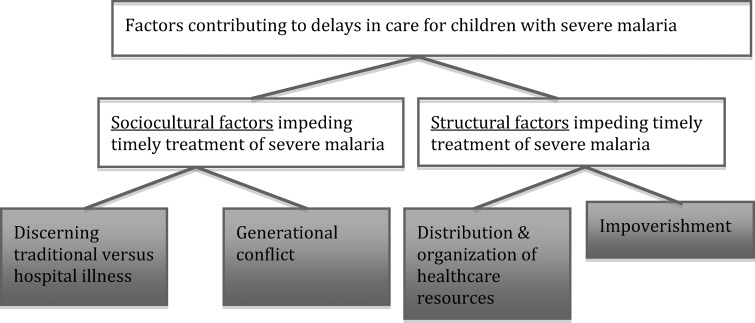
Malaria is a leading cause of pediatric mortality, and Uganda has among the highest incidences in the world. Increased morbidity and mortality are associated with delays to care. This qualitative study sought to characterize barriers to prompt allopathic care for children hospitalized with severe malaria in the endemic region of southwestern Uganda. Minimally structured, qualitative interviews were conducted with guardians of children admitted to a regional hospital with severe malaria. Using an inductive and content analytic approach, transcripts were analyzed to identify and define categories that explain delayed care. These categories represented two broad themes: sociocultural and structural factors. Sociocultural factors were 1) interviewee's distinctions of "traditional" versus "hospital" illnesses, which were mutually exclusive and 2) generational conflict, where deference to one's elders, who recommended traditional medicine, was expected. Structural factors were 1) inadequate distribution of health-care resources, 2) impoverishment limiting escalation of care, and 3) financial impact of illness on household economies. These factors perpetuate a cycle of illness, debt, and poverty consistent with a model of structural violence. Our findings inform a number of potential interventions that could alleviate the burden of this preventable, but often fatal, illness. Such interventions could be beneficial in similarly endemic, low-resource settings.
© The American Society of Tropical Medicine and Hygiene.
Figures
References
-
- Greenwood BM, Bojang K, Whitty CJM, Targett GA. Malaria. Lancet. 2005;365:1487–1498. - PubMed
-
- World Health Organization World Malaria Report 2013. 2013. http://www.who.int/malaria/publications/world_malaria_report_2013/report... Available at. Accessed September 18, 2014.
-
- Okello PE, Van Bortel W, Byaruhanga AM, Correwyn A, Roelants P, Talisuna A, D'Alessandro U, Coosemans M. Variation in malaria transmission intensity in seven sites throughout Uganda. Am J Trop Med Hyg. 2006;75:219–225. - PubMed
-
- President's Malaria Initiative. Uganda: Malaria Operational Plan 2014. http://www.pmi.gov/docs/default-source/default- document-library/malaria... Available at. Accessed March 13, 2015.
-
- Dondorp AM, Fanello CI, Hendriksen ICE, Gomes E, Seni A, Chhaganlal KD, Bojang K, Olaosebikan R, Anunobi N, Maitland K, Kivaya E, Agbenyega T, Nguah SB, Evans J, Gesase S, Kahabuka C, Mtove G, Nadjm B, Deen J, Mwanga-Amumpaire J, Nansumba M, Karema C, Umulisa N, Uwimana A, Mokuolu OA, Adedoyin OT, Johnson WB, Tshefu AK, Onyamboko MA, Sakulthaew T, Ngum WP, Silamut K, Stepniewska K, Woodrow CJ, Bethell D, Wills B, Oneko M, Peto TE, von Seidlein L, Day NP, White NJ, AQUAMAT group Artesunate versus quinine in the treatment of severe falciparum malaria in African children (AQUAMAT): an open-label, randomised trial. Lancet. 2010;376:1647–1657. - PMC - PubMed
Publication types
MeSH terms
Substances
LinkOut - more resources
Full Text Sources
Other Literature Sources
Medical