. 2015 Mar 22;7(1):14.
doi: 10.1186/s13195-015-0100-y. eCollection 2015.

A highly sensitive novel immunoassay specifically detects low levels of soluble Aβ oligomers in human cerebrospinal fluid

Affiliations

A highly sensitive novel immunoassay specifically detects low levels of soluble Aβ oligomers in human cerebrospinal fluid

Ting Yang et al. Alzheimers Res Ther. .

Abstract

Introduction: Amyloid β-protein oligomers play a key role in Alzheimer's disease (AD), but well-validated assays that routinely detect them in cerebrospinal fluid (CSF) are just emerging. We sought to confirm and extend a recent study using the Singulex Erenna platform that reported increased mean CSF oligomer levels in AD.

Methods: We tested four antibody pairs and chose one pair that was particularly sensitive, using 1C22, our new oligomer-selective monoclonal antibody, for capture. We applied this new assay to extracts of human brain and CSF.

Results: A combination of 1C22 for capture and 3D6 for detection yielded an Erenna immunoassay with a lower limit of quantification of approximately 0.15 pg/ml that was highly selective for oligomers over monomers and detected a wide size-range of oligomers. Most CSFs we tested had detectable oligomer levels but with a large overlap between AD and controls and a trend for higher mean levels in mild cognitive impairment (MCI) than controls.

Conclusion: Aβ oligomers are detectable in most human CSFs, but AD and controls overlap. MCI CSFs may have a modest elevation in mean value by this assay.


Figures
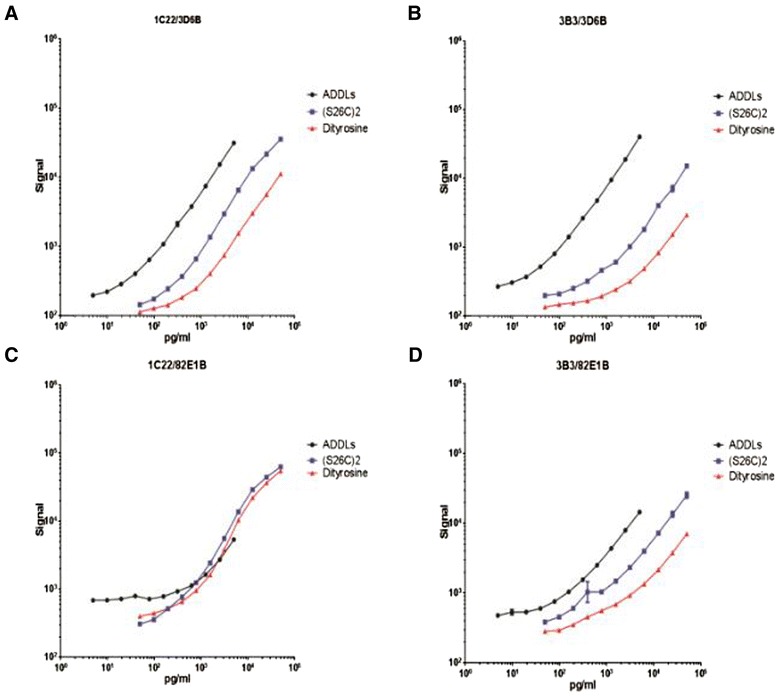
Figure 1
Figure 1
Comparison of antibody pairs in amyloid-beta oligomer enzyme-linked immunosorbent assay on the MSD platform. Four antibody pairs – 1C22/3D6B (A), 3B3/3D6B (B), 1C22/82E1B (C) and 3B3/82E1B (D) – were tested on the MSD platform (MSD Multi-Array; Meso Scale Discovery, Gaithersburg, MD, USA) for their ability to detect either amyloid-beta-derived diffusible ligands (ADDLs; black circles), the pro-aggregating (S26C)2 dimer (blue squares) or the aggregation-resistant dityrosine dimer (red triangles). Note that signal units on the y axis and concentrations of the amyloid-beta oligomers (pg/ml) on the x axis are on a log scale.
Figure 2
Figure 2
1C22/3D6 oligomer-specific ELISA on the Erenna platform specifically recognizes amyloid-beta oligomers, not monomers. (A) Amyloid-beta monomers show virtually no reactivity in the 1C22/3D6 oligomeric-specific enzyme-linked immunosorbent assay: 26,000-fold lower signal compared with oligomers. (B) Lowest end of the detection range in (A) expanded to visualize the minimal detection of monomers at very high concentrations. Dashed line at 111 on the y axis, signal of blank. ADDL, amyloid-beta-derived diffusible ligand. Erenna platform (Singulex, Alameda, CA, USA).
Figure 3
Figure 3
Analysis of size exclusion chromatography-fractioned ADDLs reveals that the oligomer-specific ELISA detects a range of different sized amyloid-beta assemblies but not monomers. The amyloid-beta-derived diffusible ligand preparation was chromatographed on a Superdex 200 10/30 HR column (GE Healthcare Biosciences, Pittsburgh, PA, USA) by eluting in sodium phosphate buffer at 0.5 ml/minute. Absorbance at 214 nm was recorded, and 0.5 ml fractions were collected and analyzed by the 1C22/3D6 Erenna oligomer-specific enzyme-linked immunosorbent assay (o-ELISA). All fractions were diluted 5 × 105-fold prior to o-ELISA. Elution positions of Blue Dextran and globular standards are indicated by arrows and molecular weights (kDa). oAβ, amyloid-beta oligomers. Erenna platform (Singulex, Alameda, CA, USA).
Figure 4
Figure 4
Oligomer-specific ELISA specifically detects human amyloid-beta species in AD-TBS brain extracts. Soluble extracts of Alzheimer’s disease (AD) brains 1 to 4 (A) and brains 5 to 9 (B) were serially diluted and assayed with the Erenna 1C22/3D6 oligomer-specific enzyme-linked immunosorbent assay (o-ELISA), revealing highly linear concentration curves in the extracts of all brains. SAT, o-ELISA value of the highest loaded standard (50 pg/ml). (C) After pre-clearing with plain beads, AD-TBS extracts of brains 5 to 9 were each subjected to sequential IPs with amyloid-beta antisera 1282 and AW7, and the resultant supernatants assayed by o-ELISA. Western blotting (inset: monoclonal antibodies 6E10 + 2G3 + 21 F12) of a representative immunodepletion experiment shows: lane 1, starting AD extract; lane 2, its supernatant after 1282 + AW7 immunodepletion; and lane 3, IP’ed 1282 + AW7 pellet. TBS, Tris-buffered saline (20 mM Tris–HCl, pH 7.4, containing 150 mM NaCl). Erenna platform (Singulex, Alameda, CA, USA).
Figure 5
Figure 5
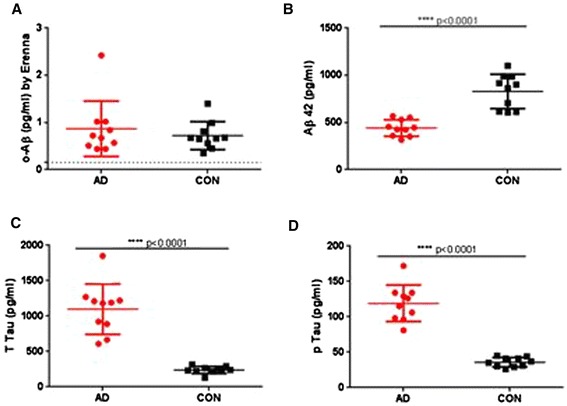
Cerebrospinal fluid levels of Aβ42, t-tau and p-tau, but not amyloid-beta oligomers, distinguish Alzheimer’s disease subjects from age-matched controls in Cohort 1. Cerebrospinal fluid (CSF) from 10 Alzheimer’s disease (AD) and 10 aged control (CON) subjects were analyzed for amyloid-beta oligomers (oAβ) (A), Aβ42 (B), total tau (C) and phosphorylated tau (D). Aβ42 quantified with monoclonal antibodies (mAbs) 21 F12 for capture and 3D6 for detection (unpaired, two-tailed t test with Welch’s correction, P <0.0001). Total tau quantified with mAbs AT120 for capture and HT7 + BT2 for detection (unpaired, two-tailed t test with Welch’s correction, P <0.0001). Tau phosphorylated at Thr181 quantified with of HT7 for capture and AT120 for detection (unpaired, two-tailed t test with Welch’s correction, P <0.0001). Horizontal bars, medians and interquartile ranges. Dashed line crosses y axis at 0.15 pg/ml, indicating the lower limit of reliable quantification. Erenna platform (Singulex, Alameda, CA, USA).
Figure 6
Figure 6
Cerebrospinal fluid levels of amyloid-beta oligomers, Aβ42, t-tau and p-tau in Cohort 2. Alzheimer’s disease subjects (AD, n = 10), mild cognitive impairment subjects (MCI, n = 10) and age-matched controls (CON, n = 10) were analyzed for amyloid-beta oligomers (oAβ) (A), Aβ42 (B), total tau (t-tau) (C) and phosphorylated tau (p-tau) (D). Aβ42, t-tau and p-tau were measured with the Luminex platform (Luminex Corporation, Austin, TX, USA) and the AlzBio3 kit (Fujirebio Europe, Ghent, Belgium). This kit simultaneously measures Aβ1–42, t-tau and P-tau181 in 75 μl cerebrospinal fluid. Horizontal bars, medians and interquartile ranges. Dashed line crosses y axis at 0.15 pg/ml, indicating the lower limit of reliable quantification. Erenna platform (Singulex, Alameda, CA, USA).
Figure 7
Figure 7
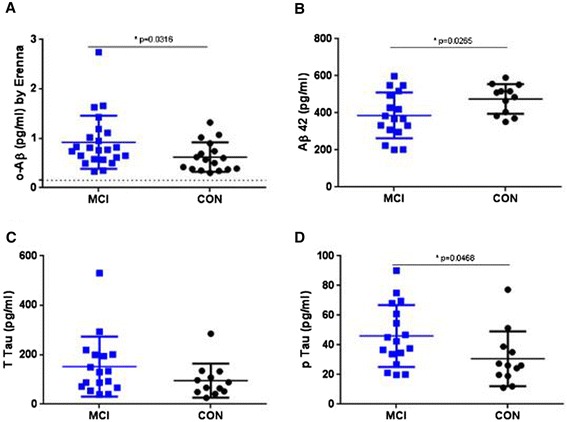
Cerebrospinal fluid levels of amyloid-beta oligomers, Aβ42, t-tau and p-tau in Cohort 3. Mild cognitive impairment subjects (MCI, n = 23) and age-matched controls (CON, n = 17) were analyzed. Significant differences are indicated. Labeling as in Figure 6. oAβ, amyloid-beta oligomers. Erenna platform (Singulex, Alameda, CA, USA).
Figure 8
Figure 8
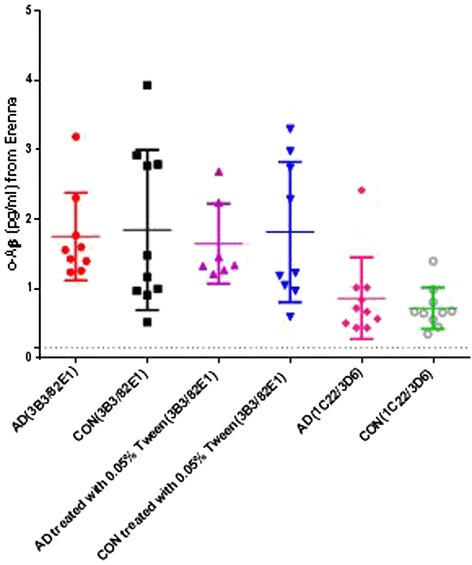
Quantifying amyloid-beta oligomers in cerebrospinal fluid of Cohort 1 using two different monoclonal antibody pairs. No significant differences in amyloid-beta oligomer (oAβ) levels between Alzheimer’s disease subjects (AD, n = 9) and controls (CON, n = 10) were obtained with either antibody pair or without versus with 0.05% Tween 20 in the samples. Labeling as in Figures 5, 6, and 7. Lower limit of reliable quantification for 1C22/3D6 and 3B3/82E1 was 0.15 pg/ml and 0.3 pg/ml, respectively; former indicated by a dashed line. Erenna platform (Singulex, Alameda, CA, USA).

References

    1. Selkoe DJ. Alzheimer’s disease is a synaptic failure. Science. 2002;298:789–91. doi: 10.1126/science.1074069. - DOI - PubMed
    1. Shankar GM, Walsh DM. Alzheimer’s disease: synaptic dysfunction and Abeta. Mol Neurodegener. 2009;4:48. doi: 10.1186/1750-1326-4-48. - DOI - PMC - PubMed
    1. Yang T, Hong S, O’Malley T, Sperling R, Walsh DM, Selkoe DJ. New ELISAs with high specificity for soluble oligomers of amyloid β-protein detect natural Aβ oligomers in human brain but not CSF. Alzheimers Dement. 2013;9:99–112. doi: 10.1016/j.jalz.2012.11.005. - DOI - PMC - PubMed
    1. Bruggink KA, Jongbloed W, Biemans EA, Veerhuis R, Claassen JA, Kuiperij HB, et al. Amyloid-beta oligomer detection by ELISA in cerebrospinal fluid and brain tissue. Anal Biochem. 2013;433:112–20. doi: 10.1016/j.ab.2012.09.014. - DOI - PubMed
    1. Holtta M, Hansson O, Andreasson U, Hertze J, Minthon L, Nagga K, et al. Evaluating amyloid-beta oligomers in cerebrospinal fluid as a biomarker for Alzheimer’s disease. PLoS One. 2013;8:e66381. doi: 10.1371/journal.pone.0066381. - DOI - PMC - PubMed