Review
. 2015 Mar 20;7(3):2044-60.
doi: 10.3390/nu7032044.

Can we translate vitamin D immunomodulating effect on innate and adaptive immunity to vaccine response?

Affiliations
Review

Can we translate vitamin D immunomodulating effect on innate and adaptive immunity to vaccine response?

Pierre Olivier Lang et al. Nutrients. .

Abstract

Vitamin D (VitD), which is well known for its classic role in the maintenance of bone mineral density, has now become increasingly studied for its extra-skeletal roles. It has an important influence on the body's immune system and modulates both innate and adaptive immunity and regulates the inflammatory cascade. In this review our aim was to describe how VitD might influence immune responsiveness and its potential modulating role in vaccine immunogenicity. In the first instance, we consider the literature that may provide molecular and genetic support to the idea that VitD status may be related to innate and/or adaptive immune response with a particular focus on vaccine immunogenicity and then discuss observational studies and controlled trials of VitD supplementation conducted in humans. Finally, we conclude with some knowledge gaps surrounding VitD and vaccine response, and that it is still premature to recommend "booster" of VitD at vaccination time to enhance vaccine response.


Figures
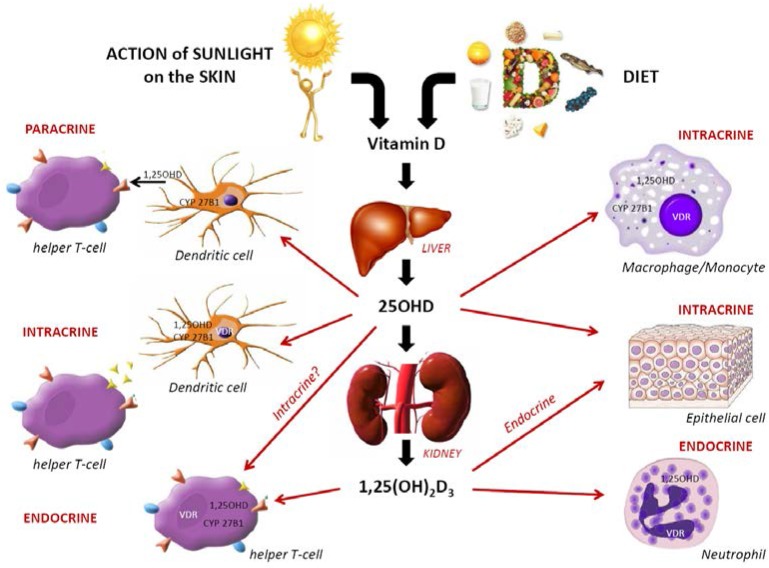
Figure 1
Figure 1
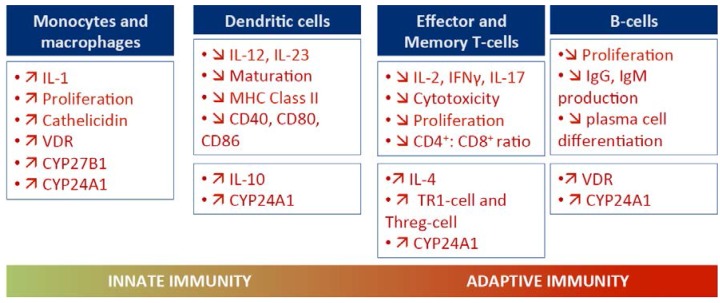
Mechanisms by which 25(OH)VitD and 1,25(OH)2VitD modulate innate and adaptive immune response (up) and overview of immunomodulatory actions on monocytes and macrophage; dendritic cells; and effector and memory T and B-cells (down). All these cells possess the enzyme (CYP27bB1) for hydroxylation steps to generate 1,25(OH)2VitD. Through endocrine, intracrine and paracrine mechanisms, the active form of VitD binds to the VitD receptor (VDR) to induce a wide range of immunological effects (adapted from Lang et al. [7]).
Figure 1
Figure 1
Mechanisms by which 25(OH)VitD and 1,25(OH)2VitD modulate innate and adaptive immune response (up) and overview of immunomodulatory actions on monocytes and macrophage; dendritic cells; and effector and memory T and B-cells (down). All these cells possess the enzyme (CYP27bB1) for hydroxylation steps to generate 1,25(OH)2VitD. Through endocrine, intracrine and paracrine mechanisms, the active form of VitD binds to the VitD receptor (VDR) to induce a wide range of immunological effects (adapted from Lang et al. [7]).
Figure 2
Figure 2
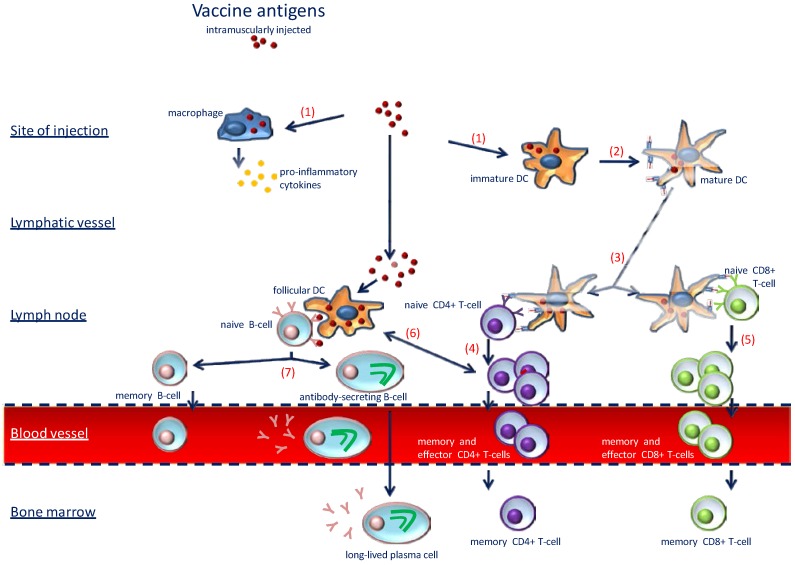
Schematic representation of the vaccine immune response. Administration of vaccine antigens induces the activation of the innate immune system. Antigens are first taken up by antigen-presenting cells (1). This local innate immune response facilitates maturation of dendritic cells (DCs) (2). Mature DCs migrate into lymph nodes (3), where they induce activation and clonal expansion of naive CD4+ (4) and CD8+ (5) T-cells. The activation and differentiation of naive B-cells is induced by antigen and CD4+ T helper cells (6) as well. Naive B-cells differentiate into memory B-cells and antibody-secreting B-cells (7). (Adapted from Lang et al. [47]).

References

    1. Holick M.F. Sunlight and vitamin D for bone health and prevention of autoimmune disease, cancers, and cardiovascular disease. Am. J. Clin. Nutr. 2004;80:1678S–1688S. - PubMed
    1. Rosen C.J. Vitamin D insufficiency. N Engl. J. Med. 2011;364:248–254. doi: 10.1056/NEJMcp1009570. - DOI - PubMed
    1. Wolpowitz D., Gilchrest B.A. The vitamin D questions: How much do you need and how should you get it? J. Am. Acad. Dermatol. 2006;54:301–317. doi: 10.1016/j.jaad.2005.11.1057. - DOI - PubMed
    1. Lang P.O., Samaras D., Samaras N. Does vitamin D deficiency contribute to further impige the state of vulnerability to infections of aging and aged adults? Eur. Geriatr. Med. 2013;4:59–65. doi: 10.1016/j.eurger.2012.11.003. - DOI
    1. Wang Y., Zhu J., DeLuca H.F. Where is the vitamin D receptor? Arch. Biochem. Biophys. 2012;523:123–133. doi: 10.1016/j.abb.2012.04.001. - DOI - PubMed