


Survival and Racial Differences of Non-Small Cell Lung Cancer in the United States Military
- PMID: 25805503
- PMCID: PMC4579211
- DOI: 10.1007/s11606-015-3280-z
Survival and Racial Differences of Non-Small Cell Lung Cancer in the United States Military
Abstract
Background: Lung cancer is the leading cause of cancer-related death in the United States (US) Military and worldwide, with non-small cell lung cancer (NSCLC) accounting for 87 % of cases.
Objectives: Using a US military cohort who receives equal and open access to healthcare, we sought to examine demographic, clinical features and outcomes with NSCLC.
Design and participants: We conducted a retrospective cohort analysis of 4,751 patients, aged ≥ 18 years and diagnosed with a first primary NSCLC between 1 January 2003 and 31 December 2013 in the US Department of Defense (DoD) cancer registry.
Main measures: Differences by patient and disease characteristics were compared using Chi-square and t-test. Kaplan Meier curves and Cox proportional hazards regression assessed overall survival.
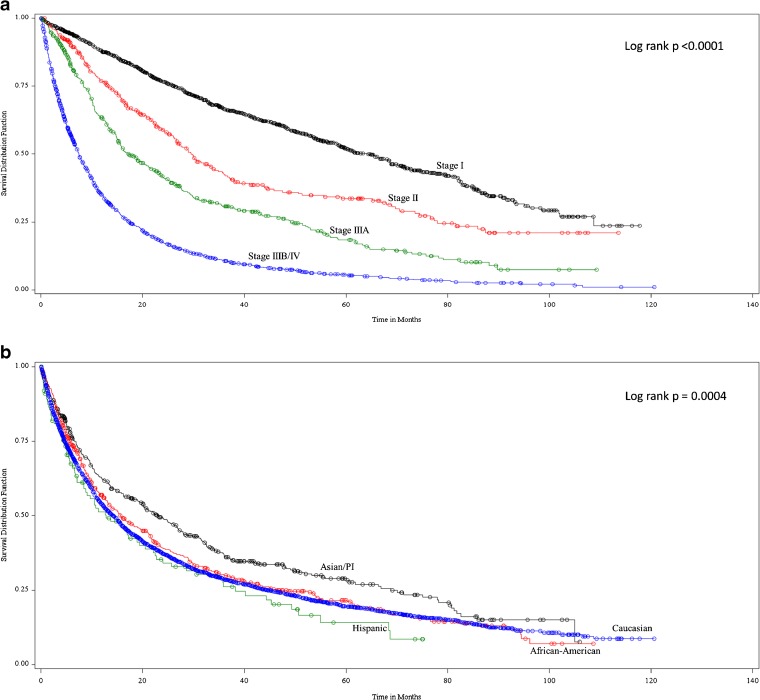
Results: The mean age at diagnosis was 66 years, 64 % were male, 72 % were Caucasian, 41 % were diagnosed at early stage, 77 % received treatment and 82 % had a history of tobacco use. Mean age at diagnosis was highest among Caucasians (67 years) and lowest among African Americans (AA; 62 years). Asian/Pacific Islanders (PI) were more likely to be female (p < 0.0001), have adenocarcinoma histology (p = 0.0003) and less likely to have a history of tobacco use (p < 0.0001) compared to other racial/ethnic groups. In multivariable survival analysis, older age, male gender, increasing stage, not receiving treatment, and tobacco history were associated with higher mortality risk. Untreated patients exhibited a 39 % higher mortality risk compared to treated patients (HR = 1.39; 95%CI = 1.23-1.57). Compared to Caucasian patients, Asian/PIs demonstrated a 20 % lower risk of death (HR = 0.80; 95%CI = 0.66-0.96). There was no difference in mortality risk between AAs and Hispanics compared to Caucasians.
Conclusion: The lack of significant outcome disparity between AAs and Caucasians and the earlier stage at diagnosis than usually seen in civilian populations suggest that equal access to healthcare may play a role in early detection and survival.
Keywords: lung cancer; military; survival outcomes.
Figures
Comment in
-
Equity in Lung Cancer Care and Outcomes.J Gen Intern Med. 2015 Oct;30(10):1385-6. doi: 10.1007/s11606-015-3346-y. J Gen Intern Med. 2015. PMID: 25903994 Free PMC article. No abstract available.
References
-
- American Cancer Society. Cancer Facts & Figures 2010. Available at: http://www.cancer.org/acs/groups/content/@nho/documents/document/acspc-0... [accessed February 26, 2015].
Publication types
MeSH terms
LinkOut - more resources
Full Text Sources
Other Literature Sources
Medical
Research Materials
Miscellaneous
