. 2015 Mar 24;18(7):pyv024.
doi: 10.1093/ijnp/pyv024.

Eating high fat chow decreases dopamine clearance in adolescent and adult male rats but selectively enhances the locomotor stimulating effects of cocaine in adolescents

Affiliations

Eating high fat chow decreases dopamine clearance in adolescent and adult male rats but selectively enhances the locomotor stimulating effects of cocaine in adolescents

Michelle G Baladi et al. Int J Neuropsychopharmacol. .

Abstract

Background: Feeding conditions can influence dopamine neurotransmission and impact behavioral and neurochemical effects of drugs acting on dopamine systems. This study examined whether eating high fat chow alters the locomotor effects of cocaine and dopamine transporter activity in adolescent (postnatal day 25) and adult (postnatal day 75) male Sprague-Dawley rats.

Methods: Dose-response curves for cocaine-induced locomotor activity were generated in rats with free access to either standard or high fat chow or restricted access to high fat chow (body weight matched to rats eating standard chow).

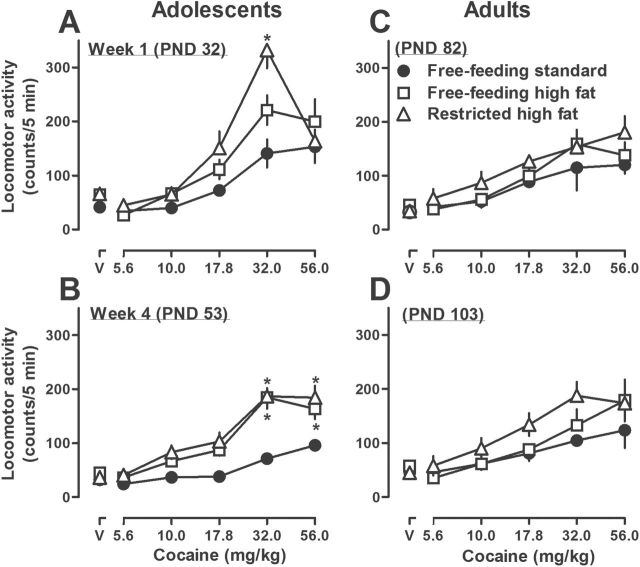
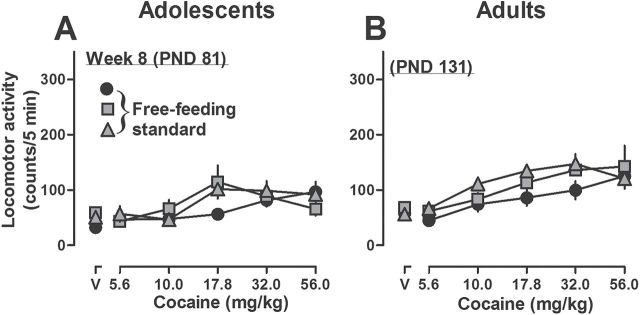
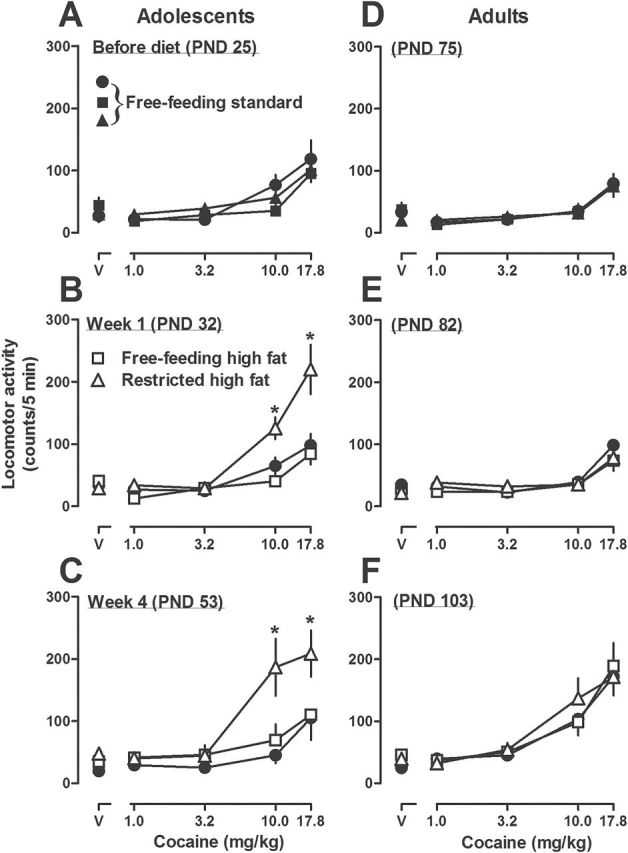
Results: Compared with eating standard chow, eating high fat chow increased the sensitivity of adolescent, but not adult, rats to the acute effects of cocaine. When tested once per week, sensitization to the locomotor effects of cocaine was enhanced in adolescent rats eating high fat chow compared with adolescent rats eating standard chow. Sensitization to cocaine was not different among feeding conditions in adults. When adolescent rats that previously ate high fat chow ate standard chow, sensitivity to cocaine returned to normal. As measured by chronoamperometry, dopamine clearance rate in striatum was decreased in both adolescent and adult rats eating high fat chow compared with age-matched rats eating standard chow.

Conclusions: These results suggest that high fat diet-induced reductions in dopamine clearance rate do not always correspond to increased sensitivity to the locomotor effects of cocaine, suggesting that mechanisms other than dopamine transporter might play a role. Moreover, in adolescent but not adult rats, eating high fat chow increases sensitivity to cocaine and enhances the sensitization that develops to cocaine.

Keywords: Cocaine; adolescents; dopamine transporter; high fat chow; locomotor activity.


Figures

Figure 1.
Figure 1.
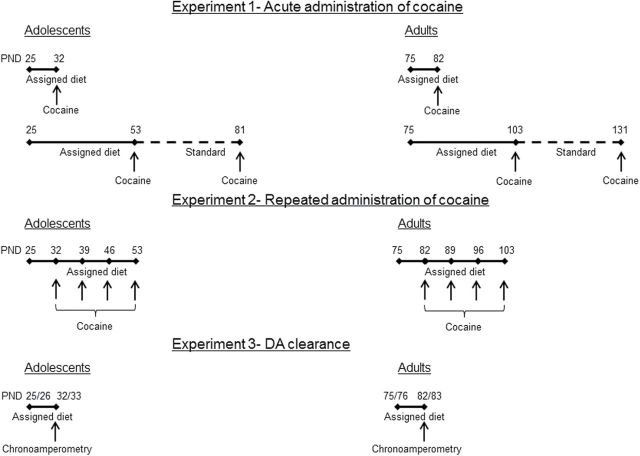
Experimental design. Numbers above time lines indicate age as postnatal day (PND) and slash mark between numbers represent the range of PND for groups (e.g., PND 25/6). Top time line is experiment 1 (acute administration of cocaine and locomotor activity), middle time line is experiment 2 (repeated administration of cocaine and locomotor activity), and bottom time line is experiment 3 (dopamine [DA] clearance).
Figure 2.
Figure 2.
Effects of acutely administered cocaine on locomotor activity in adolescent (A-B) and adult (C-D) rats with free access to either standard or high fat chow or restricted access to high fat chow for either 1 (A,C) or 4 (B,D) weeks. Each condition represents the mean ±SEM of 6 rats (i.e., data from different groups of rats are presented in different panels with symbols designating feed condition). Abscissae: dose in mg/kg of body weight; data points above V indicate the effects obtained with vehicle. Ordinates: mean locomotor activity counts/5min (±SEM). *P<.05 compared with rats that ate standard chow throughout the study at the corresponding dose of cocaine and analyzed by a 2-way (dose and feeding condition), repeated-measures ANOVA with posthoc Bonferroni’s test.
Figure 3.
Figure 3.
Area under the curve (AUC) in adolescent (postnatal day [PND] 32 and 53, left panel) and adult (PND 82 and 103, right panel) rats with free access to either standard or high fat chow or restricted access to high fat chow for either 1 or 4 weeks and treated acutely with cocaine. Each symbol represents the mean ±SEM of 6 rats (same data as plotted in Figure 1). Abscissa: PND age in days. Ordinate: mean AUC (±SEM).*P<.05 compared with rats that had free access to standard chow at the corresponding age and analyzed by a 1-way (feeding condition), repeated-measures ANOVA with posthoc Bonferroni’s test.
Figure 4.
Figure 4.
Effects of acutely administered cocaine on locomotor activity in adolescent (A) and adult (B) rats that ate standard chow for 4 weeks. Circles indicate rats that ate standard chow throughout the study; gray symbols indicate rats that previously had free (squares) or restricted (triangles) access to high fat chow (n=6 per group). See Figure 2 for other details.
Figure 5.
Figure 5.
Effects of repeated cocaine administration on locomotor activity in adolescent (A-C) and adult (D-F) rats with free access to standard chow (A,D) followed by free access to either standard or high fat chow or restricted access to high fat chow for 1 (B,E) or 4 (C,F) weeks (data from the same rats [adolescent left, adult right] are presented in upper, middle, and lower panels; n=6 per group). See Figure 2 for other details.
Figure 6.
Figure 6.
Area under the curve (AUC) in adolescent (postnatal day [PND] 25–53, left panel) and adult (PND 75–103, right panel) rats with free access to either standard or high fat chow or restricted access to high fat chow and tested once per week with cocaine for 4 weeks. Each symbol represents the mean ±SEM of 6 rats (same data as plotted in Figure 4). Abscissa: PND age in days. Ordinate: mean AUC (±SEM). *P<.05 compared with rats that had free access to standard chow throughout the study at the corresponding age. #P<.05 compared with the same rats when they had free access to standard chow at the beginning of the study (i.e., PND 25 or 75).
Figure 7.
Figure 7.
Rate of dopamine (DA) clearance (nM/sec) in adolescent (A) and adult (B) rats with free access to either standard or high fat chow or restricted access to high fat chow for 1 week. Each symbol represents the mean ±SEM of 6 to 8 rats. Abscissa: concentration of DA in pmol. Ordinates: mean DA clearance rate in nM/sec (±SEM).

References

    1. Acri JB, Carter SR, Alling K, Geter-Douglass B, Dijkstra D, Wikström H, Katz JL, Witkin JM. (1995). Assessment of cocaine-like discriminative stimulus effects of dopamine D3 receptor ligands. Eur J Pharmacol 281:R7–R9. - PubMed
    1. Amara SG, Sonders MS. (1998). Neurotransmitter transporters as molecular targets for addictive drugs. Drug Alcohol Depend 51:87–96. - PubMed
    1. Andersen SL, Teicher MH. (2000). Sex differences in dopamine receptors and their relevance to ADHD. Neurosci Biobehav Rev 24:137–141. - PubMed
    1. Arteaga I, Chen C, Reynolds AJ. (2010). Childhood predictors of adult substance abuse. Child Youth Serv Rev 32:1108–1120. - PMC - PubMed
    1. Baladi MG, France CP. (2009). High fat diet and food restriction differentially modify the behavioral effects of quinpirole and raclopride in rats. Eur J Pharmacol 610:55–60. - PMC - PubMed

Publication types

MeSH terms