


Contingent vouchers and motivational interviewing for cigarette smokers in residential substance abuse treatment
- PMID: 25805668
- PMCID: PMC4456203
- DOI: 10.1016/j.jsat.2015.02.010
Contingent vouchers and motivational interviewing for cigarette smokers in residential substance abuse treatment
Abstract
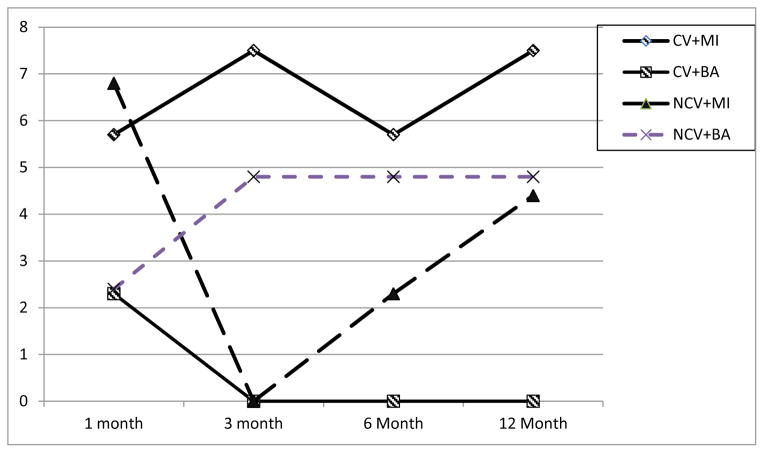
Residential drug treatment provides an opportunity to intervene with smokers with substance use disorders (SUD). A randomized controlled clinical trial compared: (1) contingent vouchers (CV) for smoking abstinence to noncontingent vouchers (NCV), crossed with (2) motivational interviewing (MI) or brief advice (BA), for 184 smokers in SUD treatment. During the voucher period, 36% of carbon monoxide readings indicated smoking abstinence for those receiving CV versus 13% with NCV (p < .001). Post-treatment (3-9 months) point-prevalence abstinence rates were low (3-4% at each follow up), with more abstinence when CV was combined with MI (6.6% on average) than with BA (0% on average). No differential effects on drug use or motivation to quit smoking occurred. Thus, CV had limited effects on long-term smoking abstinence in this population but effects were improved when CV was combined with MI. More effective methods are needed to increase motivation to quit smoking and quit rates in this high-risk population.
Keywords: Brief advice; Contingency management; Contingent vouchers; Financial incentives; Motivation to quit smoking; Motivational interviewing; Nicotine dependence; Point-prevalence abstinence; Smoking cessation; Substance use disorders.
Published by Elsevier Inc.
Figures
References
-
- Asher MK, Martin RA, Rohsenow DJ, MacKinnon SV, Traficante R, Monti PM. Perceived barriers to quitting smoking among alcohol dependent patients in treatment. Journal of Substance Abuse Treatment. 2003;24:169–174. - PubMed
-
- Baca CT, Yahne CE. Smoking cessation during substance abuse treatment: What you need to know. Journal of Substance Abuse Treatment. 2009;36:205–219. - PubMed
-
- Battjes RJ. Smoking as an issue in alcohol and drug abuse treatment. Addictive Behaviors. 1988;13:225–230. - PubMed
Publication types
MeSH terms
Grants and funding
LinkOut - more resources
Full Text Sources
Other Literature Sources
Medical
