. 2015 Mar 24;6(2):e02368-14.
doi: 10.1128/mBio.02368-14.

A modified R-type bacteriocin specifically targeting Clostridium difficile prevents colonization of mice without affecting gut microbiota diversity

Affiliations

A modified R-type bacteriocin specifically targeting Clostridium difficile prevents colonization of mice without affecting gut microbiota diversity

Dana Gebhart et al. mBio. .

Abstract

Clostridium difficile is a leading cause of nosocomial infections worldwide and has become an urgent public health threat requiring immediate attention. Epidemic lineages of the BI/NAP1/027 strain type have emerged and spread through health care systems across the globe over the past decade. Limiting person-to-person transmission and eradicating C. difficile, especially the BI/NAP1/027 strain type, from health care facilities are difficult due to the abundant shedding of spores that are impervious to most interventions. Effective prophylaxis for C. difficile infection (CDI) is lacking. We have genetically modified a contractile R-type bacteriocin ("diffocin") from C. difficile strain CD4 to kill BI/NAP1/027-type strains for this purpose. The natural receptor binding protein (RBP) responsible for diffocin targeting was replaced with a newly discovered RBP identified within a prophage of a BI/NAP1/027-type target strain by genome mining. The resulting modified diffocins (a.k.a. Avidocin-CDs), Av-CD291.1 and Av-CD291.2, were stable and killed all 16 tested BI/NAP1/027-type strains. Av-CD291.2 administered in drinking water survived passage through the mouse gastrointestinal (GI) tract, did not detectably alter the mouse gut microbiota or disrupt natural colonization resistance to C. difficile or the vancomycin-resistant Enterococcus faecium (VREF), and prevented antibiotic-induced colonization of mice inoculated with BI/NAP1/027-type spores. Given the high incidence and virulence of the pathogen, preventing colonization by BI/NAP1/027-type strains and limiting their transmission could significantly reduce the occurrence of the most severe CDIs. This modified diffocin represents a prototype of an Avidocin-CD platform capable of producing targetable, precision anti-C. difficile agents that can prevent and potentially treat CDIs without disrupting protective indigenous microbiota.

Importance: Treatment and prevention strategies for bacterial diseases rely heavily on traditional antibiotics, which impose strong selection for resistance and disrupt protective microbiota. One consequence has been an upsurge of opportunistic pathogens, such as Clostridium difficile, that exploit antibiotic-induced disruptions in gut microbiota to proliferate and cause life-threatening diseases. We have developed alternative agents that utilize contractile bactericidal protein complexes (R-type bacteriocins) to kill specific C. difficile pathogens. Efficacy in a preclinical animal study indicates these molecules warrant further development as potential prophylactic agents to prevent C. difficile infections in humans. Since these agents do not detectably alter the indigenous gut microbiota or colonization resistance in mice, we believe they will be safe to administer as a prophylactic to block transmission in high-risk environments without rendering patients susceptible to enteric infection after cessation of treatment.


Figures

FIG 1
FIG 1
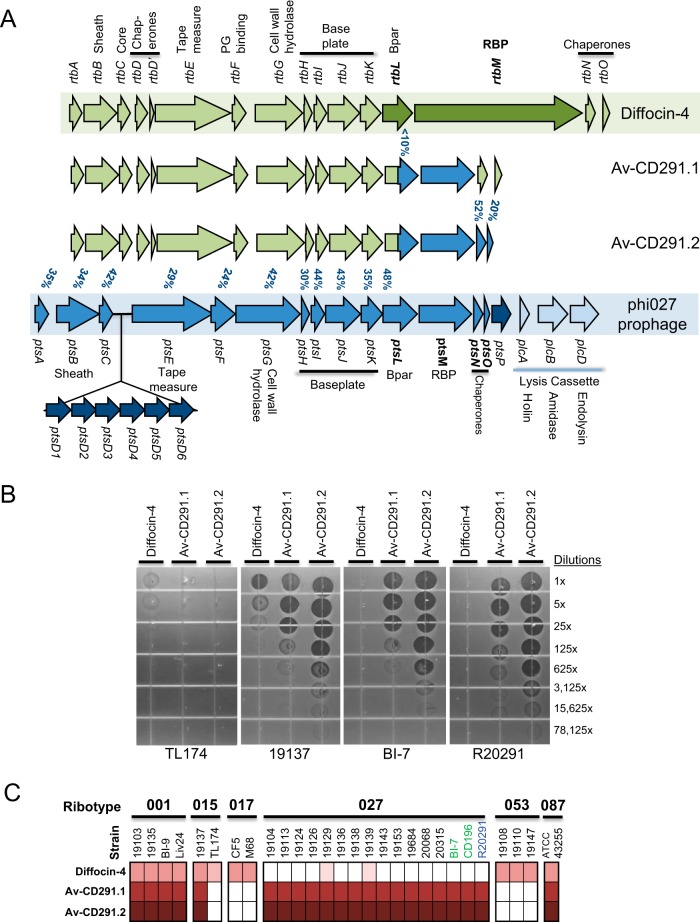
Retargeting diffocins with a prophage RBP from C. difficile strain R20291. (A) Schematic representation of gene clusters coding for diffocin-4 (green) and modified diffocins Av-CD291.1 and Av-CD291.2 and including the tail structure genes of the phi027 prophage (blue). Genes are color coded according to source. For the phi027 prophage, the lysis cassette present only in the phi027 prophage is depicted in light blue and structural genes with no homology in the diffocin gene cluster are depicted in dark blue. The percentages of similarity between the diffocin-4 and phi027 genes are given (blue). (B) In vitro spot bioassays for bactericidal activity are shown for several strains. Preparations of diffocin-4, Av-CD291.1, and Av-CD291.2 were serially diluted and spotted on a soft agar lawn containing the indicated target strain. Dark zones of clearance indicate killing. Overlapping but distinct killing specificities for each diffocin preparation, which were all produced from a genetically identical B. subtilis host cell and by the same method, indicate killing is specific to the diffocin and not due to any nonspecific, contaminating B. subtilis protein. (C) The strain coverage for diffocin-4, Av-CD291.1, and Av-CD291.2 for ribotypes 001, 015, 017, 027, 053, and 087 is shown. White indicates no killing, and maroon indicates killing—with intensity of maroon reflecting robustness of killing. Strain designations in green and blue indicate known FQR1 and FQR2 phylogenies, respectively. An additional 20 strains representing 13 ribotypes were also tested and found not to be sensitive to Av-CD291.2 (data not shown).
FIG 2
FIG 2
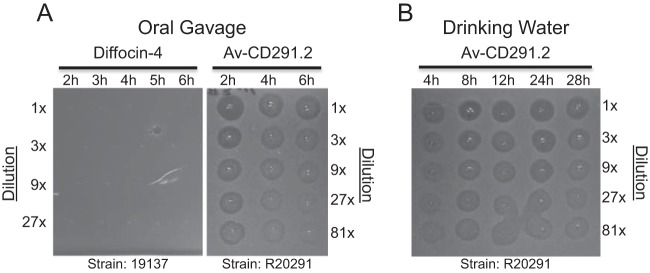
Enteric pharmacokinetics of diffocin-4 and Av-CD291.2 orally administered to mice. R-type bacteriocins that survive transit through the GI tract intact are detectable in feces by in vitro spot bioassays for bactericidal activity. Briefly, groups of 3 mice were administered diffocin-4 or Av-CD291.2 in 1% NaHCO3 (100 µg/dose [5 × 10¹¹ KU]) via oral gavage (A) or in drinking water (60 µg/ml [3 × 10¹¹ KU/ml]) containing 4% sucrose and 1% NaHCO3 for 28 h (B). Drinking water consumption averaged ~0.5 ml/h. Fecal pellets were collected and homogenized at the times indicated after oral gavage (A) or after introduction of Av-CD291.2 in drinking water (B). Fecal pellets collected at the indicated times were then filtered to remove microbial contaminants. The filtered homogenates were serially diluted and spotted on a soft agar lawn of the appropriately sensitive C. difficile strain R20291 (RT027). Dark zones of clearance indicate killing. Results from a representative mouse are shown for each condition.
FIG 3
FIG 3
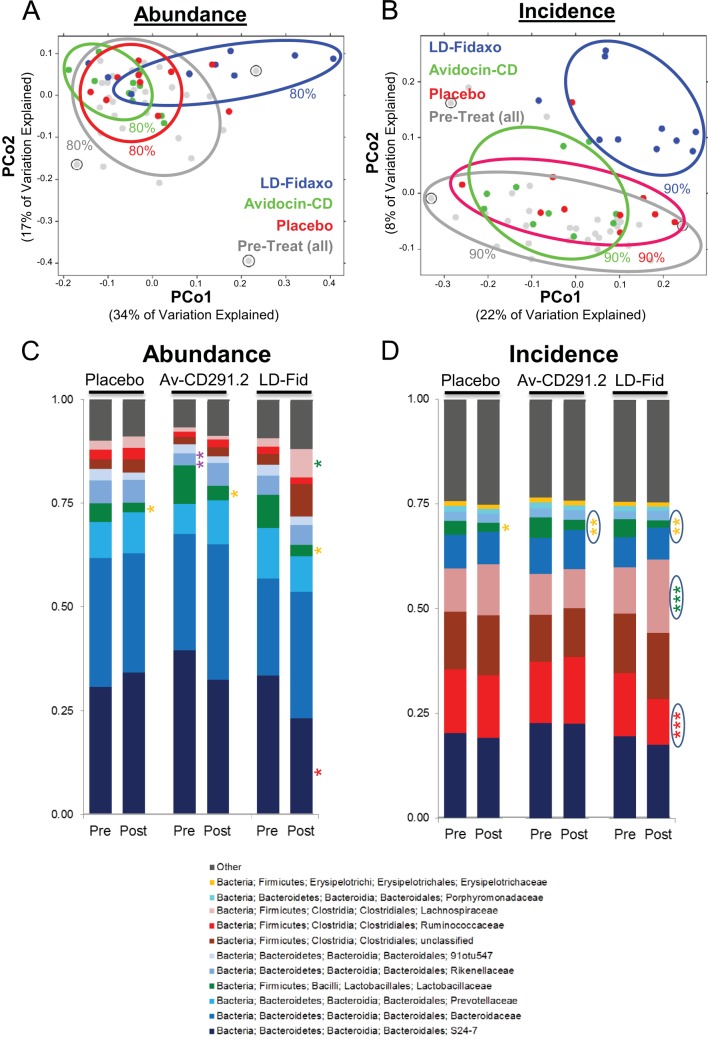
Oral administration of Av-CD291.2 in drinking water does not disturb the indigenous gut microbiota of healthy mice. (A) Analysis of the variance between microbial communities from the feces of healthy mice pretreatment (all) and posttreatment for each of the groups. The variance was assessed by the average relative abundance (weighted UniFrac distances) of OTU using principal component analysis. Samples are color coded according to treatment. Circled pretreatment samples indicate pretreatment outliers (one from each pretreatment cohort) that were removed from the microbiota analyses. Zone of inclusion are given with percentages. PCo1, principal component 1; PCo2, principal component 2. (B) Same as in panel A, except the average relative incidence (unweighted UniFrac distances) for OTU was assessed. (C) Bar charts depict the average family level composition (top 9) of OTU detected for each treatment group pre- and posttreatment by relative abundance. Significant differences between pre- and posttreatment are indicated by asterisks (*, 0.01 < P < 0.05; **, 0.001 < P < 0.01). Green asterisks indicate families elevated posttreatment, red asterisks indicate families reduced posttreatment, orange asterisks indicate families reduced posttreatment relative to all pretreatments, and purple indicates a family lower in one pretreatment cohort relative to most or all other pre- and posttreatment cohorts. (D) Same as in panel C, except the average family-level compositions (top 9) pre- and posttreatment were detected by relative incidence. Significant differences between pre- and posttreatment are indicated by asterisks as in panel C (***, P < 0.001). Circled asterisks indicate significant differences that remained after a false discovery rate correction was applied.
FIG 4
FIG 4
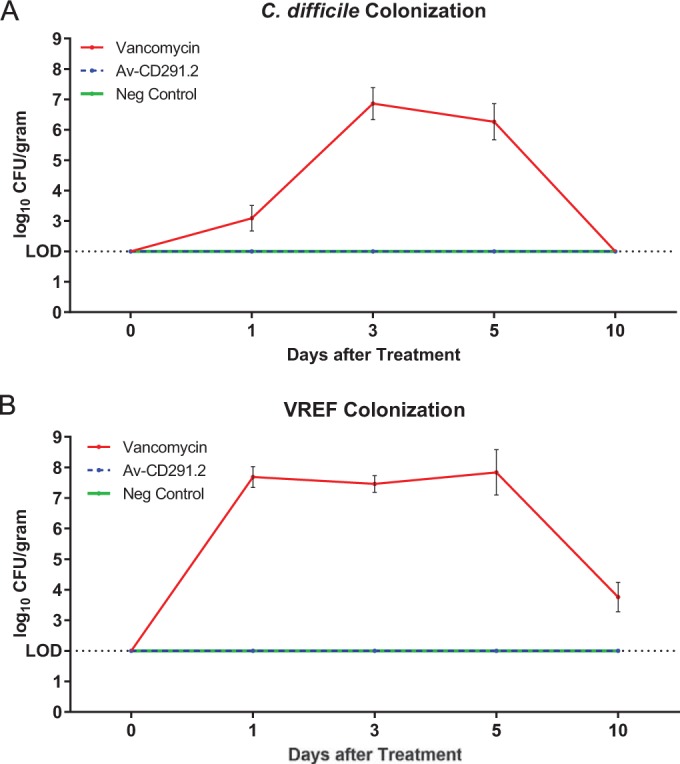
Oral administration of Av-CD291.2 in drinking water does not disturb colonization resistance to C. difficile (A) or vancomycin-resistant E. faecium (VREF) (B) in mice. Mice were administered Av-CD291.2 (2× the equivalent daily dose [mg/kg] in the microbiota study), vancomycin (37.5 mg/kg/day), or the placebo control for 4 days in the drinking water. Following a washout period, mice were inoculated with the BI/NAP1/027-type C. difficile strain or VREF C68 strain (104 CFU) by oral gavage. Fecal samples were collected on days 1, 3, 5, and 10 postinoculation and assayed for C. difficile or VREF CFU. If pathogens were not detected in stool, the lower limit of detection (2 log10 CFU/g) was assigned. The standard errors of the means (SEM) for vancomycin-treated mice are shown.

Comment in

References

    1. Centers for Disease Control and Prevention 2013. Antibiotic resistance threats in the United States, 2013. Centers for Disease Control and Prevention, Atlanta, GA.
    1. See I, Mu Y, Cohen J, Beldavs ZG, Winston LG, Dumyati G, Holzbauer S, Dunn J, Farley MM, Lyons C, Johnston H, Phipps E, Perlmutter R, Anderson L, Gerding DN, Lessa FC. 2014. NAP1 strain type predicts outcomes from Clostridium difficile infection. Clin Infect Dis 58:1394–1400. doi:10.1093/cid/ciu125. - DOI - PMC - PubMed
    1. Tickler IA, Goering RV, Whitmore JD, Lynn AN, Persing DH, Tenover FC, Healthcare Associated Infection Consortium . 2014. Strain types and antimicrobial resistance patterns of Clostridium difficile isolates from the United States: 2011–2013. Antimicrob Agents Chemother 58:4214–4218. doi:10.1128/AAC.02775-13. - DOI - PMC - PubMed
    1. He M, Miyajima F, Roberts P, Ellison L, Pickard DJ, Martin MJ, Connor TR, Harris SR, Fairley D, Bamford KB, D’Arc S, Brazier J, Brown D, Coia JE, Douce G, Gerding D, Kim HJ, Koh TH, Kato H, Senoh M, Louie T, Michell S, Butt E, Peacock SJ, Brown NM, Riley T, Songer G, Wilcox M, Pirmohamed M, Kuijper E, Hawkey P, Wren BW, Dougan G, Parkhill J, Lawley TD. 2013. Emergence and global spread of epidemic healthcare-associated Clostridium difficile. Nat Genet 45:109–113. doi:10.1038/ng.2478. - DOI - PMC - PubMed
    1. Figueroa I, Johnson S, Sambol SP, Goldstein EJC, Citron DM, Gerding DN. 2012. Relapse versus reinfection: recurrent Clostridium difficile infection following treatment with fidaxomicin or vancomycin. Clin Infect Dis 55(Suppl 2):S104–S109. doi:10.1093/cid/cis357. - DOI - PMC - PubMed

Publication types

MeSH terms

LinkOut - more resources