


Decreases in adolescent weekly alcohol use in Europe and North America: evidence from 28 countries from 2002 to 2010
- PMID: 25805792
- PMCID: PMC4408543
- DOI: 10.1093/eurpub/ckv031
Decreases in adolescent weekly alcohol use in Europe and North America: evidence from 28 countries from 2002 to 2010
Abstract
Background: This study examined trends in adolescent weekly alcohol use between 2002 and 2010 in 28 European and North American countries.
Methods: Analyses were based on data from 11-, 13- and 15-year-old adolescents who participated in the Health Behaviour in School-Aged Children (HBSC) study in 2002, 2006 and 2010.
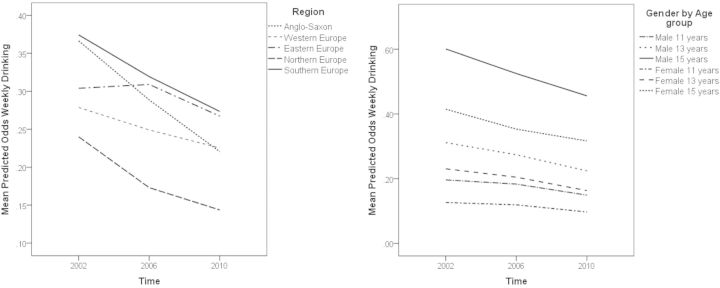
Results: Weekly alcohol use declined in 20 of 28 countries and in all geographic regions, from 12.1 to 6.1% in Anglo-Saxon countries, 11.4 to 7.8% in Western Europe, 9.3 to 4.1% in Northern Europe and 16.3 to 9.9% in Southern Europe. Even in Eastern Europe, where a stable trend was observed between 2002 and 2006, weekly alcohol use declined between 2006 and 2010 from 12.3 to 10.1%. The decline was evident in all gender and age subgroups.
Conclusions: These consistent trends may be attributable to increased awareness of the harmful effects of alcohol for adolescent development and the implementation of associated prevention efforts, or changes in social norms and conditions. Although the declining trend was remarkably similar across countries, prevalence rates still differed considerably across countries.
© The Author 2015. Published by Oxford University Press on behalf of the European Public Health Association. All rights reserved.
Figures
References
-
- Rehm JUR, Rehn N, Room R, et al. The global distribution of average volume of alcohol consumption and patterns of drinking. Eur Addict Res. 2003;9:147–56. - PubMed
-
- Anderson P, Baumberg B. Alcohol in Europe. A Public Health Perspective. Luxembourg: European Communities; 2006. pp. 75–130.
-
- Hibell B, Guttormsson U, Ahlström S, et al. The 2011 ESPAD Report. Substance Use among Students in 36 European Countries. Stockholm: The Swedish Council for Information on Alcohol and Other Drugs (CAN); 2012. pp. 123–34.
MeSH terms
LinkOut - more resources
Full Text Sources
Other Literature Sources
Medical
