


What has happened to suicides during the Greek economic crisis? Findings from an ecological study of suicides and their determinants (2003-2012)
- PMID: 25807950
- PMCID: PMC4386238
- DOI: 10.1136/bmjopen-2014-007295
What has happened to suicides during the Greek economic crisis? Findings from an ecological study of suicides and their determinants (2003-2012)
Erratum in
-
Correction.BMJ Open. 2017 Mar 10;7(3):e007295corr1. doi: 10.1136/bmjopen-2014-007295corr1. BMJ Open. 2017. PMID: 28283494 Free PMC article. No abstract available.
Abstract
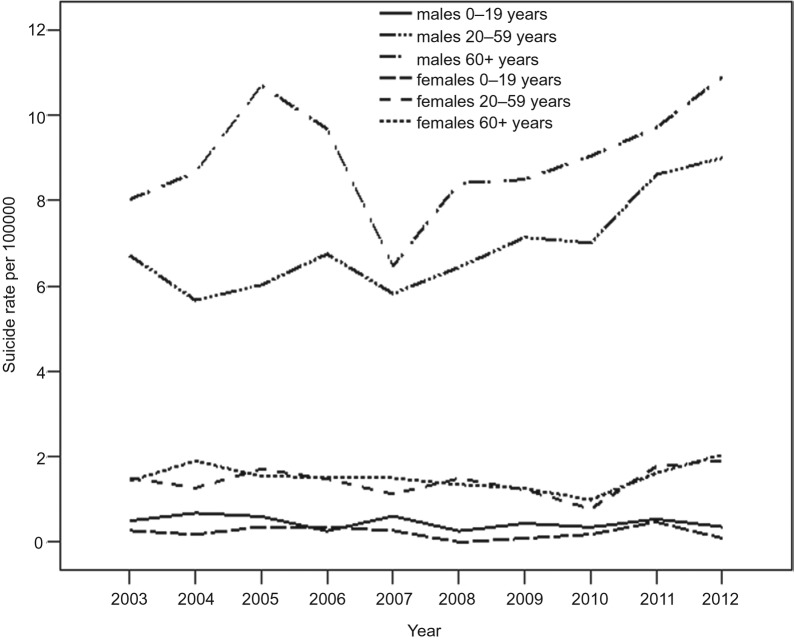
Objectives: There is a controversy about the impact of economic crisis on suicide rates in Greece. We analysed recent suicide data to identify who has been most affected and the relationships to economic and labour market indicators.
Setting: Greece.
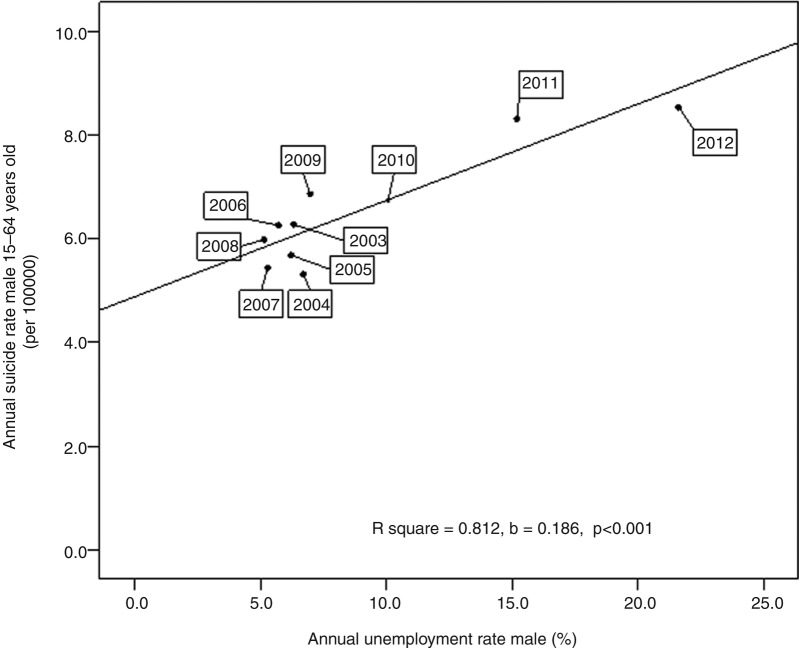
Primary and secondary outcome measures: Age-specific and sex-specific suicide rates in Greece for the period 2003-2012 were calculated using data provided by the Hellenic Statistical Authority. We performed a join-point analysis to identify discontinuities in suicide trends between 2003 and 2010, prior to austerity, and in 2011-2012, during the period of austerity. Regression models were used to assess relationships between unemployment, Gross Domestic Product (GDP) and suicide rates for the entire period by age and sex.
Results: The mean suicide rate overall rose by 35% between 2010 and 2012, from 3.37 to 4.56/100,000 population. The suicide mortality rate for men increased from 5.75 (2003-2010) to 7.43/100,000 (2011-2012; p<0.01). Among women, the suicide rate also rose, albeit less markedly, from 1.17 to 1.55 (p=0.03). When differentiated by age group, suicide mortality increased among both sexes in the age groups 20-59 and >60 years. We found that each additional percentage point of unemployment was associated with a 0.19/100,000 population rise in suicides (95% CI 0.11 to 0.26) among working age men.
Conclusions: We found a clear increase in suicides among persons of working age, coinciding with austerity measures. These findings corroborate concerns that increased suicide risk in Greece is a health hazard associated with austerity measures.
Keywords: EPIDEMIOLOGY; Greece; austerity; suicides.
Published by the BMJ Publishing Group Limited. For permission to use (where not already granted under a licence) please go to http://group.bmj.com/group/rights-licensing/permissions.
Figures
References
-
- Rauch B, Göttsche M, Brähler G et al. Fact and fiction in EU-governmental economic data. German Econ Rev 2011;12:243–55. 10.1111/j.1468-0475.2011.00542.x - DOI
-
- Hope K. Grim effects of austerity show on Greek streets. Financial Times 17 February 2012.
-
- Henley J. Greece on the breadline: how leftovers became a meal. Guardian 14 March 2012.
Publication types
MeSH terms
Grants and funding
LinkOut - more resources
Full Text Sources
Other Literature Sources
Medical
