


The Rural Obstetric Workforce in US Hospitals: Challenges and Opportunities
- PMID: 25808202
- PMCID: PMC4580490
- DOI: 10.1111/jrh.12112
The Rural Obstetric Workforce in US Hospitals: Challenges and Opportunities
Abstract
Purpose: The purpose of this study was to describe the types and combinations of clinicians who are delivering babies in rural hospitals, their employment status, the relationship between hospital birth volume and staffing models, and the staffing challenges faced by rural hospitals.
Methods: We conducted a telephone survey of 306 rural hospitals in 9 states: Colorado, Iowa, Kentucky, New York, North Carolina, Oregon, Vermont, Washington, and Wisconsin, from November 2013 to March 2014 to assess their obstetric workforce. Bivariate associations between hospitals' annual birth volume and obstetric workforce characteristics were examined, as well as qualitative analysis of workforce changes and staffing challenges.
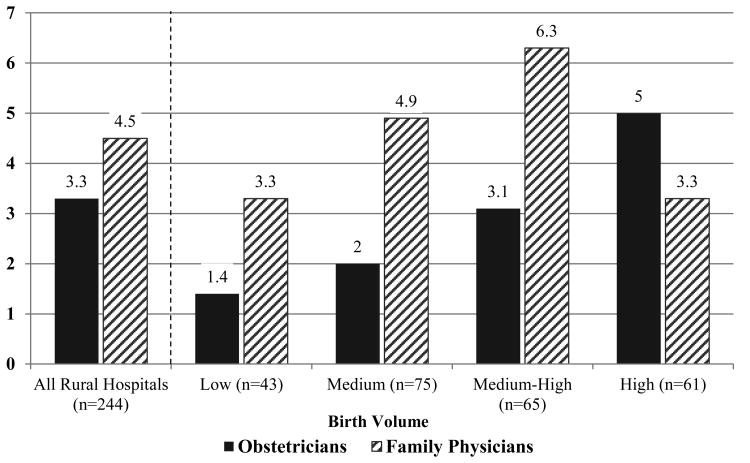
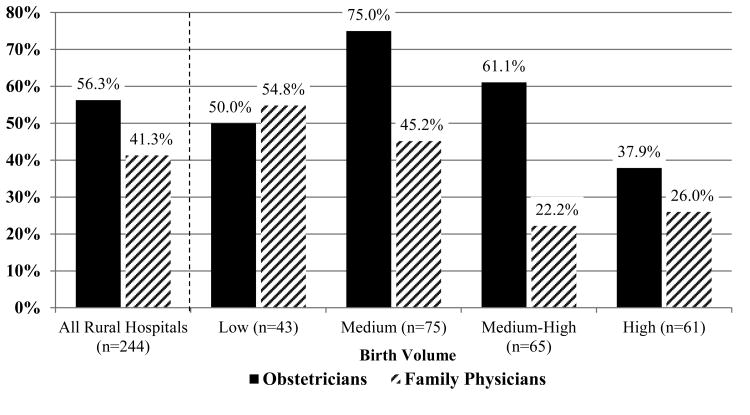
Findings: Hospitals with lower birth volume (<240 births per year) are more likely to have family physicians and general surgeons attending deliveries, while those with a higher birth volume more frequently have obstetricians and midwives attending deliveries. Reported staffing challenges include scheduling, training, census fluctuation, recruitment and retention, and intrahospital relationships.
Conclusions: Individual hospitals working in isolation may struggle to address staffing challenges. Federal and state policy makers, regional collaboratives, and health care delivery systems can facilitate solutions through programs such as telehealth, simulation training, and interprofessional education.
Keywords: access to care; family medicine; health services research; hospitals; physician supply.
© 2015 National Rural Health Association.
Figures
References
-
- Rayburn WF, Richards ME, Elwell EC. Drive times to hospitals with perinatal care in the United States. Obstet Gynecol. 2012;119(3):611–616. - PubMed
-
- Zhao L. Working paper #2007–04. Chapel Hill, NC: The Walsh Center for Rural Health Analysis; Apr, 2007. Why are fewer hospitals in the delivery business? cited 2014 August 8.
-
- Simpson KR. An overview of distribution of births in United States hospitals in 2008 with implications for small volume perinatal units in rural hospitals. J Obstet Gynecol Neonatal Nurs. 2011;40(4):432–439. - PubMed
-
- Kozhimannil KB, Hung P, Prasad S, Casey M, McClellan M, Moscovice IS. Birth volume and the quality of obstetric care in rural hospitals. J Rural Health. 2014;30(4):335–43. - PubMed
Publication types
MeSH terms
Grants and funding
LinkOut - more resources
Full Text Sources
Other Literature Sources
Medical
