


Apolipoprotein L1 gene variants in deceased organ donors are associated with renal allograft failure
- PMID: 25809272
- PMCID: PMC4784684
- DOI: 10.1111/ajt.13223
Apolipoprotein L1 gene variants in deceased organ donors are associated with renal allograft failure
Abstract
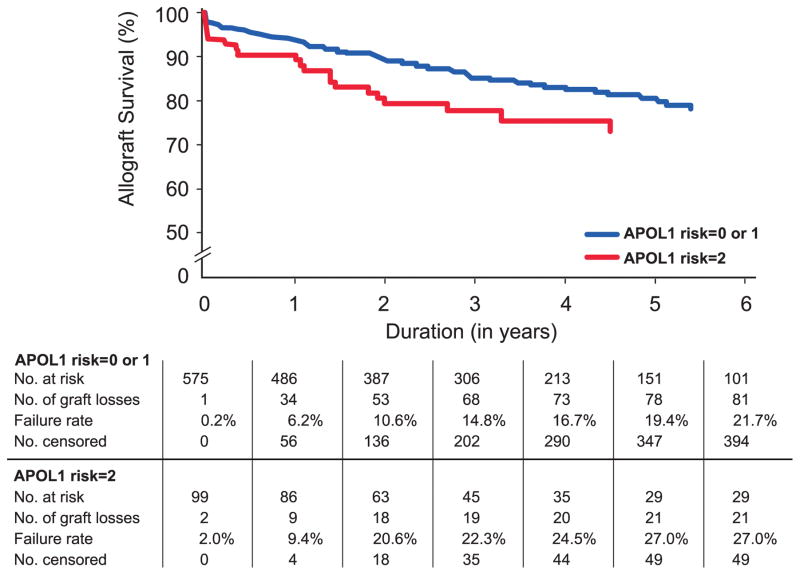
Apolipoprotein L1 gene (APOL1) nephropathy variants in African American deceased kidney donors were associated with shorter renal allograft survival in a prior single-center report. APOL1 G1 and G2 variants were genotyped in newly accrued DNA samples from African American deceased donors of kidneys recovered and/or transplanted in Alabama and North Carolina. APOL1 genotypes and allograft outcomes in subsequent transplants from 55 U.S. centers were linked, adjusting for age, sex and race/ethnicity of recipients, HLA match, cold ischemia time, panel reactive antibody levels, and donor type. For 221 transplantations from kidneys recovered in Alabama, there was a statistical trend toward shorter allograft survival in recipients of two-APOL1-nephropathy-variant kidneys (hazard ratio [HR] 2.71; p = 0.06). For all 675 kidneys transplanted from donors at both centers, APOL1 genotype (HR 2.26; p = 0.001) and African American recipient race/ethnicity (HR 1.60; p = 0.03) were associated with allograft failure. Kidneys from African American deceased donors with two APOL1 nephropathy variants reproducibly associate with higher risk for allograft failure after transplantation. These findings warrant consideration of rapidly genotyping deceased African American kidney donors for APOL1 risk variants at organ recovery and incorporation of results into allocation and informed-consent processes.
Keywords: clinical research / practice; donors and donation: deceased; genetics; genomics; kidney disease; kidney transplantation / nephrology; molecular biology; translational research / science.
© Copyright 2015 The American Society of Transplantation and the American Society of Transplant Surgeons.
Figures
Comment in
-
APOL1 genotyping of African American deceased organ donors: not just yet.Am J Transplant. 2015 Jun;15(6):1457-8. doi: 10.1111/ajt.13230. Epub 2015 Mar 24. Am J Transplant. 2015. PMID: 25809950 No abstract available.
-
Transplantation: APOL1 gene variants associated with renal allograft failure.Nat Rev Urol. 2015 May;12(5):238. doi: 10.1038/nrurol.2015.82. Epub 2015 Apr 14. Nat Rev Urol. 2015. PMID: 25868560 No abstract available.
References
-
- Department of Health and Human Services HRaSAHSBDoT. OPTN / SRTR 2010 Annual Data Report. Rockville, MD: 2011. Organ Procurement and Transplantation Network (OPTN) and Scientific Registry of Transplant Recipients (SRTR)
-
- Takemoto S, Terasaki PI, Cecka JM, Cho YW, Gjertson DW. Survival of nationally shared, HLA-matched kidney transplants from cadaveric donors. The UNOS Scientific Renal Transplant Registry. N Engl J Med. 1992 Sep 17;327(12):834–9. - PubMed
Publication types
MeSH terms
Substances
Grants and funding
LinkOut - more resources
Full Text Sources
Other Literature Sources
Medical
Research Materials
Miscellaneous
