


Sequential hybrid procedure for persistent atrial fibrillation
- PMID: 25809548
- PMCID: PMC4392449
- DOI: 10.1161/JAHA.114.001754
Sequential hybrid procedure for persistent atrial fibrillation
Abstract
Background: Catheter ablation of persistent atrial fibrillation yields an unsatisfactorily high number of failures. The hybrid approach has recently emerged as a technique that overcomes the limitations of both surgical and catheter procedures alone.
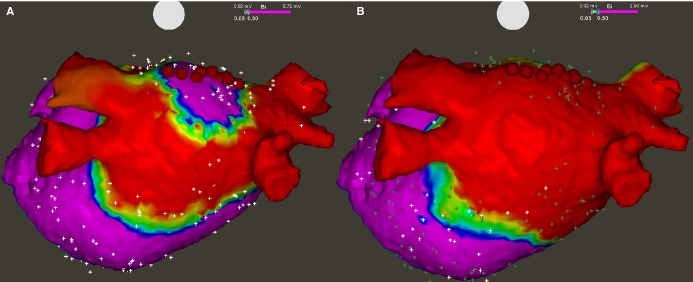
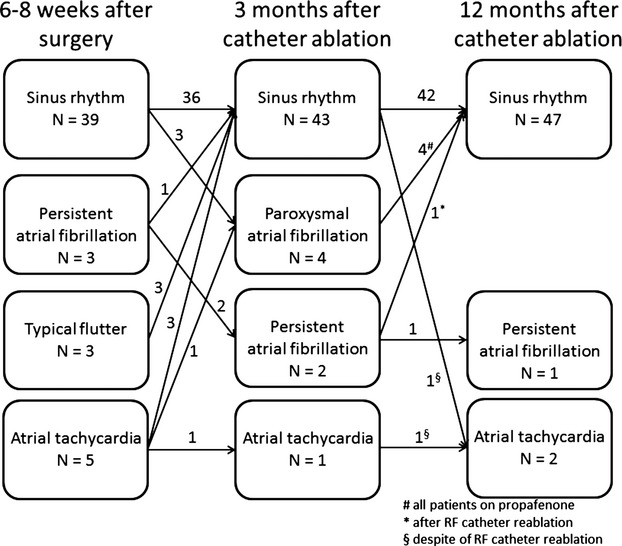
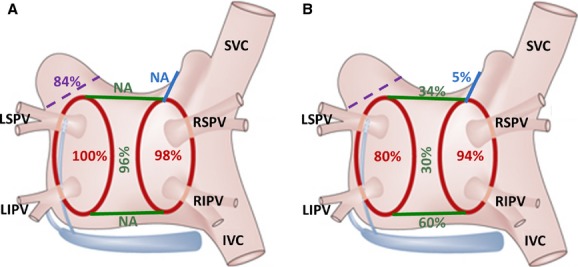
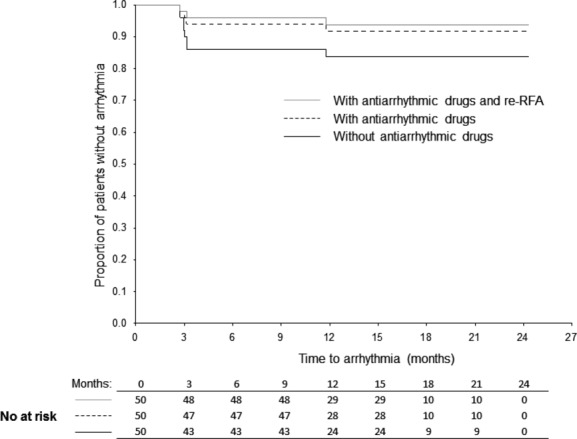
Methods and results: We investigated the sequential (staged) hybrid method, which consists of a surgical thoracoscopic radiofrequency ablation procedure followed by radiofrequency catheter ablation 6 to 8 weeks later using the CARTO 3 mapping system. Fifty consecutive patients (mean age 62±7 years, 32 males) with long-standing persistent atrial fibrillation (41±34 months) and a dilated left atrium (>45 mm) were included and prospectively followed in an unblinded registry. During the electrophysiological part of the study, all 4 pulmonary veins were found to be isolated in 36 (72%) patients and a complete box-lesion was confirmed in 14 (28%) patients. All gaps were successfully re-ablated. Twelve months after the completed hybrid ablation, 47 patients (94%) were in normal sinus rhythm (4 patients with paroxysmal atrial fibrillation required propafenone and 1 patient underwent a redo catheter procedure). The majority of arrhythmias recurred during the first 3 months. Beyond 12 months, there were no arrhythmia recurrences detected. The surgical part of the procedure was complicated by 7 (13.7%) major complications, while no serious adverse events were recorded during the radiofrequency catheter part of the procedure.
Conclusions: The staged hybrid epicardial-endocardial treatment of long-standing persistent atrial fibrillation seems to be extremely effective in maintenance of normal sinus rhythm compared to radiofrequency catheter or surgical ablation alone. Epicardial ablation alone cannot guarantee durable transmural lesions.
Clinical trial registration: URL: www.ablace.cz Unique identifier: cz-060520121617.
Keywords: hybrid approach; persistent atrial fibrillation; radiofrequency ablation; sequential; surgical treatment.
© 2015 The Authors. Published on behalf of the American Heart Association, Inc., by Wiley Blackwell.
Figures
Comment in
-
Hybrid epicardial and endocardial ablation of atrial fibrillation: is ablation on two sides of the atrial wall better than one?J Am Heart Assoc. 2015 Mar 25;4(3):e001893. doi: 10.1161/JAHA.115.001893. J Am Heart Assoc. 2015. PMID: 25809549 Free PMC article. No abstract available.
References
-
- Go AS, Hylek EM, Phillips KA, Chang Y, Henault LE, Selby JV, Singer DE. Prevalence of diagnosed atrial fibrillation in adults: national implications for rhythm management and stroke prevention: the AnTicoagulation and Risk Factors in Atrial Fibrillation (ATRIA) study. JAMA. 2001; 285:2370-2375. - PubMed
-
- Heeringa J, van der Kuip DA, Hofman A, Kors JA, van Herpen G, Stricker BH, Stijnen T, Lip GY, Witteman JC. Prevalence, incidence and lifetime risk of atrial fibrillation: the Rotterdam study. Eur Heart J. 2006; 27:949-953. - PubMed
-
- Camm AJ, Lip GY, De CR, Savelieva I, Atar D, Hohnloser SH, Hindricks G, Kirchhof P, Bax JJ, Baumgartner H, Ceconi C, Dean V, Deaton C, Fagard R, Funck‐Brentano C, Hasdai D, Hoes A, Kirchhof P, Knuuti J, Kolh P, McDonagh T, Moulin C, Popescu BA, Reiner Z, Sechtem U, Sirnes PA, Tendera M, Torbicki A, Vahanian A, Windecker S, Vardas P, Al‐Attar N, Alfieri O, Angelini A, Blomstrom‐Lundqvist C, Colonna P, De SJ, Ernst S, Goette A, Gorenek B, Hatala R, Heidbuchel H, Heldal M, Kristensen SD, Kolh P, Le Heuzey JY, Mavrakis H, Mont L, Filardi PP, Ponikowski P, Prendergast B, Rutten FH, Schotten U, Van Gelder IC, Verheugt FW. 2012 focused update of the ESC Guidelines for the management of atrial fibrillation: an update of the 2010 ESC Guidelines for the management of atrial fibrillation. *Developed with the special contribution of the European Heart Rhythm Association. Europace. 2012; 14:1385-1413. - PubMed
-
- Bertaglia E, Tondo C, De Simone A, Zoppo F, Mantica M, Turco P, Iuliano A, Forleo G, La Rocca V, Stabile G. Does catheter ablation cure atrial fibrillation? Single‐procedure outcome of drug‐refractory atrial fibrillation ablation: a 6‐year multicentre experience. Europace. 2010; 12:181-187. - PubMed
-
- Fiala M, Chovancik J, Wojnarova D, Bulkova V, Pindor J, Szymeczek H, Labrova R, Toman O, Januska J, Spinar J. Characterization of residual coronary sinus‐related tachycardia during ablation of longstanding persistent atrial fibrillation. Vnitr Lek. 2011; 57:33-42. - PubMed
Publication types
MeSH terms
Substances
LinkOut - more resources
Full Text Sources
Medical
