


Xylitol-containing products for preventing dental caries in children and adults
- PMID: 25809586
- PMCID: PMC9345289
- DOI: 10.1002/14651858.CD010743.pub2
Xylitol-containing products for preventing dental caries in children and adults
Abstract
Background: Dental caries is a highly prevalent chronic disease which affects the majority of people. It has been postulated that the consumption of xylitol could help to prevent caries. The evidence on the effects of xylitol products is not clear and therefore it is important to summarise the available evidence to determine its effectiveness and safety.
Objectives: To assess the effects of different xylitol-containing products for the prevention of dental caries in children and adults.
Search methods: We searched the following electronic databases: the Cochrane Oral Health Group Trials Register (to 14 August 2014), the Cochrane Central Register of Controlled Trials (CENTRAL) (The Cochrane Library, 2014, Issue 7), MEDLINE via OVID (1946 to 14 August 2014), EMBASE via OVID (1980 to 14 August 2014), CINAHL via EBSCO (1980 to 14 August 2014), Web of Science Conference Proceedings (1990 to 14 August 2014), Proquest Dissertations and Theses (1861 to 14 August 2014). We searched the US National Institutes of Health Trials Register (http://clinicaltrials.gov) and the WHO Clinical Trials Registry Platform for ongoing trials. No restrictions were placed on the language or date of publication when searching the electronic databases.
Selection criteria: We included randomised controlled trials assessing the effects of xylitol products on dental caries in children and adults.
Data collection and analysis: Two review authors independently screened the results of the electronic searches, extracted data and assessed the risk of bias of the included studies. We attempted to contact study authors for missing data or clarification where feasible. For continuous outcomes, we used means and standard deviations to obtain the mean difference and 95% confidence interval (CI). We used the continuous data to calculate prevented fractions (PF) and 95% CIs to summarise the percentage reduction in caries. For dichotomous outcomes, we reported risk ratios (RR) and 95% CIs. As there were less than four studies included in the meta-analysis, we used a fixed-effect model. We planned to use a random-effects model in the event that there were four or more studies in a meta-analysis.
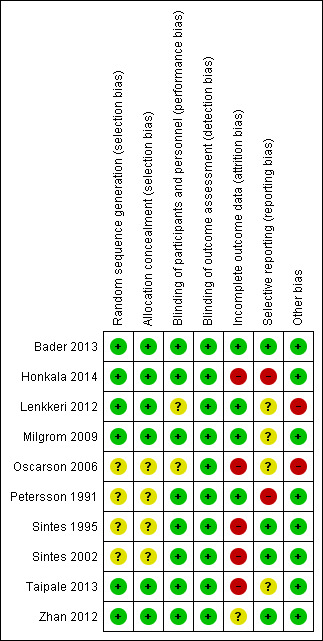
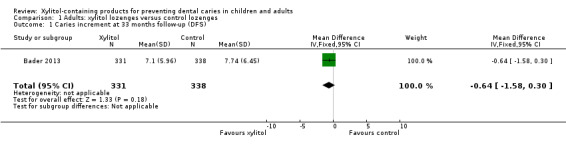
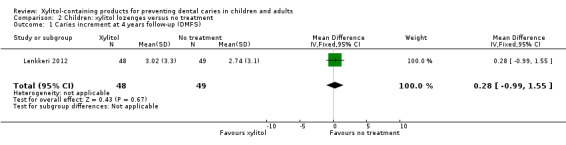
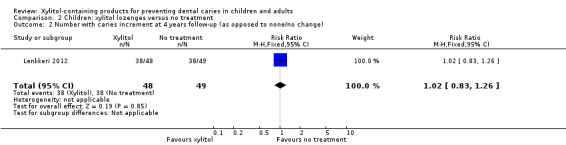
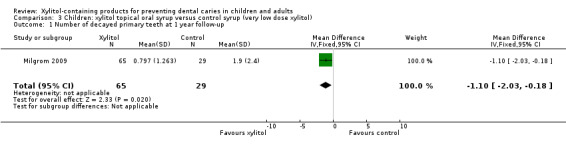
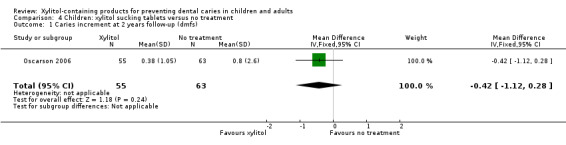
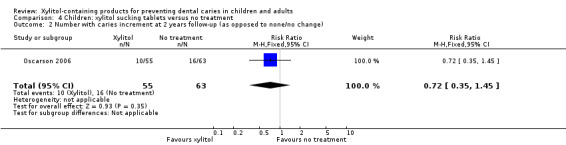
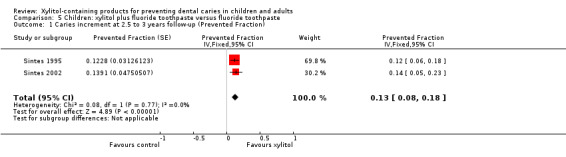
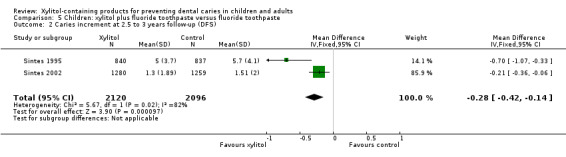
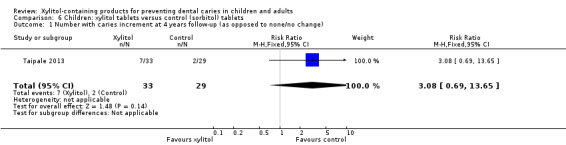
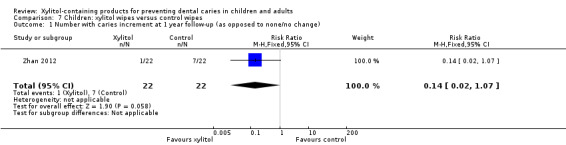
Main results: We included 10 studies that analysed a total of 5903 participants. One study was assessed as being at low risk of bias, two were assessed as being at unclear risk of bias, with the remaining seven being at high risk of bias.The main finding of the review was that, over 2.5 to 3 years of use, a fluoride toothpaste containing 10% xylitol may reduce caries by 13% when compared to a fluoride-only toothpaste (PF -0.13, 95% CI -0.18 to -0.08, 4216 children analysed, low-quality evidence).The remaining evidence on children, from small single studies with risk of bias issues and great uncertainty associated with the effect estimates, was insufficient to determine a benefit from xylitol products. One study reported that xylitol syrup (8 g per day) reduced caries by 58% (95% CI 33% to 83%, 94 infants analysed, low quality evidence) when compared to a low-dose xylitol syrup (2.67 g per day) consumed for 1 year.The following results had 95% CIs that were compatible with both a reduction and an increase in caries associated with xylitol: xylitol lozenges versus no treatment in children (very low quality body of evidence); xylitol sucking tablets versus no treatment in infants (very low quality body of evidence); xylitol tablets versus control (sorbitol) tablets in infants (very low quality body of evidence); xylitol wipes versus control wipes in infants (low quality body of evidence).There was only one study investigating the effects of xylitol lozenges, when compared to control lozenges, in adults (low quality body of evidence). The effect estimate had a 95% CI that was compatible with both a reduction and an increase in caries associated with xylitol.Four studies reported that there were no adverse effects from any of the interventions. Two studies reported similar rates of adverse effects between study arms. The remaining studies either mentioned adverse effects but did not report any usable data, or did not mention them at all. Adverse effects include sores in the mouth, cramps, bloating, constipation, flatulence, and loose stool or diarrhoea.
Authors' conclusions: We found some low quality evidence to suggest that fluoride toothpaste containing xylitol may be more effective than fluoride-only toothpaste for preventing caries in the permanent teeth of children, and that there are no associated adverse-effects from such toothpastes. The effect estimate should be interpreted with caution due to high risk of bias and the fact that it results from two studies that were carried out by the same authors in the same population. The remaining evidence we found is of low to very low quality and is insufficient to determine whether any other xylitol-containing products can prevent caries in infants, older children, or adults.
Conflict of interest statement
There are no financial conflicts of interest and the review authors declare that they do not have any associations with any parties who may have vested interests in the results of this review.
Figures

Comment in
-
Xylitol and caries prevention.Evid Based Dent. 2015 Jun;16(2):37-8. doi: 10.1038/sj.ebd.6401088. Evid Based Dent. 2015. PMID: 26114781
References
References to studies included in this review
Bader 2013 {published data only}
Honkala 2014 {published data only}
-
- Honkala S, Runnel R, Saag M, Olak J, Nõmmela R, Russak S, et al. Effect of erythritol and xylitol on dental caries prevention in children. Caries Research 2014;48(5):482‐90. - PubMed
Lenkkeri 2012 {published data only}
-
- Lenkkeri AM, Pienihäkkinen K, Hurme S, Alanen P. The caries‐preventive effect of xylitol/maltitol and erythritol/maltitol lozenges: results of a double‐blinded, cluster‐randomized clinical trial in an area of natural fluoridation. International Journal of Paediatric Dentistry / the British Paedodontic Society [and] the International Association of Dentistry for Children 2012;22(3):180‐90. - PubMed
Milgrom 2009 {published data only}
Oscarson 2006 {published data only}
-
- Oscarson P, Lif Holgerson P, Sjöström I, Twetman S, Stecksén‐Blicks C. Influence of a low xylitol‐dose on mutans streptococci colonisation and caries development in preschool children. European Archives of Paediatric Dentistry 2006;7(3):142‐7. - PubMed
Petersson 1991 {published data only}
-
- Petersson LG, Birkhed D, Gleerup A, Johansson M, Jönsson G. Caries‐preventive effect of dentifrices containing various types and concentrations of fluorides and sugar alcohols. Caries Research 1991;25(1):74‐9. - PubMed
Sintes 1995 {published data only}
-
- Sintes JL, Escalante C, Stewart B, McCool JJ, Garcia L, Volpe AR, et al. Enhanced anticaries efficacy of a 0.243% sodium fluoride/10% xylitol/silica dentifrice: 3‐year clinical results. American Journal of Dentistry 1995;8(5):231‐5. - PubMed
Sintes 2002 {published data only}
-
- Sintes J, Elias‐Boneta A, Stewart B, Volpe AR. Anticaries efficacy of a sodium monofluorophosphate dentifrice containing 10% xylitol in a dical base. (Abstract FDI World Dental Congress). International Dental Journal 2001;51(5):374.
-
- Sintes JL, Elias‐Boneta A, Stewart B, Volpe AR, Lovett J. Anticaries efficacy of a sodium monofluorophosphate dentifrice containing xylitol in a dicalcium phosphate dihydrate base. A 30‐month caries clinical study in Costa Rica. American Journal of Dentistry 2002;15(4):215‐9. - PubMed
Taipale 2013 {published data only}
-
- Taipale T, Pienihäkkinen K, Alanen P, Jokela J, Söderling E. Administration of Bifidobacterium animalis subsp. lactis BB‐12 in early childhood: a post‐trial effect on caries occurrence at four years of age. Caries Research 2013;47(5):364‐72. - PubMed
-
- Taipale T, Pienihäkkinen K, Salminen S, Jokela J, Söderling E. Bifidobacterium animalis subsp. lactis BB‐12 administration in early childhood: a randomized clinical trial of effects on oral colonization by mutans streptococci and the probiotic. Caries Research 2012;46(1):69‐77. - PubMed
References to studies excluded from this review
Alanen 2000 {published data only}
-
- Alanen P, Holsti ML, Pienihäkkinen K. Sealants and xylitol chewing gum are equal in caries prevention. Acta Odontologica Scandinavica 2000;58(6):279‐84. - PubMed
Alanen 2000b {published data only}
-
- Alanen P, Isokangas P, Gutmann K. Xylitol based caries prevention without professionals suggests cost‐effectiveness. Community Dental Health 1998;15(3):204.
-
- Alanen P, Isokangas P, Gutmann K. Xylitol candies in caries prevention: results of a field study in Estonian children. Community Dentistry and Oral Epidemiology 2000;28(3):218‐24. - PubMed
-
- Alanen P, Isokangas P, Visnapuu V, Gutmann K. Xylitol candies compare xylitol chewing gum in caries prevention [abstract]. Journal of Dental Research 1998;77(Spec Iss B [Abstracts]):973, Abstract no: 2731.
Chi 2014 {published data only}
Kandelman 1990 {published data only}
-
- Kandelman D, Gagnon G. A 24‐month clinical study of the incidence and progression of dental caries in relation to consumption of chewing gum containing xylitol in school preventive programs. Journal of Dental Research 1990;69(11):1771‐5. - PubMed
-
- Kandelman D, Gagnon G. Clinical results after 12 months from a study of the incidence and progression of dental caries in relation to consumption of chewing‐gum containing xylitol in school preventive programs. Journal of Dental Research 1987;66(8):1407‐11. - PubMed
-
- Kandelman D, Gagnon G. Effect on dental caries of xylitol chewing gum; two‐year results [abstract]. Journal of Dental Research 1988;67(Spec Iss):172, Abstract no: 472.
Kovari 2003 {published data only}
-
- Kovari H, Pienihäkkinen K, Alanen P. Use of xylitol chewing gum in daycare centers: a follow‐up study in Savonlinna, Finland. Acta Odontologica Scandinavica 2003;61(6):367‐70. - PubMed
Lee 2014 {unpublished data only}
-
- Lee C, Spiekerman C, Heima M, Eggertsson H, Ferretti G, Milgrom P, et al. Xylitol effectiveness in a school‐based cluster randomized clinical trial. Caries Research 2014 (unpublished). - PubMed
Machiulskiene 2001 {published data only}
-
- Machiulskiene V, Nyvad B, Baelum V. Caries preventive effect of sugar‐substituted chewing gum. Community Dentistry and Oral Epidemiology 2001;29(4):278‐88. - PubMed
Scheinin 1975 {published data only}
-
- Scheinin A, Mäkinen KK, Tammisalo E, Rekola M. Turku sugar studies XVIII. Incidence of dental caries in relation to 1‐year consumption of xylitol chewing gum. Acta Odontologica Scandinavica 1975;33(5):269‐78. - PubMed
Additional references
AAPD 2010
-
- American Academy of Pediatric Dentistry. Policy on the Use of Xylitol in Caries Prevention. Oral Health Policies 2006, revised 2010; Vol. 36, issue 6.
AAPD 2013
-
- American Academy of Pediatric Dentistry. Guide‐line on caries‐risk assessment and management for infants, children, and adolescents. Pediatric Dentistry 2013;35(5):E157‐64. - PubMed
ADA 2011
-
- Rethman MP, Beltrán‐Aguilar ED, Billings RJ, Burne RA, Clark M, Donly KJ, et al. Nonfluoride caries‐preventive agents. Executive summary of evidence‐based clinical recommendations. Journal of the American Dental Association 2011;142(9):1065‐71. - PubMed
Alanen, Gutmann 2000
-
- Alanen P, Isokangas P, Gutmann K. Xylitol candies in caries prevention: results of a field study in Estonian children. Community Dentistry and Oral Epidemiology 2000;28:218‐24. - PubMed
Antonio 2011
-
- Antonio AG, Pierro VS, Maia LC. Caries preventive effects of xylitol‐based candies and lozenges: a systematic review. Journal of Public Health Dentistry 2011;71(2):117‐24. - PubMed
Assev 2002
Azarpazhooh 2011
Benson 2004
Birkhed 1984
-
- Birkhed D, Edwardsson S, Kalfas S, Svensäter G. Cariogenicity of sorbitol. Swedish Dental Journal 1984;8(3):147‐54. - PubMed
Bowen 1978
-
- Bowen WH. Role of carbohydrates in dental caries. In: Shaw JH, Roussos GG editor(s). Sweeteners and Dental Caries. Washington: IRL Press, 1978:147–52.
Brunzell 1978
-
- Brunzell JD. Use of fructose, xylitol, or sorbitol as a sweetener in diabetes mellitus. Diabetes Care 1978;1(4):223‐30. - PubMed
Chen 1996
-
- Chen MS, Hunter P. Oral health and quality of life in New Zealand: a social perspective. Social Science and Medicine 1996;43(8):1213‐22. - PubMed
CONSORT 2010
-
- Schulz KF, Altman DG, Moher D, CONSORT Group. CONSORT 2010 statement: updated guidelines for reporting parallel group randomised trials. International Journal of Surgery 2011;9(8):672‐7. - PubMed
DBOH 2014
-
- Public Health England. Delivering better oral health: an evidence‐based toolkit for prevention. Third edition. 2014.
Deshpande 2008
-
- Deshpande A, Jadad AR. The impact of polyol‐containing chewing gums on dental caries: a systematic review of original randomized controlled trials and observational studies. Journal of the American Dental Association 2008;139(12):1602‐14. - PubMed
Dowd 1999
-
- Dowd FJ. Saliva and dental caries. Dental Clinic of North America 1999;43(4):579‐97. - PubMed
Dubey 1965
-
- Dubey SD, Lehnhoff RW, Radike AW. A statistical confidence interval for true per cent reduction in caries‐incidence studies. Journal of Dental Research 1965;44:921‐3. - PubMed
Egger 1997
Featherstone 1999
-
- Featherstone JD. Prevention and reversal of dental caries: role of low level fluoride. Community Dentistry and Oral Epidemiology 1999;27(1):31‐40. - PubMed
Fontana 2012
-
- Fontana M, González‐Cabezas C. Are we ready for definitive clinical guidelines on xylitol/polyol use?. Advances in Dental Research 2012;24(2):123‐8. - PubMed
GRADE 2004
Harris 2012
Higgins 2003
Higgins 2011
-
- Higgins JPT, Green S (editors). Cochrane Handbook for Systematic Reviews of Interventions version 5.1.0 (updated March 2011). The Cochrane Collaboration, 2011. Available from www.cochrane‐handbook.org.
Hiiri 2010
Hogg 1991
-
- Hogg SD, Rugg‐Gun AJ. Can the oral flora adapt to sorbitol?. Journal of Dentistry 1991;19(5):263‐71. - PubMed
Hosey 2006
Jones 1979
-
- Jones RW, Krull LH, Blessin CW, Inglett GE. Neutral sugars of hemicellulose fractions of pith from stalks of selected plants (maize, sorghum, sugarcane, and sunflowers, sucrose substitutes, human diet). Cereal Chemistry 1979;106(3):441‐5.
Lamanda 2007
Lee 2012
Ly 2006
-
- Ly KA, Milgrom P, Rothen M. Xylitol, sweeteners, and dental caries. Pediatric Dentistry 2006;28(2):154‐63; discussion 92‐8. - PubMed
Makinen 1982
-
- Makinen KK, Scheinin A. Xylitol and dental caries. Annual Review of Nutrition 1982;2:133‐50. - PubMed
Manji 1991
-
- Manji F, Fejerskov O, Nagelkerke NJ, Baelum V. A random effects model for some epidemiological features of dental caries. Community Dentistry and Oral Epidemiology 1991;19(6):324‐8. - PubMed
Marinho 2003
Marinho 2009
-
- Marinho VC. Cochrane reviews of randomized trials of fluoride therapies for preventing dental caries. European Archives of Paediatric Dentistry 2009;10:183‐91. - PubMed
Marinho 2013
Marsh 1992
-
- Marsh P, Martin M. Oral Microbiology. London: Chapman and Hall, 1992.
Milgrom 2006
Milgrom 2012
Milgrom, Rothen 2009
Miyasawa 2003
-
- Miyasawa H, Iwami Y, Mayanagi H, Takahashi N. Xylitol inhibition of anaerobic acid production by Streptococcus mutans at various pH levels. Oral Microbiology and Immunology 2003;18(4):215‐9. - PubMed
Moynihan 2013
Mäkinen 2005
-
- Mäkinen KK, Saag M, Isotupa KP, Olak J, Nōmmela R, Söderling E, et al. Similarity of the effects of erythritol and xylitol on some risk factors of dental caries. Caries Research 2005;39(3):207‐15. - PubMed
Mäkinen 2011
Nyvad 1997
-
- Nyvad B. Fejerskov O. Assessing the stage of caries lesion activity on the basis of clinical and microbiological examination. Community Dentistry and Oral Epidemiology 1997;25:69‐75. - PubMed
Pereira‐Ceni 2009
Petersen 2003
-
- Petersen PE. The World Oral Health Report 2003: continuous improvement of oral health in the 21st century ± the approach of the WHO Global Oral Health Programme. Community Dentistry and Oral Epidemiology 2003;31 Suppl 1:3‐23. - PubMed
Pitts 2004
-
- Pitt NM. Modern concepts of caries measurement. Journal of Dental Research 2004;83:43‐7. - PubMed
Qualtrough 2005
-
- Qualtrough AJE, Satterthwaite JD, Morrow LA, Brunton PA. Principles of Operative Dentistry. Blackwell, 2005.
Reese 2007
-
- Reese S, Guggenheim B. A novel TEM contrasting technique for extracellular polysaccharides in in vitro biofilms. Microscopy Research and Technique 2007;70:816‐22. - PubMed
RevMan 2014 [Computer program]
-
- The Nordic Cochrane Centre, The Cochrane Collaboration. Review Manager (RevMan). Version 5.3. Copenhagen: The Nordic Cochrane Centre, The Cochrane Collaboration, 2014.
Ruhl 2012
Sambunjak 2011
Sato 1996
-
- Sato M, Fujiwara S, Tsuchiya H, Fuji T, Iinuma M, Tosa H, et al. Flavones with antibacterial activity against cariogenic bacteria. Journal of Ethnopharmacology 1996;54:171‐6. - PubMed
Sharif 2010
-
- Sharif MO, Fedorowicz Z, Tickle M, Brunton PA. Repair or replacement of restorations: do we accept built in obsolescence or do we improve the evidence?. British Dental Journal 2010;209(4):171‐4. - PubMed
Sheiham 2014
SIGN 2014
-
- Scottish Intercollegiate Guidelines Network (SIGN). Dental interventions to prevent caries in children. A national clinical guideline. Dental interventions to prevent caries in children. A national clinical guideline. SIGN Guideline no 138. Edinburgh: http://www.sign.ac.uk, 2014.
Skaret 1998
-
- Skaret E, Raadal M, Berg E, Kvale G. Dental anxiety among 18‐yr‐olds in Norway. Prevalence and related factors. European Journal of Oral Sciences 1998;106(4):835‐43. - PubMed
SPIRIT 2013
Stephen 1978
-
- Stephen KW. Caries reduction and cost‐benefit after 3 years of sucking fluoride tablets daily at school. A double‐blind trial. British Dental Journal 1978;144:202‐6. - PubMed
Söderling 2009
Söderling 2009b
-
- Söderling EM. Xylitol, mutans streptococci, and dental plaque.. Advances in Dental Research 2009;21(1):74‐8. - PubMed
Söderling 2010
Takahashi 2011
Tanzer 2006
Trahan 1985
-
- Trahan L, Bareil M, Gauthier L, Vadeboncoeur C. Transport and phosphorylation of xylitol by a fructose phosphotransferase system inStreptococcus mutans. Caries Research 1985;19:53‐63. - PubMed
Trahan 1987
-
- Trahan L, Mouton C. Selection for Streptococcus mutans with an altered xylitol transport capacity in chronic xylitol consumers. Journal of Dental Research 1987;66(5):982‐8. - PubMed
Trahan 1995
-
- Trahan L. Xylitol: a review of its action on mutans streptococci and dental plaque‐its clinical significance. International Dental Journal 1995;45:77‐92. - PubMed
Twetman 2009
-
- Twetman S. Current controversies ‐ is there merit?. Advances in Dental Research 2009;21(1):48‐52. - PubMed
Vadeboncoeur 1983
-
- Vadeboncoeur C, Trahan L, Mouton C, Mayrand D. Effect of xylitol on the growth and glycolysis of acidogenic oral bacteria. Journal of Dental Research 1983;62:882‐4. - PubMed
van Loveren 2004
-
- Loveren C. what is the evidence for caries‐preventive and caries‐therapeutic effects?. Caries Research 2004;38:286‐93. - PubMed
van Rijkom 1998
-
- Rijkom HM, Truin GJ, 't Hof MA. A meta‐analysis of clinical studies on the caries‐inhibiting effect of fluoride gel treatment. Caries Research 1998;32:83‐92. - PubMed
Walsh 2010
Wang 1981
-
- Wang YM, Eys JV. Nutritional significance of fructose and sugar alcohols. Annual Review of Nutrition 1981;1:437‐75. - PubMed
Publication types
MeSH terms
Substances
LinkOut - more resources
Full Text Sources
Other Literature Sources
Medical
Research Materials
