. 2015 Jun;89(11):5981-95.
doi: 10.1128/JVI.00320-15. Epub 2015 Mar 25.

What Do Chaotrope-Based Avidity Assays for Antibodies to HIV-1 Envelope Glycoproteins Measure?

Affiliations

What Do Chaotrope-Based Avidity Assays for Antibodies to HIV-1 Envelope Glycoproteins Measure?

Marina R Alexander et al. J Virol. 2015 Jun.

Abstract

When HIV-1 vaccine candidates that include soluble envelope glycoproteins (Env) are tested in humans and other species, the resulting antibody responses to Env are sifted for correlates of protection or risk. One frequently used assay measures the reduction in antibody binding to Env antigens by an added chaotrope (such as thiocyanate). Based on that assay, an avidity index was devised for assessing the affinity maturation of antibodies of unknown concentration in polyclonal sera. Since a high avidity index was linked to protection in animal models of HIV-1 infection, it has become a criterion for evaluating antibody responses to vaccine candidates. But what does the assay measure and what does an avidity index mean? Here, we have used a panel of monoclonal antibodies to well-defined epitopes on Env (gp120, gp41, and SOSIP.664 trimers) to explore how the chaotrope acts. We conclude that the chaotrope sensitivity of antibody binding to Env depends on several properties of the epitopes (continuity versus tertiary- and quaternary-structural dependence) and that the avidity index has no simple relationship to antibody affinity for functional Env spikes on virions. We show that the binding of broadly neutralizing antibodies against quaternary-structural epitopes is particularly sensitive to chaotrope treatment, whereas antibody binding to epitopes in variable loops and to nonneutralization epitopes in gp41 is generally resistant. As a result of such biases, the avidity index may at best be a mere surrogate for undefined antibody or other immune responses that correlate weakly with protection.

Importance: An effective HIV-1 vaccine is an important goal. Such a vaccine will probably need to induce antibodies that neutralize typically transmitted variants of HIV-1, preventing them from infecting target cells. Vaccine candidates have so far failed to induce such antibody responses, although some do protect weakly against infection in animals and, possibly, humans. In the search for responses associated with protection, an avidity assay based on chemical disruption is often used to measure the strength of antibody binding. We have analyzed this assay mechanistically and found that the epitope specificity of an antibody has a greater influence on the outcome than does its affinity. As a result, the avidity assay is biased toward the detection of some antibody specificities while disfavoring others. We conclude that the assay may yield merely indirect correlations with weak protection, specifically when Env vaccination has failed to induce broad neutralizing responses.


Figures

FIG 1
FIG 1
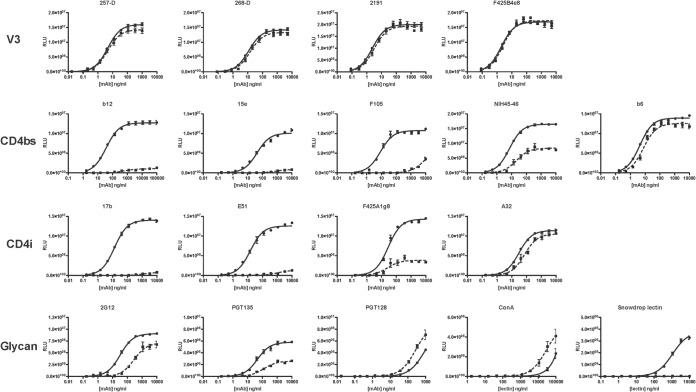
Chaotrope effects on the binding of gp120-specific MAbs and lectins. The MAbs and lectins were titrated against D7324-captured gp120 (JR-FL) in ELISAs. Quantification of bound MAb, detected as luminescence (relative light units [RLU]), is expressed on the y axis as a function of MAb concentration (ng/ml) on the x axis. Ligand binding after chaotrope (NaSCN) or control (PBS) treatment is represented by dashed and solid lines, respectively. The data points are the mean results from three intra-assay replicates, and the error bars show the standard errors of the means (SEM). Each plot is representative of ≥2 replicate experiments.
FIG 2
FIG 2
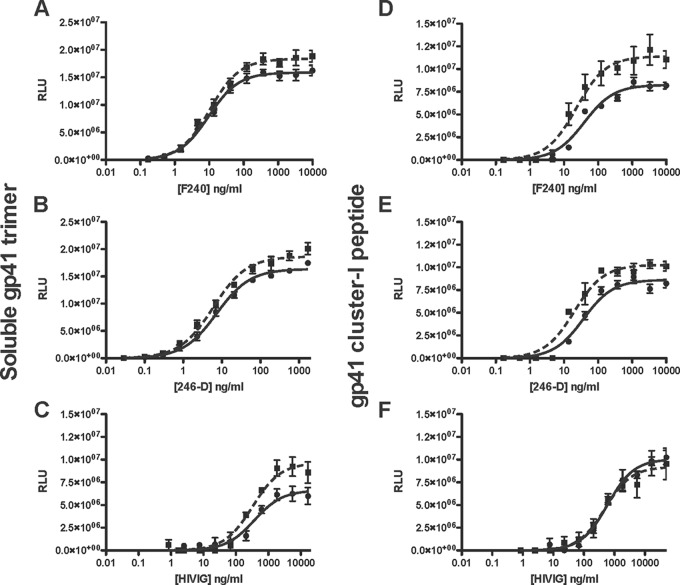
Chaotrope effects on the binding of gp41-specific MAbs and HIVIG. The MAbs and HIVIG were titrated against wells directly coated with gp41 trimer (A to C) or gp41 peptide (D to F) in ELISAs. Bound Ab, detected as luminescence (RLU), is expressed on the y axis as a function of Ab concentration (ng/ml) on the x axis (MAb F240, MAb 246-D, or HIVIG as indicated). Ab binding after chaotrope (NaSCN) or control (PBS) treatment is represented by dashed and solid lines, respectively. The data points are the mean results from three intra-assay replicates, and the error bars show the SEM. Each plot is representative of ≥2 replicate experiments.
FIG 3
FIG 3
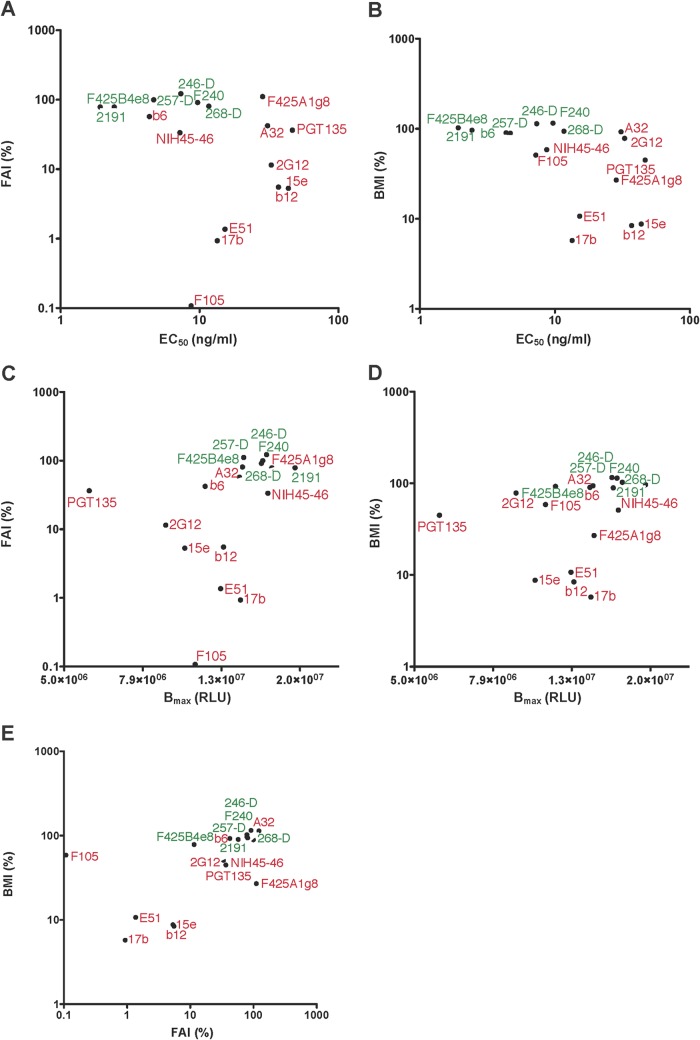
Resistance of binding to the chaotrope does not correlate well with MAb affinity. EC50 and Bmax values were calculated by fitting a sigmoid function to the data shown in Fig. 1 and 2A and B. The functional affinity index (FAI) and the Bmax index (BMI) are two different measurements of the resistance to chaotrope treatment of MAb binding to the Env Ag. FAI (%) was plotted against EC50 (ng/ml) (A), BMI (%) against EC50 (ng/ml) (B), FAI (%) against Bmax (RLU) (C), BMI (%) against Bmax (RLU) (D), and FAI (%) against BMI (%) (E). Symbols representing Abs targeting the more continuous epitopes (V3 and gp41) and the more composite epitopes are labeled in green and red, respectively.
FIG 4
FIG 4
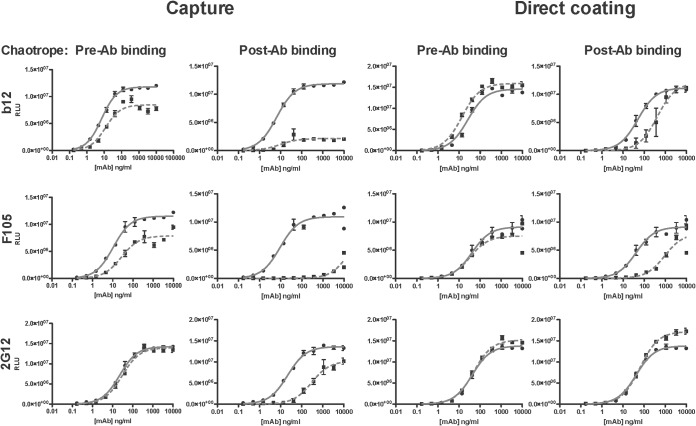
Antigenic perturbation by the chaotrope contributes to reduced binding of MAbs to gp120. The plots on the left show MAb binding to gp120 in capture ELISA, and those on the right show the binding in the direct-coating ELISA, as indicated. For each type of assay, the results of the pre- and post-Ab-binding chaotrope (NaSCN) treatments are shown under the respective labels in the left and right columns (the ELISA conditions for the post-MAb-binding condition in the capture assay were like those in the experiments whose results are shown in Fig. 1.) In each assay, luminescence (RLU) is expressed on the y axis as a function of MAb concentration (ng/ml) on the x axis. The MAb binding after chaotrope or control (PBS) treatment is represented by dashed and solid lines, respectively. The data points are the mean results from three intra-assay replicates, and the error bars show the SEM. Each plot is representative of ≥2 replicate experiments.
FIG 5
FIG 5
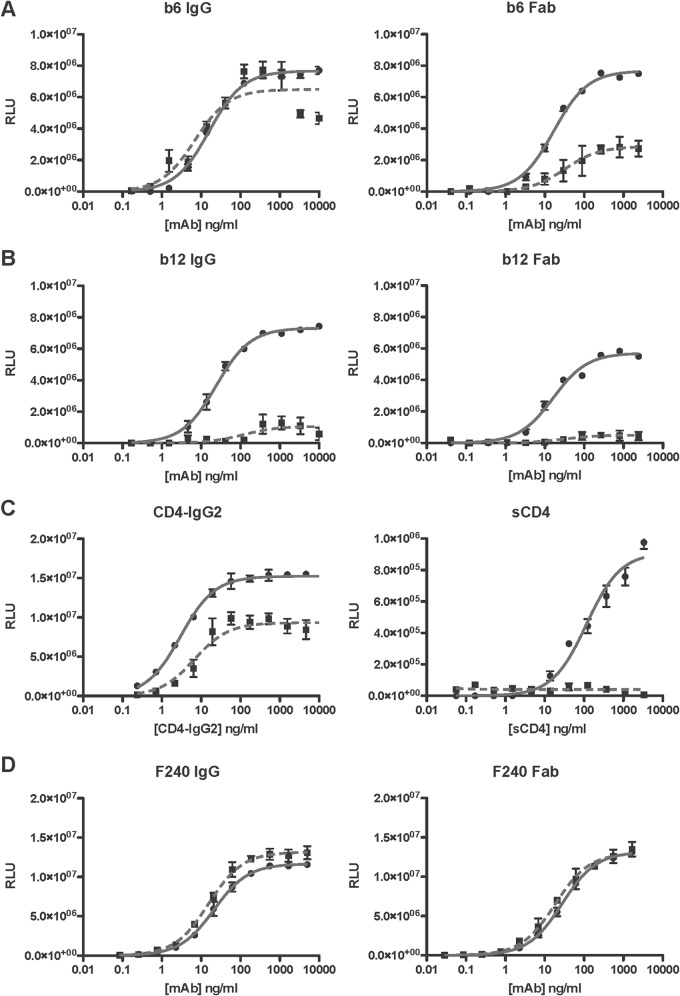
Chaotrope resistance increases with valency. Mono-, bi-, and tetravalent ligands were titrated against D7324-captured gp120 (JR-FL) in ELISAs. Binding, detected as luminescence (RLU), is expressed on the y axis as a function of ligand concentration (ng/ml) on the x axis. The potentially bi- or tetravalent binding of IgG and CD4-IgG2 is shown on the left, and the monovalent binding of Fabs and sCD4 on the right. The ligands were b6 IgG/Fab (A), b12 IgG/Fab (B), CD4-IgG2/sCD4 (C), and F24 IgG/Fab (D). Ligand binding after chaotrope (NaSCN) or control (PBS) treatment is represented by dashed and solid lines, respectively. The data points are the mean results from three intra-assay replicates, and the error bars show the SEM. Each plot is representative of ≥2 replicate experiments.
FIG 6
FIG 6
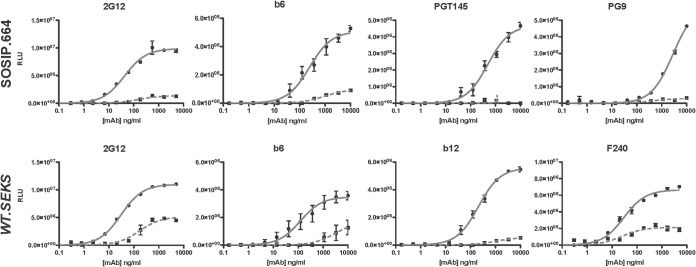
The binding of MAbs to Env trimers is chaotrope sensitive. The MAbs were titrated against D7324-captured, nativelike BG505 SOSIP.664-D7324 trimers (top row) or uncleaved, nonnative BG505 WT.SEKS-D7324 gp140 proteins (bottom row). Bound MAb, detected as luminescence (RLU), is expressed on the y axis as a function of MAb concentration (ng/ml) on the x axis. The MAb binding after chaotrope (NaSCN) or control (PBS) treatment is represented by dashed and solid lines, respectively. Note the differences in y-axis scale between diagrams. The data points are the mean results from three intra-assay replicates, and the error bars show the SEM. Each plot is representative of ≥2 replicate experiments.

References

    1. Plotkin SA. 2008. Vaccines: correlates of vaccine-induced immunity. Clin Infect Dis 47:401–409. doi: 10.1086/589862. - DOI - PubMed
    1. Burton DR, Ahmed R, Barouch DH, Butera ST, Crotty S, Godzik A, Kaufmann DE, McElrath MJ, Nussenzweig MC, Pulendran B, Scanlan CN, Schief WR, Silvestri G, Streeck H, Walker BD, Walker LM, Ward AB, Wilson IA, Wyatt R. 2012. A blueprint for HIV vaccine discovery. Cell Host Microbe 12:396–407. doi: 10.1016/j.chom.2012.09.008. - DOI - PMC - PubMed
    1. Klasse PJ, Sanders RW, Cerutti A, Moore JP. 2012. How can HIV-type-1-Env immunogenicity be improved to facilitate antibody-based vaccine development? AIDS Res Hum Retroviruses 28:1–15. doi: 10.1089/aid.2011.0053. - DOI - PMC - PubMed
    1. Klein F, Mouquet H, Dosenovic P, Scheid JF, Scharf L, Nussenzweig MC. 2013. Antibodies in HIV-1 vaccine development and therapy. Science 341:1199–1204. doi: 10.1126/science.1241144. - DOI - PMC - PubMed
    1. Shibata R, Igarashi T, Haigwood N, Buckler-White A, Ogert R, Ross W, Willey R, Cho MW, Martin MA. 1999. Neutralizing antibody directed against the HIV-1 envelope glycoprotein can completely block HIV-1/SIV chimeric virus infections of macaque monkeys. Nat Med 5:204–210. doi: 10.1038/5568. - DOI - PubMed

Publication types

MeSH terms

LinkOut - more resources