


doi: 10.3390/molecules20045260.
Synthesis and biological properties of 5-(1H-1,2,3-triazol-4-yl)isoxazolidines: a new class of C-nucleosides
Affiliations
- PMID: 25812148
- PMCID: PMC6272400
- DOI: 10.3390/molecules20045260
Item in Clipboard
Synthesis and biological properties of 5-(1H-1,2,3-triazol-4-yl)isoxazolidines: a new class of C-nucleosides
Molecules.
.
Abstract
A novel series of C-nucleosides, featuring the presence of a 1,2,3-triazole ring linked to an isoxazolidine system, has been designed as mimetics of the pyrimidine nucleobases. An antiproliferative effect was observed for compounds 17a and 17b: the growth inhibitory effect reaches the 50% in HepG2 and HT-29 cells and increases up to 56% in the SH-SY5Y cell line after 72 h of incubation at a 100 µM concentration.
Conflict of interest statement
The authors declare no conflict of interest.
Figures

Examples of C-Nucleosides.
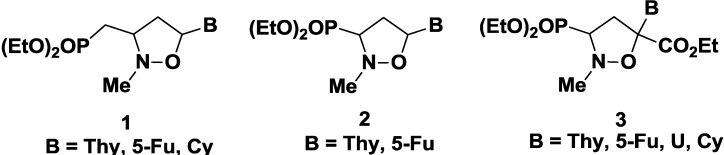
Phosphonated N,O-nucleosides.

Examples of N,O-Nucleosides.

Synthesis of C-Vinyl triazoles 12a–g.

Synthesis of isoxazolidinyl-triazoles 16a–g and 17a–g by 1,3-dipolar cycloaddition.
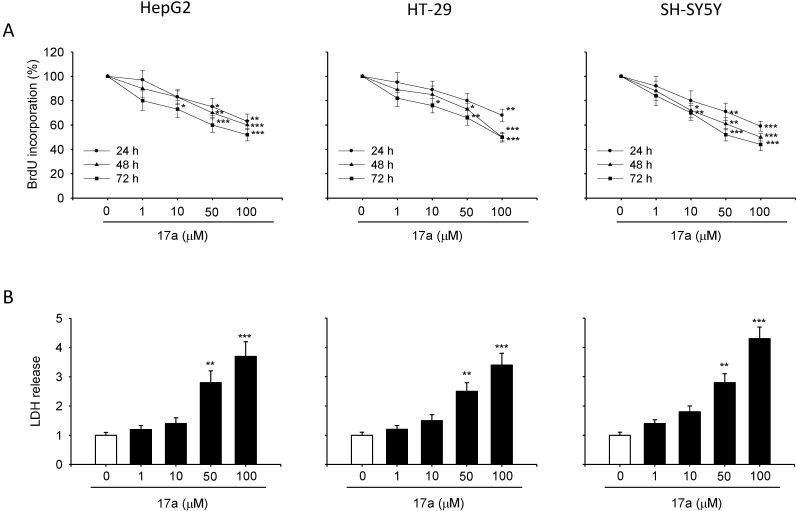
Compound 17a reduces cell proliferation and induce LDH release. HepG2, HT-29 and SH-SY5Y cells were exposed to increased concentration of 17a compound for 24, 48 and 72 h. (A) Proliferation rate assessed by BrdU assay. (B) Cytotoxic effect assessed in terms of LDH release after 24 h of exposure. Each value is the mean ± S.E.M. of three experiments performed eight times (BrdU) or in triplicate (LDH) and repeated three different times. *
p < 0.05 vs. ctrl, **
p < 0.01 vs. ctrl, ***
p < 0.001 vs. ctrl.

Compound 17b inhibit cell growth and determine LDH release. (A) Proliferation rate assessed by BrdU assay after 24–72 h of treatment. (B) Cytotoxic activities evaluated by the test of LDH after 24 h of incubation. Each value is the mean ± S.E.M. of three experiments performed in eight times (BrdU) or in triplicate (LDH) and repeated three different times. *
p < 0.05 vs. ctrl, **
p < 0.01 vs. ctrl, ***
p < 0.001 vs. ctrl.
References
-
- De Clercq E. The history of antiretrovirals: Key discoveries over the past 25 years. Rev. Med. Virol. 2009;19:287–299. - PubMed
-
- De Clercq E. Antiviral Drug Strategies. Wiley-VCH; Weinheim, Germany: 2011.
-
- Vanek V., Budesinsky M., Rinnova M., Rosenberg I. Prolinol-based nucleoside phosphonic acids: New isosteric conformationally flexible nucleotide analogues. Tetrahedron. 2009;65:862–876. doi: 10.1016/j.tet.2008.11.035. - DOI
-
- Ishitsuka H., Shimma N. Capecitabine Preclinical Studies: From Discovery to Translational Research. In: Herdewijn P., editor. Modified Nucleosides in Biochemistry, Biotechnology and Medicine. Wiley-VCH; Weinheim, Germany: 2008. pp. 587–600.
Publication types
MeSH terms
Substances
LinkOut - more resources
Full Text Sources
Other Literature Sources
